E dim Guitar Chord
Chord Diagrams, Interactive Fretboard and Chord Theory
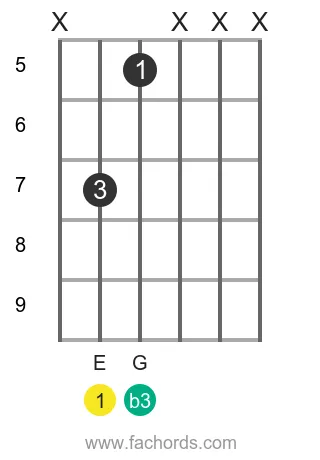
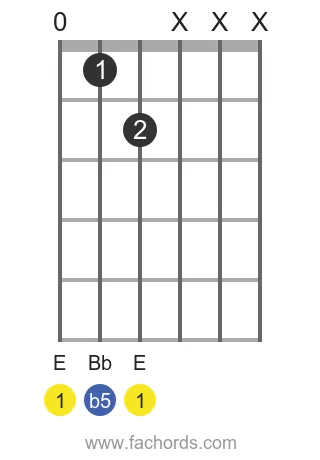
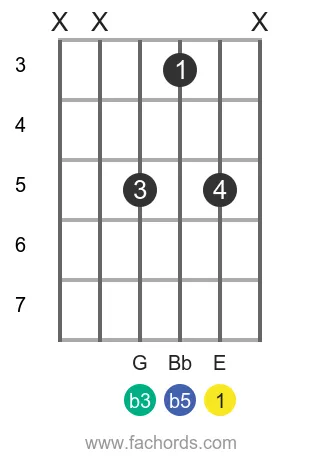
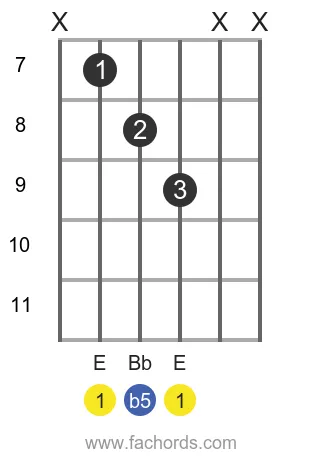
E diminished guitar chord is also written as Edim, E°, Em(b5) or Emb5.
Position 1
Movable
Position 2
Open
Position 3
Movable
Position 4
Movable
Position 5
Open
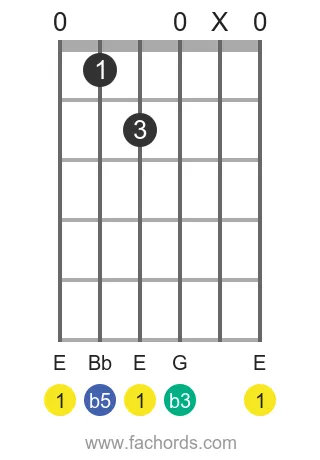
Position 6
Movable
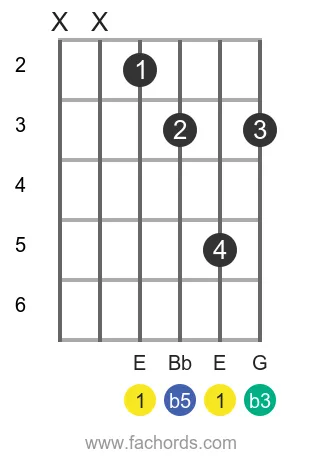
Position 7
Movable
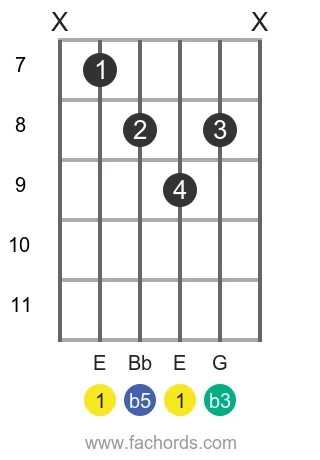
 Find more shapes in our all guitar chords online library. If you
prefer a printable pdf, download
the Free Guitar Chords Chart Pdf
Find more shapes in our all guitar chords online library. If you
prefer a printable pdf, download
the Free Guitar Chords Chart Pdf
You can also use this accessible Edim chord page, with written diagram instructions and screen-reader support for blind users.
Explore the Edim Chord: Play with Real-time Mic Feedback
Want a structured chord roadmap instead of jumping between pages?
Go to the full guitar chords tutorial.
Dive into the expressive world of music by experimenting with the E dim chord, a truly captivating member of the Diminished Chords family that injects tension and drama into your compositions. This chord, comprised of the notes E, G, and Bb, is uniquely built from the intervals 1, b3, and b5 – representing its Root, Minor Third, and Diminished Fifth. Use our interactive fretboard as your personal exploration lab; play the Edim chord and receive immediate, real-time mic feedback on your accuracy, ensuring you master its precise sound before moving on.
Understanding the Chord Construction and intervals that define it is crucial for truly mastering the E dim chord. This chord, a prime example of Diminished Guitar Chords, is characterized by its inherent instability and strong leading-tone function, making it an excellent harmonic device for creating movement towards resolution. While it produces a dissonant and tense sound on its own, it excels at setting up other chords, urging the listener's ear to anticipate what comes next. Learn how to strategically use this tension to add depth and complexity to your arrangements and perhaps even Improve Chords Change in your playing.
Before delving into the theory and exploring various diagrams, from easiest to most challenging, or learning how to apply this chord across different keys in songs, we strongly encourage you to first experiment with the interactive tool above. Get hands-on with the E dim chord, feel its unique character, and let your ears guide you through its musical possibilities.
Notes in the E dim chord:
How the Diminished chord is built:
Play This Chord With Other Roots
C dim | D dim | E dim | F dim | G dim | A dim | B dim | C#dim | D#dim | F#dim | G#dim | A#dim | Abdim | Bbdim | Dbdim | Ebdim | Gbdim

Created by
Giancarlo is a musician (teaching guitar since 2000), software engineer, AI consultant and published researcher
FAQ
What are the notes that make up the E dim chord?
The E dim chord is comprised of three specific notes: E, G, and Bb. E is the root note, G is the minor third above E, and Bb is the diminished fifth above E.
What do the intervals 1, b3, and b5 represent in the E dim chord?
These intervals define the E dim chord's structure. '1' refers to the Root (E). 'b3' indicates a Minor Third (G), meaning it's three semitones above the root. 'b5' signifies a Diminished Fifth (Bb), which is six semitones above the root, creating a unique, tense sound.
Why does the E dim chord sound dissonant or tense?
The E dim chord's dissonant and tense sound comes from the specific combination of its intervals, particularly the diminished fifth (b5). This interval creates a sense of unresolved tension, which is characteristic of all diminished chords.
When should I use an E dim chord in my guitar playing?
You should use an E dim chord when you want to add tension or a sense of anticipation to your music. It's often employed to lead into a more stable major or minor chord, providing a dramatic resolution.