Guitar Fretboard Notes
Interactive Chart and Complete Map of the Neck
A beginner-friendly guide to every note on the guitar fretboard, with an interactive virtual fretboard, diagrams for every key and a free PDF map.
Most guitar players neglect to learn the notes on the fretboard, relying instead on fixed chord shapes and scale patterns. Unlike pianists or saxophonists, who can name every note on their instrument from day one, guitarists often miss out on applying music theory and sight-reading to their playing.
This guide shows you how to learn all the notes on the guitar fretboard, it is faster, easier and more rewarding than you think. Use the interactive fretboard below to explore the neck, then follow the step-by-step method to lock the notes into memory in about a month of casual practice.
Interactive Virtual Guitar Fretboard
Use this interactive guitar fretboard to explore every note on the neck. Click any fret to hear the note, pick which note to highlight from the toolbar, switch between sharps (#) and flats (b) notation, flip to left-handed mode, change tuning to Drop D (or other alternate tunings) and adjust the BPM for the audio playback. Below the fretboard, a piano keyboard mirrors the highlighted notes so you can connect guitar fretboard notes to their piano equivalents.
The tool above highlights selected notes across a 15-fret guitar neck (currently showing all C notes in yellow). The top toolbar gives you full control:
- Note selector, pick any of the 12 chromatic notes to highlight everywhere it appears on the fretboard.
- Sharps / flats toggle, display accidentals as C# or Db depending on the key you are working in.
- Left-handed mode, flip the neck for a true lefty fretboard view.
- Alternate tunings, switch between standard tuning, Drop D, and other common tunings to see how the notes shift on the neck.
- Audio playback & BPM, play the highlighted notes as a sequence at the tempo you choose for ear training.
- Share & download, save the current fretboard view or share a direct link to it.
Below the fretboard, a labeled piano keyboard mirrors the highlighted notes with green outlines, providing a cross-instrument visual reference for any note on the guitar fretboard.
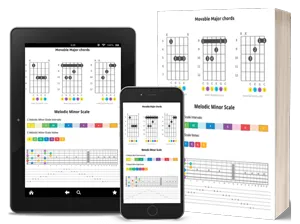
Suggested Resource For This Tutorial: Free Guitar Fretboard Chart PDF

This free guitar notes map includes several diagrams that show the notes on the fretboard for each musical key.
This resource will help you understand the fretboard step-by-step , starting with a map of natural notes only , and gradually introducing sharp and flat notes one at a time.
The Musical Alphabet
The musical alphabet consists of the seven natural notes:
A, B, C, D, E, F, and G.
This sequence of notes repeats at higher pitches, known as higher octaves.
Each octave is numbered to help identify the pitch range of notes. For example, in standard piano tuning, Middle C is labeled as C4.
This means it's the C note in the fourth octave of a standard 88-key piano. The next higher C note is C5, and the one below Middle C is C3.
A1 B1 C1 D1 E1 F1 G1 A2 B2 C2 D2 E2 F2 G2 A3 B3 C3 D3 E3 F3 G3 A4 B4 C4 D4 E4 F4 G4 A5...continue
On a piano, these natural notes correspond to the white keys. If you start at Middle C (C4) and move up to the next C (C5), you'll pass through all the natural notes in order: C, D, E, F, G, A, B, and then arrive at the next C.
Guitar Neck Notes | Don't Worry, There's a Logic to This

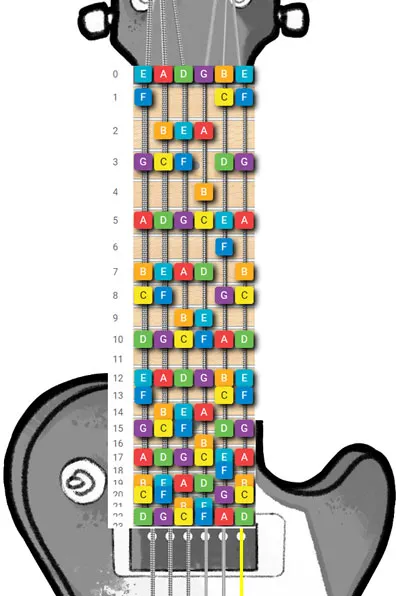
22 frets guitar neck map shown from the same point of view of the guitar player.
The picture above shows you the notes on the fretboard.
At first glance, it might look like a big mess: a bunch of note names scattered everywhere.
If you're feeling confused, just remember that in the diagram, the thickest string (E) is at the bottom of the image, and the guitar headstock is on the left .
 Essentially,
the diagram is
created from the
perspective
of a guitar player holding their instrument.
Essentially,
the diagram is
created from the
perspective
of a guitar player holding their instrument.
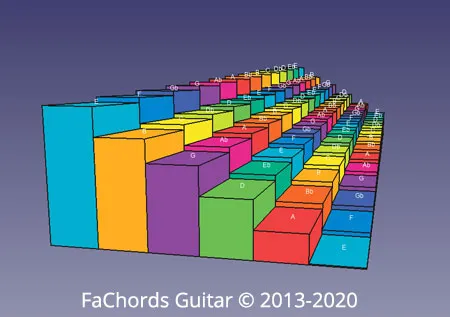
Now we're going to learn some strategies that will make understanding this map easier. (If you want something cool, I even created a LEGO 3D model of the fretboard, which might help you visualize the notes better).
Fretboard Guitar Theory | First Things to Know
There are some rules that can simplify learning the fretboard.
We'll take this step-by-step , so feel free to jump ahead if you're already familiar.
Some guitar players use the CAGED system to organize the fretboard.
It's a helpful tool, but to fully benefit from it, you need to know the names of the notes, so stick with us and continue with this tutorial.
1) Learn the Names of the Open Strings
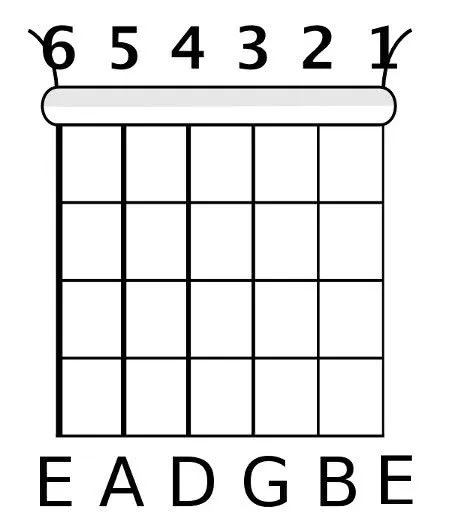 To start, you should memorize at least
6 notes
: the names of the open strings!
To start, you should memorize at least
6 notes
: the names of the open strings!
Memorizing the names and order of the strings will be useful for learning other things.
Often in tutorials and videos, you'll encounter instructions like " place your finger on the 2nd fret of the 6th string ".
Guitar Strings Order
The order of guitar strings is a bit counterintuitive, as they are counted from the thinnest to the thickest.
From the guitarist's perspective, the first string (high E) is actually the farthest from you and closest to the floor.
So, the guitar strings order is:
- 1st string - E (the thinnest, highest pitch)
- 2nd string - B
- 3rd string - G
- 4th string - D
- 5th string - A
- 6th string - E (the thickest, lowest pitch)
Notes and Frequencies
For the sake of completeness, it's worth mentioning the frequencies of the fretboard notes .
You might only need this information when producing music, but it's good to know the basics.
A pitch is measured in Hertz , and each fret corresponds to a different pitch.
A well-known frequency is 440 Hertz , which is 2 octaves above the A open string's pitch of 110 Hertz . The Diapason , also known as a Tuning Fork , a device for tuning the guitar, oscillates at 440 Hertz.
| Open string | Note | Frequency (Hz) |
|---|---|---|
| 1st (thinnest) | E | 329.63 |
| 2nd | B | 246.94 |
| 3rd | G | 196.00 |
| 4th | D | 146.83 |
| 5th | A | 110.00 |
| 6th (thickest) | E | 82.41 |
If you want to learn more about note names and frequency, check out my MIDI, note, and frequency interactive tutorial.
Guitar String Acronyms: Mnemonic Tricks
You can use a mnemonic trick to help you memorize open string names.
By using a phrase in which the first letter of each word corresponds to the name of a string, memorizing becomes easier.
In the acronyms below, the names of the strings are ordered from the thickest to the thinnest ( E A D G B E ):
- E at A ll D ay G et B ig E asy
- E very A mateur D oes G et B etter E ventually
- E ddie A te D ynamite G ood B ye E ddie
- E lephants A nd D onkeys G row B ig E ars
It's perfectly fine to create phrases in the opposite order: from the thinnest string (1st) to the thickest (6th), E B G D A E .
Choose what works better for you!
- E aster B unny G ets D runk A fter E aster
- E very B oy G ets D izzy A round E lle
For more effective memorization, you should create your own phrases ( there are endless possibilities ); here's one of my phrases, with Italian words: E mozionanti A vventure D ove G randi B arche E splodono . If you come up with something cool, please share it in the comments below!
2) The Notes of the Lowest E String Are the Same as the Highest E String
You've probably already noticed that there are 2 strings tuned to E: the lowest (6th) and the highest (1st).
These strings, also called external strings (because they are on the upper and lower borders of the fretboard), have different pitches, but their note names are the same .
So we only need to memorize the notes on 5 strings!
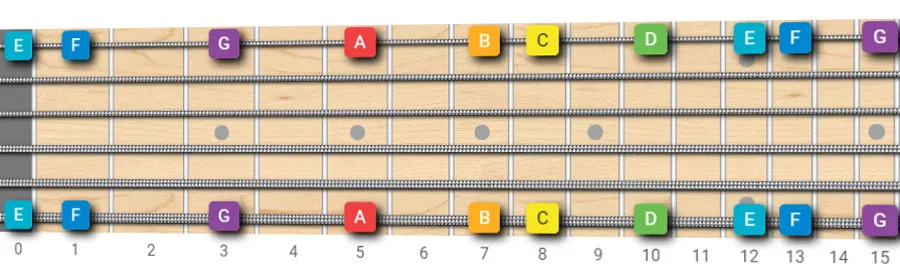
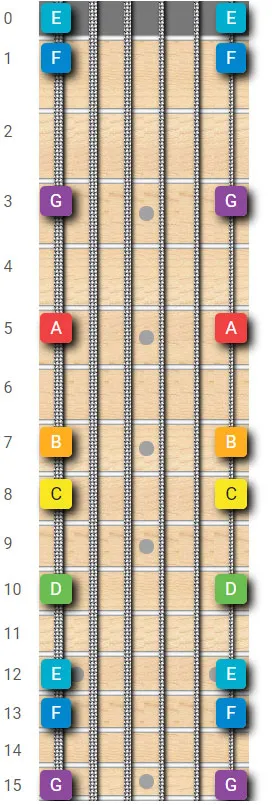
The notes on the 6th (thickest) string are the same as the 1st (thinnest) string!
3) Learn the Frets Numbers (0-11)
So far, we've only looked at open strings. Now it's time to think horizontally and focus on the frets.
Here are some key points about the frets of the guitar neck:
Fret Number 0 Corresponds to the Open String
On chord diagrams, tabs, and other forms of guitar notation, if you see a fret labeled 0 , it means that you should play the string open, without pressing any fret.
On Each String, the Note at Fret 0 is the Same as the Note at Fret 12 (and the same applies to the next frets: 1=13, 2=14, 3=15, and so on)
Here's why: in music, there are
only 12 notes
, the natural notes:
C
D
E
F
G
A
B
and the sharp/flat notes (we'll cover this later)
C#/Db
D#/Eb
F#/Gb
G#/Ab
A#/Bb
So, if you start from C and go up one note at a time, after
12 steps
, you'll
return
to C:
The same applies to the guitar frets; if you start from any fret, after 12 steps (or frets), you'll
return to
the same note.
Let's take, for example, the E lowest string , shown in the picture below.
The notes on the first 11 frets (0-11) are the same as those on frets 12-22:
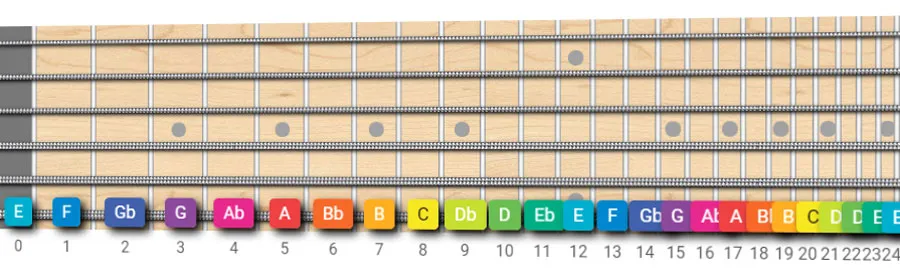
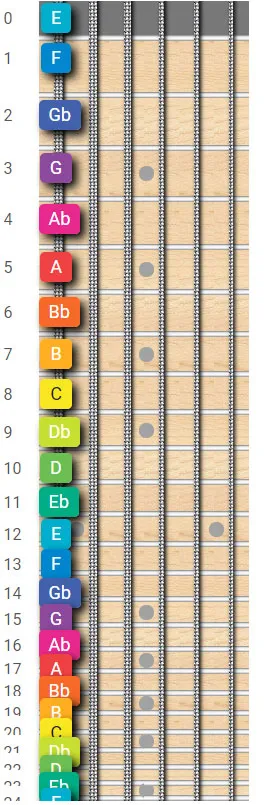
The notes on frets 0 to 11 are the same as those on frets 12 to 22 (depending on the model, a guitar can have 20-24 frets) Click to zoom
To help you grasp this concept better, think of it this way: a guitar has 2 identical fingerboards of 12 frets each , placed one after the other.
4) Use Fretboard Dots as a Visual Aid
Have you ever wondered what the dots on a guitar fretboard mean?
Even if some brands have fancy fretboard dots that are beautiful (guessing game: what guitar has birds on the fretboard?), they are also practical for finding your way around the neck.
You can use them as landmarks for fretboard navigation .
On most guitars, these rules apply:
- An inlay is placed at the 3rd fret
- An inlay is placed at the 5th fret
- An inlay is placed at the 7th fret
- An inlay is placed at the 9th fret
- A double inlay (or another symbol) is placed at the 12th fret
- The same pattern repeats on the frets above the 12th (inlays on frets 15, 17, 19, 21, and double inlays on 24).
Ok, so far we've learned that we only need to learn the notes of 12 * 5 = 60 frets (because the first 12 frets are the same as the next 12, and the 1st and 6th strings share the same notes).
But there are many other things that can help us master the fretboard .
Next, we'll delve deeper into the geometry of the fretboard :
Guitar Notes On Staff
Below, you'll find six images showing the fretboard notes on staff. While being able to read music isn't strictly necessary to be a great musician, it certainly helps.
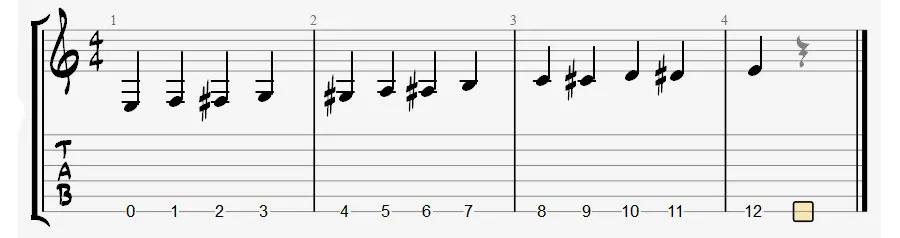
E low string notes on staff
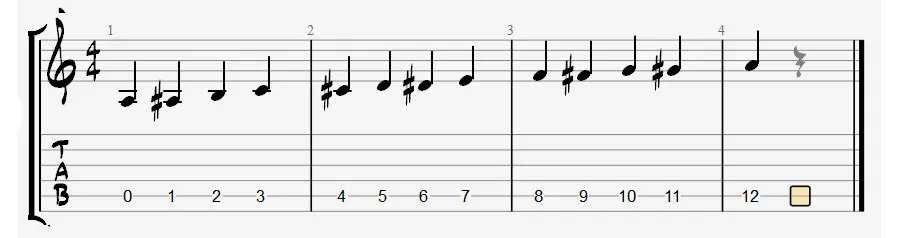
A string notes on staff
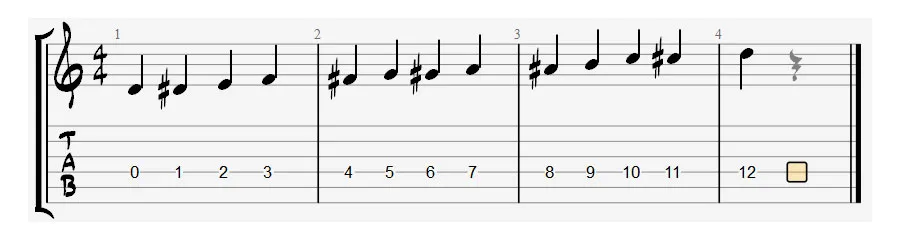
D string notes on staff
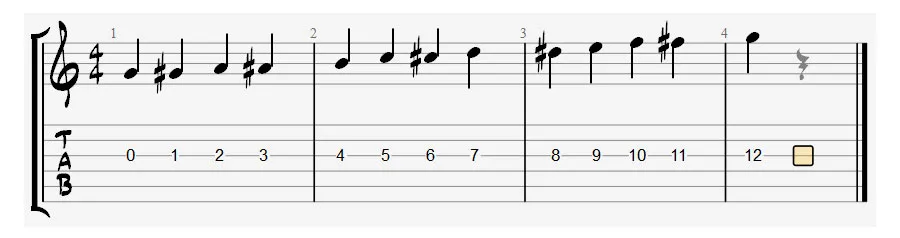
G string notes on staff
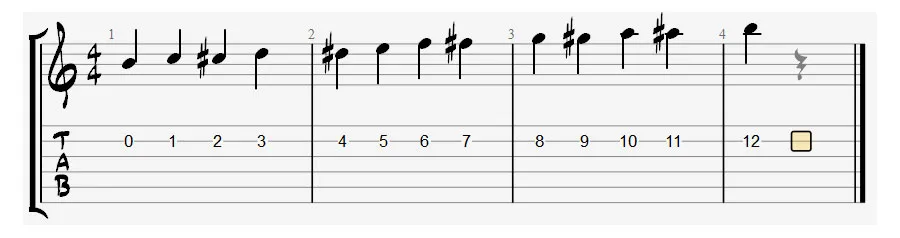
B string notes on staff
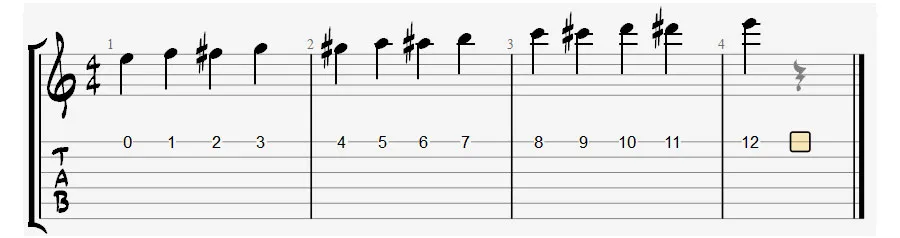
E high string notes on staff
How to Really Master the Fretboard
Now things are going to get interesting.
Once, Andres Segovia , the famous virtuoso Spanish classical guitarist, said, " The guitar is the easiest instrument to play, and the hardest to play well ".
True story. Even if you're a complete beginner, you could memorize a few chord shapes, strum the strings a bit, and you can say that you're " playing the guitar ".
But you might not know the notes that make up the chords you're playing or how to introduce variations to your playing.
In the following sections, we'll learn how the fretboard really works.
Before we continue, be sure to get your free access to the download area here: you'll gain access to many chords, scales, and theory PDFs.
Why Should I Learn the Fretboard?
Learning the Fretboard Opens Up a New World of Possibilities
I promise you: if you want to truly understand guitar fretboard theory and are ready to commit to studying and learning some music theory and its relationship with the neck's geometry , you'll be rewarded with the ability to play better and better.
During your solos, you'll automatically find the notes that your mind and your heart suggest.
In short, you'll play music, not just guitar .
If you've ever felt trapped in fixed scale patterns and chord shapes, you know what I mean.
Ok, now that you understand that, to become a complete musician, you need to learn the fretboard. But why does it seem so difficult at first ?
Well, the main challenge with the guitar neck is that, unlike the piano keyboard where the notes are laid out horizontally in a single row, on the guitar the same note can be found in multiple places .
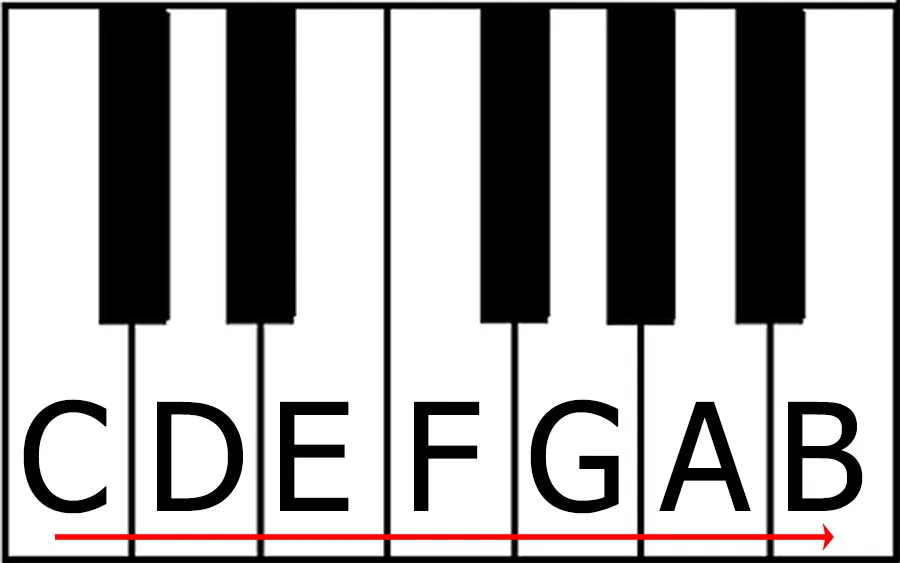
Piano keyboard layout: there is only 1 path, 1 option for playing the C major scale from C lowest to C one octave (7 white notes) higher
For example, suppose you want to play a C major scale starting from the 3rd fret of the fifth string (A string).
We all know (or should know) that the C major scale consists of C, D, E, F, G, A, B notes.
Take a look at the image below: clearly, there are different paths to play this scale.
You could switch strings after playing C and play the D note on the fourth string (D), or you could stay on the fifth string and play the D on that string.
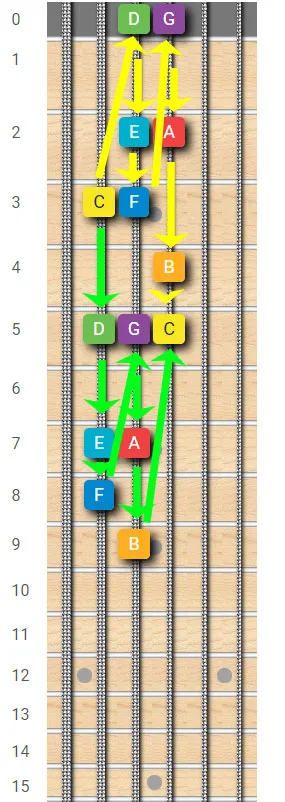
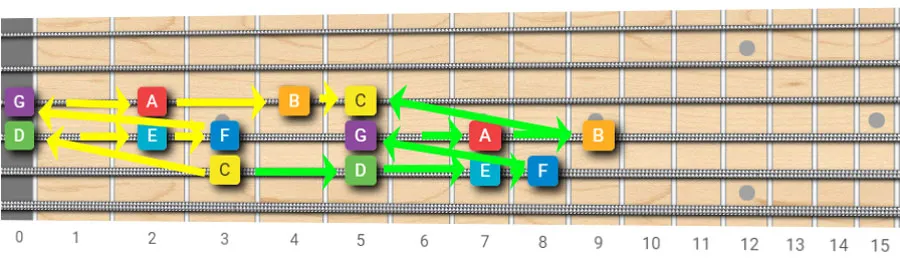
Guitar fretboard layout: there are
different paths
for playing the
same scale
(option 1:
yellow path
, option
2:
red path
)
From a beginner's perspective, having too many options makes things complicated .
On the other hand, for those who master the fretboard, the guitar's layout enhances its expressive and musical possibilities.
But don't worry, we'll explore some strategies to help you tame the fretboard's complexity.
Trick #1: See the Fretboard Strings as 6 Piano Keyboards
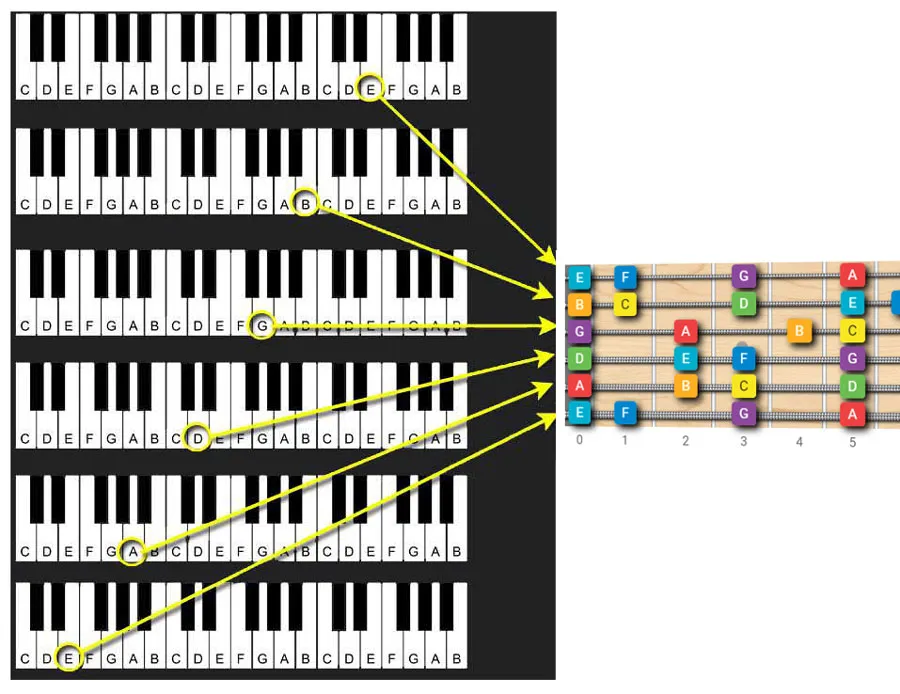
A helpful mental trick for understanding the fretboard is to view each string as a separate piano keyboard , starting from the respective note.
As mentioned earlier, the standard tuning of the guitar, from the thickest string to the thinnest, is E A D G B E .
- The sixth string (and its related piano keyboard) starts with the E note
- The fifth string (and its related piano keyboard) starts with the A note
- The fourth string (and its related piano keyboard) starts with the D note
- The third string (and its related piano keyboard) starts with the G note
- The second string (and its related piano keyboard) starts with the B note
- The first string (and its related piano keyboard) starts with the E note (2 octaves, 14 white keys higher than the lowest E string)
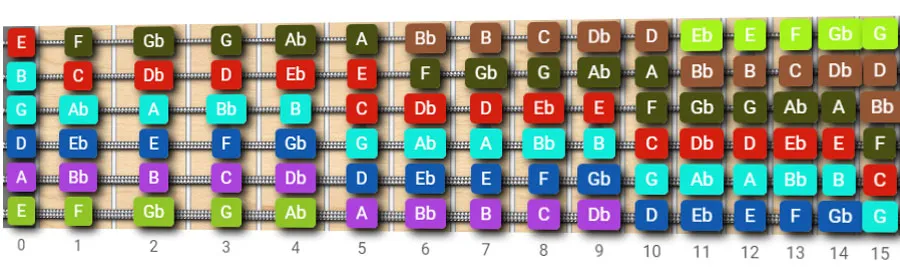
Fretboard Map: Notes With Same Pitches
A useful visualization is to highlight the notes that share the same pitch across different strings using the same color.
In the fretboard diagram below, you can see where the same notes (with the same name and pitch) can be played on different strings.
Fretboard Strings Relationship and Standard Guitar Tuning
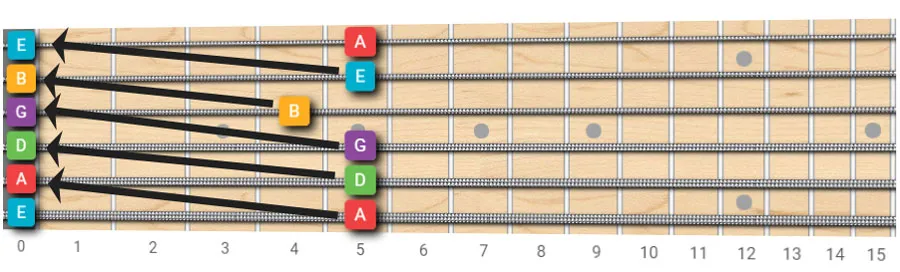
Given the piano keyboard-string analogy, it's easier to explain the standard guitar tuning .
First, we need to tune the lowest E string with a tuner.
This gives us a standard reference that aligns with other musicians.
Then, we can tune the other strings using the previous string as a reference.
We mentioned earlier that the fifth string is tuned to an A note.
- So, press the A note on the sixth string (low E), located at the 5th fret, and tune the fifth open string (A) until the two strings sound the same pitch.
- Repeat this process with the other strings (see the diagram below).
- The fourth open string (D) should match the pitch of the 5th fret on the fifth string.
- The third open string (G) should match the pitch of the 5th fret on the fourth string, and so on.
- Just note the small difference with the third string (G): here, you must press the 4th fret (instead of the 5th) to tune the second string (B). We'll discuss why later.
This video clearly shows how to tune your guitar
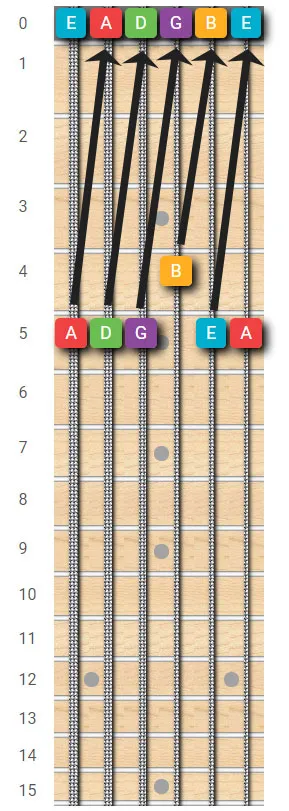
Guitar standard tuning
What About the Black Keys? (Half Steps and Whole Steps)
Now it's time to talk a bit (just a bit) about music theory. In Western music, the smallest distance between two notes is called a half-step (or semitone).
A distance of 2 half-steps is called a whole step .
On the piano keyboard, the distance between the keys (whether white or black) is 1 half-step .
If we look at the piano
keyboard again, we can see that there is a black key between each pair of white keys, except for the
space
between
B
and C
, and
E and F
.
So here's the first important thing
to
notice:
- Between C and D there is 1 whole-step (2 half-steps)
- Between D and E there is 1 whole-step (2 half-steps)
- Between E and F there is 1 half-step
- Between F and G there is 1 whole-step (2 half-steps)
- Between G and A there is 1 whole-step (2 half-steps)
- Between A and B there is 1 whole-step (2 half-steps)
- Between B and C there is 1 half-step
Thus, the structure of the Major Scale is made up of 2 whole steps ( C-D-E ), 1 half-step ( E-F ), 3 whole steps ( F-G-A-B ), and 1 half-step ( B-C ). On the fingerboard, we don't have black or white keys, but we do have frets .
1 fret = 1 half-step = 1 semitone
Let's look at the C Major Scale on the guitar neck .
As mentioned earlier, we have different options for playing a given scale.
This time, for visualization convenience, I've chosen to start from the first fret of the B string , which is a C, and play the scale horizontally on the same string , to better visualize the steps and half-steps structure:
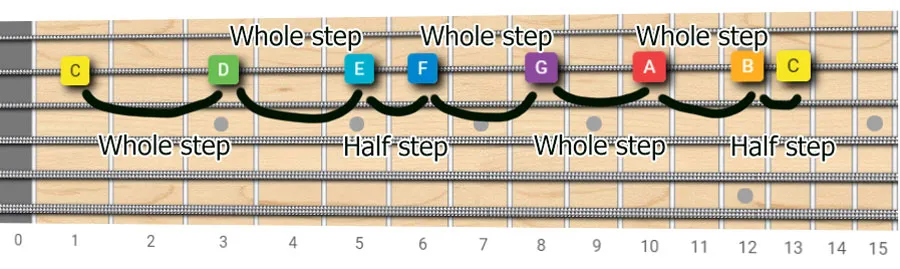
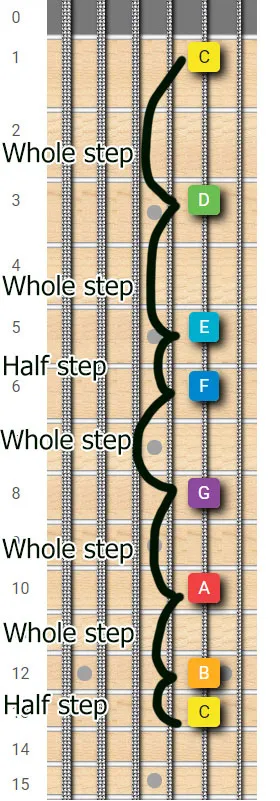
C major scale on the second (B) string
Sharps and Flats and Neck Frets
In music theory, there are two symbols that, when applied to a note, change its pitch and name.
These are called sharps and flats:
For example, a D flat is a D note lowered by 1 half-step, while a C sharp is a C note raised by 1 half-step. D flat and C sharp have different names, but they have the same pitch .
On the guitar fretboard, they are placed on the same fret ! You'll learn why the same fret can have different names in future lessons. Technically, this topic is called " enharmonics ," but don't worry about that for now.
Let's now introduce the chromatic scale , a scale consisting of 12 half-steps required to move from a note to the same note 1 octave above.
The C chromatic scale is as follows:
C - C#/Db - D - D#/Eb - E - F - F#/Gb - G - G#/Ab - A - A#/Bb - B - C
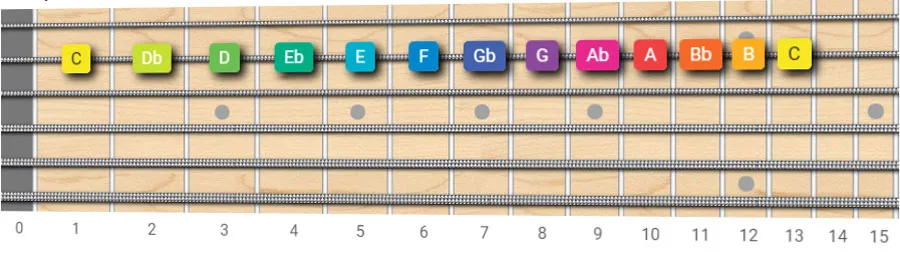
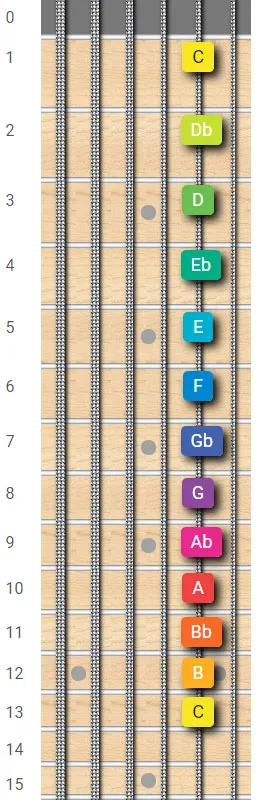
C chromatic scale on the second (B) string
Playing the chromatic scale on the fretboard is straightforward because you only need to play one fret after the other.
Notice that between the lowest C and the higher C, there are 12 frets , or 12 half-steps
Trick #2: Fretboard Octaves
Beginner guitar players usually memorize only the notes on the sixth and fifth strings , because they learn barre chord shapes and need to find the root notes of the chords.
Starting with this knowledge, it's possible to use the fretboard's geometry to find notes on the other strings.
Pro tip: In the following link, I'll show you the so-called octave intervals : starting from a given note, you can find the same note on the higher strings, 1 or 2 octaves above.
This is a great visual aid that helps you find your notes quickly.
Octaves will also be useful when you start learning about guitar triads and chord inversions.
Trick #3 | Fretboard Chart PDF
In the free guitar notes chart PDF , you'll find several maps of the fretboard notes.
Let's take a look:
We have natural notes (C D E F G A B), notes with sharps (like C# and D#), and notes with flats (like Bb, Db, and Eb).
To begin, it's easier to memorize only the natural notes, followed by the notes with flats, and finally the notes with sharps.
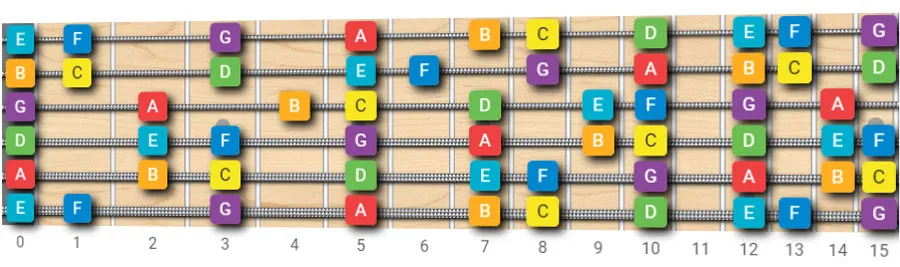
Diagram showing only natural notes (no sharps or flats)
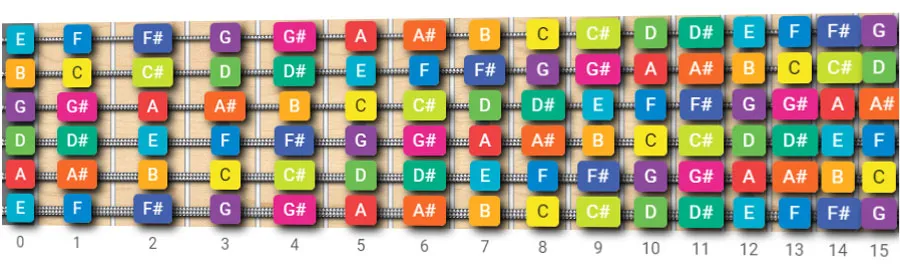
Diagram showing natural notes and sharp notes.
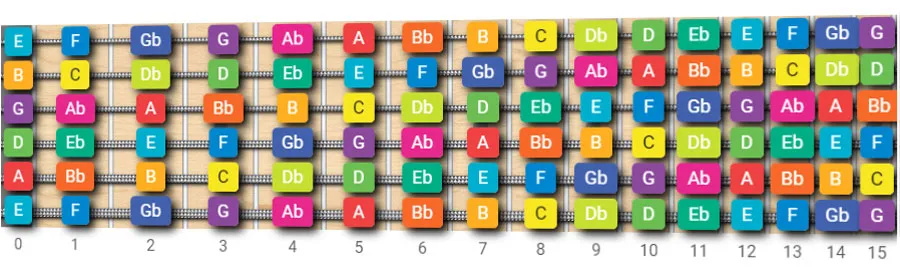
Diagram showing natural notes and flat notes.
The PDF chart contains several fretboard maps , each showing a particular guitar key . This way, it's easier to focus on the notes of a given key and learn the notes step-by-step.
The layout of the maps is clear and easy to remember
In the diagrams, the musical keys are organized following the circle of fifths , which is a method to display and memorize the sharps/flats belonging to a given key.
Starting with the C key, which has no sharps/flats, you'll notice that as you change keys, following the Circle of Fifths, one sharp/flat is introduced at a time.
Don't worry if you're not familiar with the circle of fifths ; this concept is clearly visualized in the PDF.
Below, you'll find some guitar note maps for the most common keys.
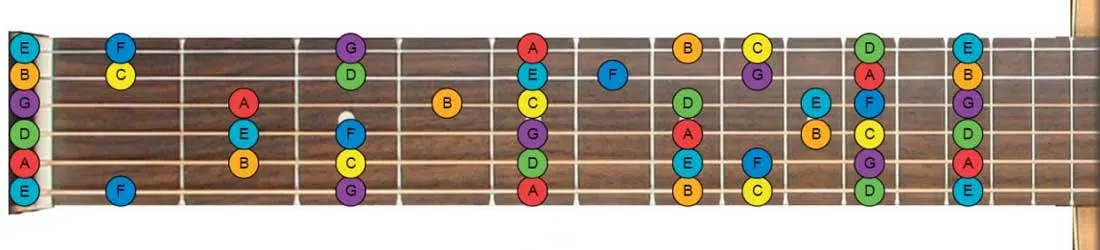
Neck Notes Chart for C Major Key
-
C Major
: C - D - E - F - G - A - B - C
Sharps/flats: none
As mentioned earlier, one of the best ways to learn the notes on the fretboard is to start by memorizing only the natural notes.
This strategy requires less effort, as you're only dealing with 7 notes.
Below is the guitar notes diagram for the C key , which only has natural notes.
Take your time to memorize these notes, as they'll be the foundation for more complex concepts.
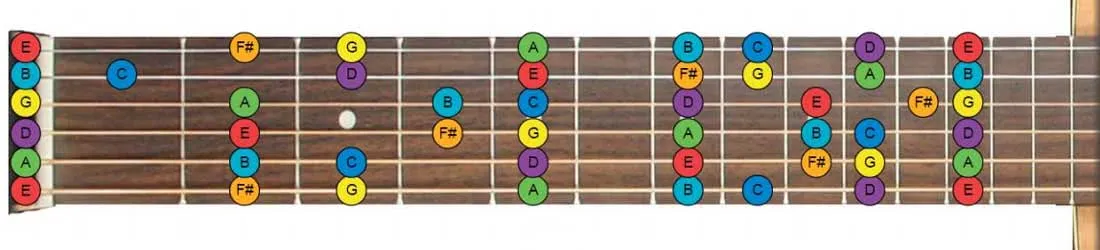
Fretboard Diagram for G Major Key
Once you have the C major notes down, you can move on to the next key, which, according to the Circle of Fifths, is the G key.
The G key has an F sharp instead of an F , so you only need to raise the F by one half-step.
-
G Major
:
G - A - B - C - D - E - F# - G
Sharps/flats: F#
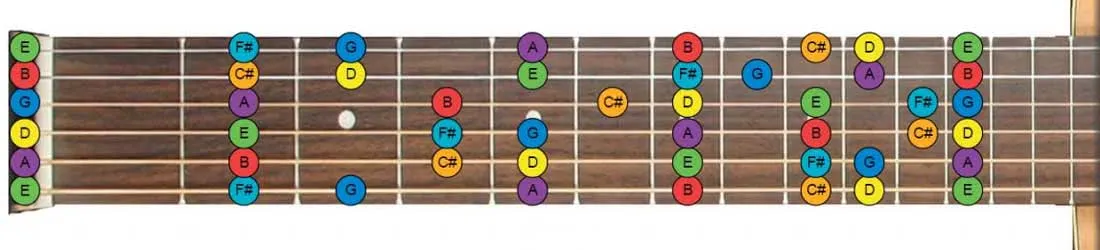
Guitar Fretboard Notes Chart for D Major Key
-
D Major
:
D - E - F# - G - A - B - C# - D
Sharps/flats: F#, C#
The D major key introduces the C sharp note. Now you're a fretboard wizard, and you can easily find this new note by raising the C by one half-step.
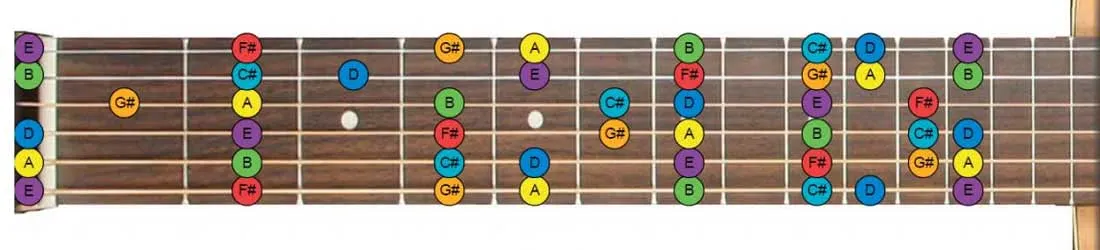
Guitar Notes Diagram for A Major Key
-
A Major
:
A - B - C# - D - E - F# - G# - A
Sharps/flats: F#, C#, G#
The same mechanism as above applies: the new note in the A major key is G#. So just raise the G by one half-step.
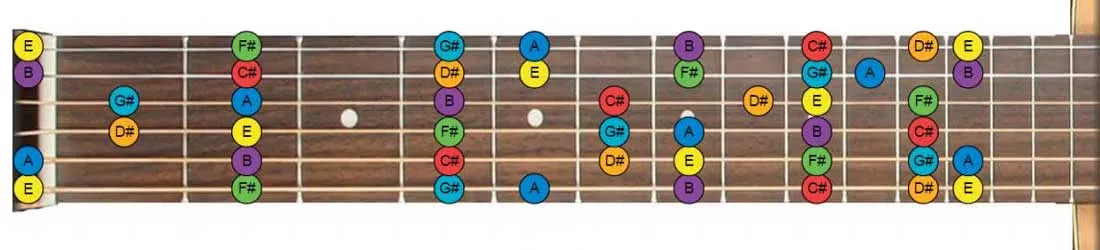
Guitar Neck Diagram for E Major Key
-
E Major
:
E - F# - G# - A - B - C# - D# - E
Sharps/flats: F# C# G# D#
Here comes the E major key with a new note, D sharp.
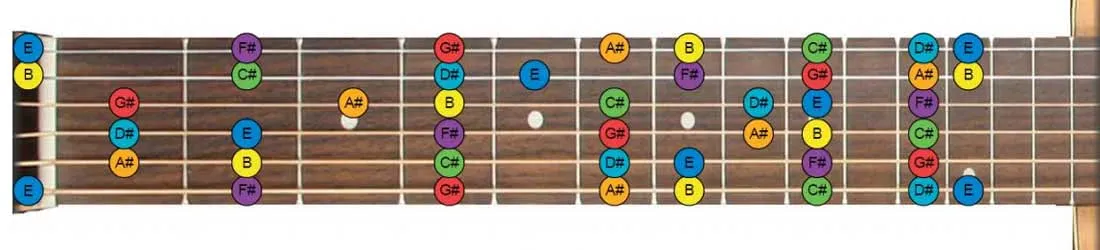
Fretboard Notes Chart for B Major Key
-
B Major
:
B – C# - D# - E - F# - G# - A# - B
Sharps/flats: F# C# G# D# A#
Now it's time for the B major key, with A sharp as the new note! You'll find the other keys and their diagrams in the PDF .
Major Keys Summary: Notes and Sharps/Flats
| Key | Notes | Sharps / Flats |
|---|---|---|
| C Major | C – D – E – F – G – A – B – C | none |
| G Major | G – A – B – C – D – E – F# – G | F# |
| D Major | D – E – F# – G – A – B – C# – D | F#, C# |
| A Major | A – B – C# – D – E – F# – G# – A | F#, C#, G# |
| E Major | E – F# – G# – A – B – C# – D# – E | F#, C#, G#, D# |
| B Major | B – C# – D# – E – F# – G# – A# – B | F#, C#, G#, D#, A# |
Trick #4: Online Fretboard Trainer Game
We're quite proud of this tool because thousands of guitar players use it daily. It's a free browser game that you can use online without installing anything.
It helps you quickly memorize all the fretboard notes while having fun.
Launch the fretboard trainer now.
There are many exercises to memorize the fretboard , but this little tool can really speed up your learning. Check it out!
Guitar Neck Notes | More Resources to Learn the Fretboard
Ok, in this tutorial, we've covered a lot of ground. Now you should have a good understanding of the guitar fretboard and some material to practice.
Take your time to internalize these concepts, download the notes map PDF , practice with the fretboard trainer game for at least 10 minutes a day, and in no time, you'll find yourself flying effortlessly up and down the neck .
Another effective way to deepen your understanding of the fretboard and its sounds is to sing each note as you play it.
If you have any doubts or questions, just ask in the comments below, and please share your feedback.
To stay updated on new tutorials, subscribe to the free newsletter (you'll also get access to the download area with lots of free printable resources)
Guitar Fretboard FAQ
What is a guitar fretboard?
The guitar fretboard (also called the fingerboard) is the long, narrow surface on the guitar neck where you press the strings to change their pitch. It is divided by metal frets into segments ,each fret raises the pitch by one half-step (semitone). A standard guitar has 19 to 24 frets, but the notes repeat after fret 12, so you only need to learn the first 12 frets to know the entire neck.
What are the notes on the guitar fretboard?
In standard tuning, the open strings (thickest to thinnest) are E, A, D, G, B, E. Each fret raises the pitch by one half-step, cycling through the 12 chromatic notes: C, C#/Db, D, D#/Eb, E, F, F#/Gb, G, G#/Ab, A, A#/Bb, B. After fret 12 the same notes repeat one octave higher.
How many notes are there on a guitar fretboard?
Western music has only 12 unique pitch classes. On a 22-fret guitar that is 138 playable positions (6 strings × 23 including the open string), but only 12 unique note names. Every note appears in multiple places on the neck ,that is what makes the guitar fretboard both expressive and confusing for beginners.
What is the fastest way to learn the guitar fretboard?
The fastest method is: (1) memorize the open strings E A D G B E, (2) focus on the 6th and 5th strings first (they are the roots of most barre chords and share notes with the 1st string), (3) use fretboard octave shapes to map notes onto the other strings, and (4) practice 10 minutes a day with an interactive fretboard trainer. Most players reach fluency in about 30 days.
Why do guitar fretboards have dots?
The dots are called inlays and act as visual landmarks. The standard pattern places single dots at frets 3, 5, 7, 9, and a double dot (or different shape) at fret 12, then the same pattern repeats from fret 15 to 24. They help you find positions on the neck without looking down at the strings.
Are the notes on the 6th and 1st strings the same?
Yes. Both strings are tuned to E in standard tuning, so they share the same note names at every fret, only the pitch differs (the 1st string sounds two octaves higher). For example, the 5th fret on both strings is A. This means you only need to memorize 5 unique strings, not 6.
What is the difference between a fretboard and a fingerboard?
On a guitar the two terms are used interchangeably. Strictly speaking, the fingerboard is the wooden surface itself (rosewood, maple, ebony) and the fretboard is the same surface plus the metal frets. Most guitarists use fretboard for both.
Do I need to learn music theory to learn the fretboard?
No, but a small amount of theory makes it dramatically easier. You only need three ideas: the musical alphabet (A B C D E F G), half-steps and whole steps, and the difference between sharps and flats. With those three concepts you can decode the entire fretboard.
More Guitar Fretboard Resources
Here below, you'll find all the resources designed to help deepen your fretboard knowledge:

Created by
Giancarlo is a musician (teaching guitar since 2000), software engineer, AI consultant and published researcher