Practice the Dmaj Chord on Guitar with Real-time Feedback
Want a structured chord roadmap instead of jumping between pages?
Go to the full guitar chords tutorial.
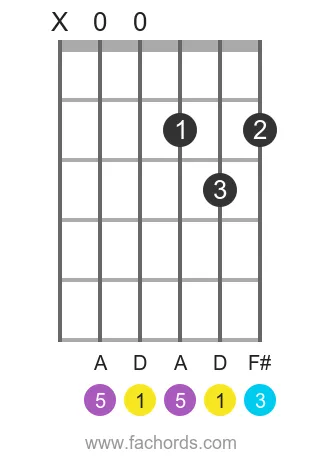
Struggling to nail the D major (D maj) chord? Our interactive tool provides instant mic feedback, verifying your accuracy as you play. Use the virtual fretboard to visualize the notes D, F#, and A, which are built from the Root, Major Third, and Perfect Fifth intervals (1, 3, and 5). This fundamental chord is a cornerstone of the Major Chords family.
The D major chord, as a major chord, serves as a stable tonal center in countless songs, providing a sense of resolution and completeness. Understanding how chords like D maj are constructed by stacking intervals is crucial, and our dedicated guide on Chord Construction offers a deep dive into this process. You can also explore how different voicings affect the feel of a chord by learning about Understanding Chord Inversions. To truly master the D maj chord in various musical contexts, practicing smooth transitions is key; our tips on how to Improve Chords Change will guide you.
Before moving on, play along with our virtual fretboard to truly internalize the D maj chord. Below, you'll find comprehensive chord diagrams, arranged from the easiest fingerings to more challenging shapes, alongside deeper theoretical explanations that delve into its role in various keys and musical genres. Use this page to practice the D maj chord and then incorporate it into your favorite songs.
Notes in the D maj chord:
How to create the Major chord:
Keys With The D Major Chord
Here are the most common keys in which you can find a D major chord.
Notice that in the key of G, the D major is the dominant chord (5th degree). That's the reason why G and D play well together.
G Major Key
D Major Key
A Major Key
E Minor Key
F# Minor Key
Scales To Play Over a D Major Chord
This is a major chord, so any scale with root, a major third and a perfect fifth could be a good fit. Here are some examples:
- D major scale
- D Lydian scale
- D Mixolydian scale
- D Major Pentatonic scale
Songs With The D Major Chord
Hotel California is the first song that comes to mind when thinking to a D major chord. It's Am E7 G D F C Dm E7 (again, notice the G -> D transition).
Sweet Home Alabama by Lynyrd Skynyrd is formed by D, C and G. This song is a great example of D mixolydian modal progression.
Love hurts by Nazareth is another awesome song with a D major: The progression is indeed G Em C D.
Variations for The D Major Chord
The D major chord is often used along the following shapes.
Basically, you put the pinkie on the 3rd fret of the G string (G), to play a D sus4, D(1) G(4) A(5).
Then you lift it, then you play again the D major, and then you lift also the ring finger, leaving the E high string open and forming a D sus2 chord D(1) E(2) A(5).
D major
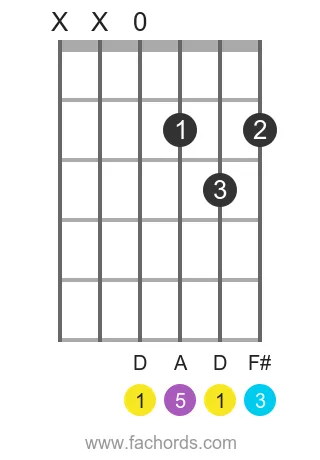
D sus4
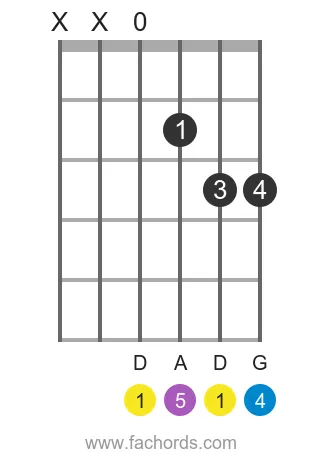
D sus2
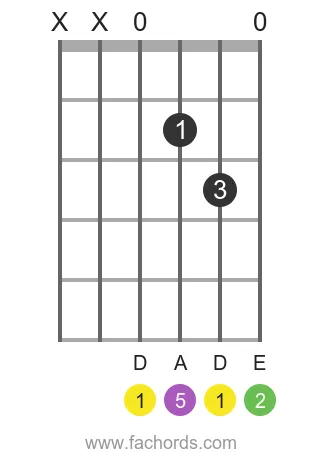
You can experiment with these chord voicings and variations by using my chord explorer tool.
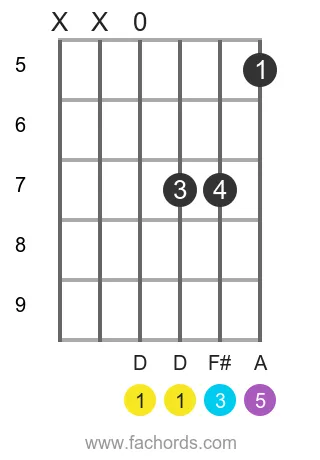
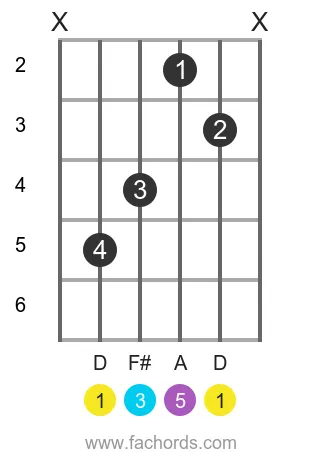
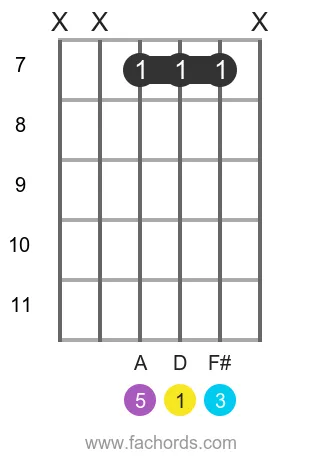
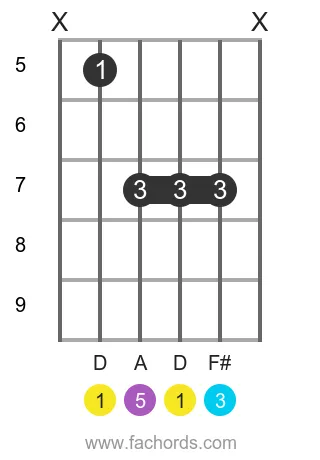
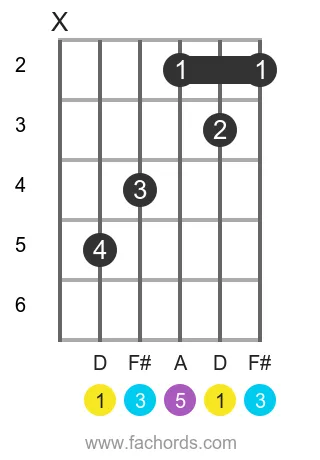
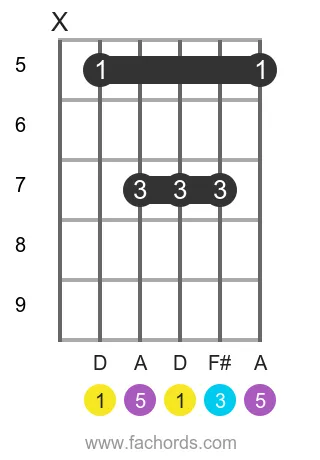
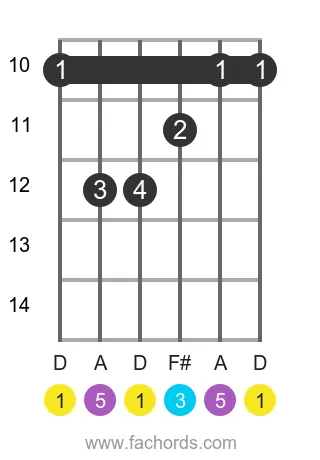
Fingerings for the Dmaj guitar chord
Position 1
Movable
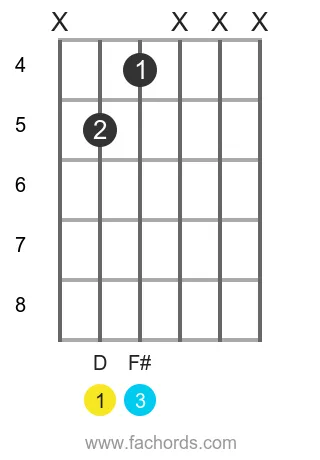
Position 2
Open
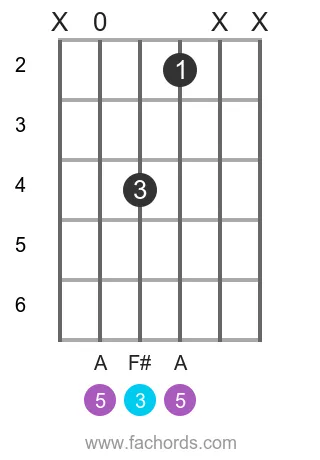
Position 3
Movable
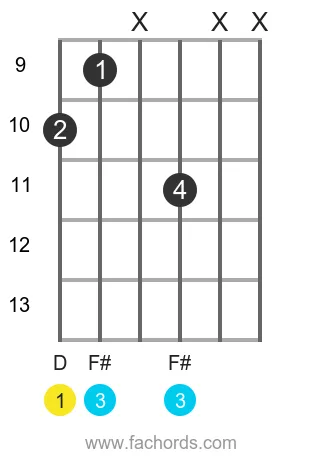
Position 4
Open
Position 5
Open
Position 6
Open
Position 7
Movable
Position 8
Barre
Movable
Position 9
Barre
Movable
Position 10
Barre
Movable
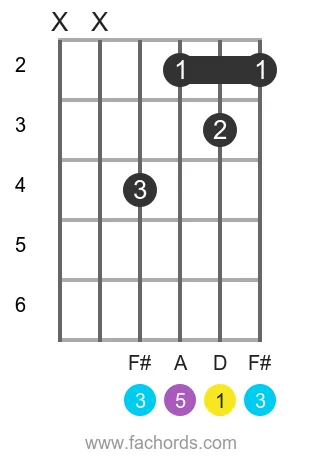
Position 11
Barre
Movable
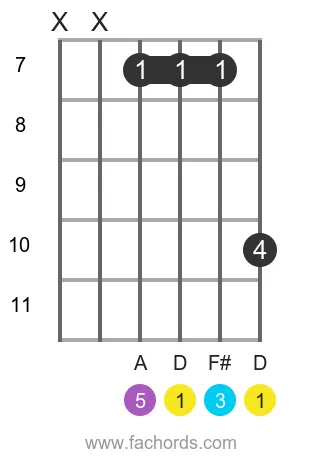
Position 12
Barre
Movable
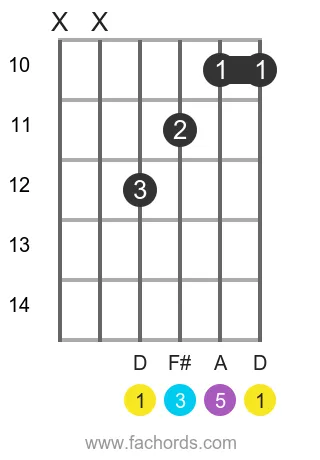
Position 13
Barre
Open
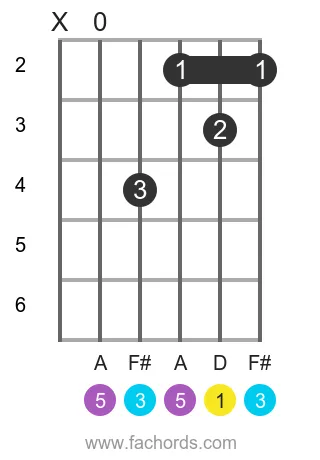
Position 14
Barre
Movable
Position 15
Barre
Movable
Position 16
Barre
Movable
 Find more shapes in our all guitar chords online library. If you
prefer a printable pdf, download
the Free Guitar Chords Chart Pdf
Find more shapes in our all guitar chords online library. If you
prefer a printable pdf, download
the Free Guitar Chords Chart Pdf
You can also use this accessible Dmaj chord page, with written diagram instructions and screen-reader support for blind users.

Created by
Giancarlo is a musician (teaching guitar since 2000), software engineer, AI consultant and published researcher
FAQ
What are the specific notes that form a D major chord?
The D major chord is built using three distinct notes: D, F#, and A. These notes correspond to the Root, Major Third, and Perfect Fifth intervals, respectively.
In what common musical keys does the D major chord typically appear?
The D major chord is a versatile chord found in several keys. It functions as the I (tonic) chord in the key of D Major, the IV (subdominant) chord in A Major, the V (dominant) chord in G Major, the VI chord in F# Minor, and the VII chord in E Minor.
What scales can be effectively played over a D major chord?
Since the D major chord is a major chord, scales that feature a root, major third, and perfect fifth are good choices. Recommended scales include the D Major scale, D Lydian scale, D Mixolydian scale, and the D Major Pentatonic scale.
How are Dsus2 and Dsus4 chords formed from a D major chord?
Dsus2 and Dsus4 are variations of the D major chord. To form Dsus4, you replace the major third (F#) with a perfect fourth (G), often by adding your pinky on the 3rd fret of the G string. To form Dsus2, you replace the major third (F#) with a major second (E), typically by lifting the ring finger and leaving the high E string open.
What is the function of the D major chord within the key of G Major?
In the key of G Major, the D major chord functions as the V (dominant) chord, which is the 5th degree of the scale. This explains why the G and D chords often sound harmonious together in chord progressions.