Practice C Major: Perfect Your Chords with Live Fretboard Feedback
Want a structured chord roadmap instead of jumping between pages?
Download the step-by-step Guitar Chord Ebook
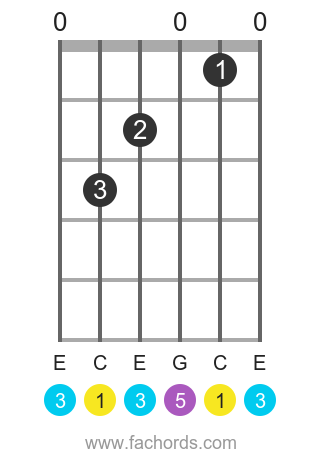
Ready to conquer the C Major chord? Challenge yourself with our interactive fretboard and instantly verify your playing accuracy using its real-time mic feedback. This fundamental chord, a member of the Major Chords family, is built from the notes C, E, and G, representing the 1st (root), 3rd (major third), and 5th (perfect fifth) intervals. You can also explore its arpeggio playback and different voicings directly on the screen.
The C Major chord provides a sense of stability and often acts as a tonal center in countless songs, laying a foundational harmony. Understanding its composition-the root, major third, and perfect fifth intervals-is crucial for deeper musical insight. If you're interested in how chords are built from these fundamental building blocks, our comprehensive guide on Chord Construction offers invaluable insights. Practicing smooth transitions between chords is also key to fluid playing; find tips on how to Improve Chords Change.
Before you dive into the theory, start by trying out the interactive fretboard above. Below, you’ll find chord diagrams for C Major, ranging from the easiest open positions to more challenging barre shapes, alongside detailed theoretical explanations. Explore how this chord fits into various songs and keys, solidifying your practical understanding. Test yourself and elevate your guitar playing!
C maj chord Notes:
How the Major chord is built:
The C Guitar Chord On Guitar
The C Major chord is built on the C Major scale, stacking the 1st, 3rd and 5th notes:
C D E F G A B C
So, counting 1, 3 and 5, we get: C E and G.
Keys Where You Can Find The C Major Chord
The C major chord contains natural notes only, so it's present in different keys:
C Major Key
| Key | I | ii | iii | IV | V | vi | vii |
|---|---|---|---|---|---|---|---|
| C | C | Dm | Em | F | G | Am | B dim |
G Major Key
| Key | I | ii | iii | IV | V | vi | vii |
|---|---|---|---|---|---|---|---|
| G | G | Am | Bm | C | D | Em | F# dim |
F Major Key
| Key | I | ii | iii | IV | V | vi | vii |
|---|---|---|---|---|---|---|---|
| F | F | Gm | Am | Bb | C | Dm | E dim |
E Minor Key
| Key | i | ii | III | iv | v | VI | VII |
|---|---|---|---|---|---|---|---|
| E | Em | F# dim | G | Am | Bm | C | D |
A Minor Key
| Key | i | ii | III | iv | v | VI | VII |
|---|---|---|---|---|---|---|---|
| A | Am | B dim | C | Dm | Em | F | G |
Progressions That Use The C Major Chord
There are probably thousands of songs with a C major chord somewhere. Here are some of the most popular:
- 1 4 5: C F G
- 1 6m 4 5: C Am F G
- 1 5 6m 4: C G Am F
My full tutorial on common chord progression will give you a detailed view on how put chords together.
Scales To Play Over a C Major Chord
Basically any scale that has a Major Third and a Perfect Fifth will be a great fit for this chord, for example:
- C major scale
- C Lydian scale
- C Mixolydian scale
- C Major Pentatonic scale
To learn more about this concept, check my complete ebook Scales Over Chords | Learn How To Play The Right Scales Over Any Chord.
Songs With The C Major Chord
The C major chord is one of the most used, and you can find it in songs like Imagine, The House Of The Rising Sun, Hallelujah, Time After Time, Ain't No Sunshine, Blowin’ in the Wind and many others.
You definitely want to learn it!
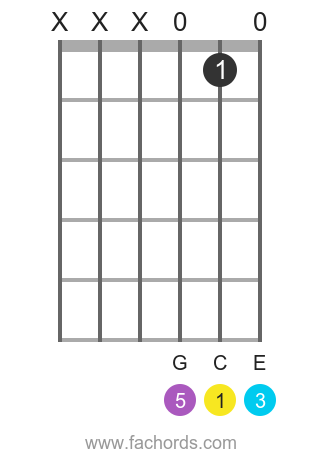
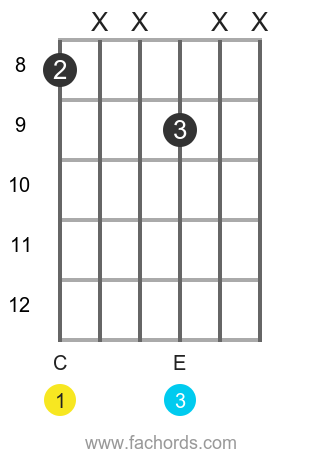
How To Play The C Major Chord | Guitar Shapes
Position 1
Open
Position 2
Movable
Position 3
Movable
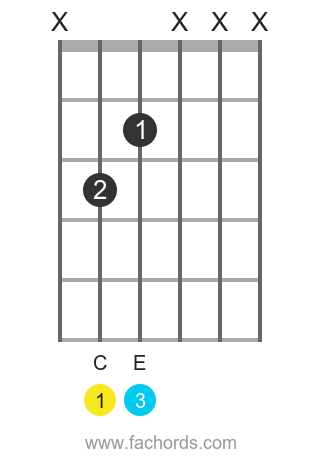
Position 4
Open
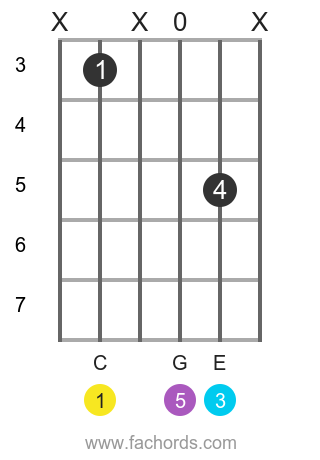
Position 5
Movable
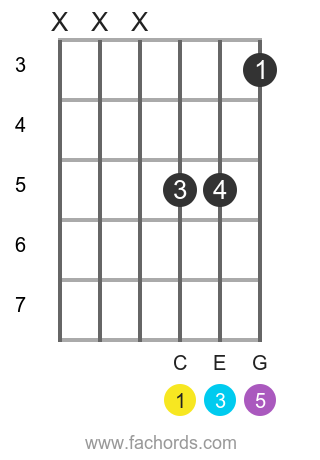
Position 6
Open
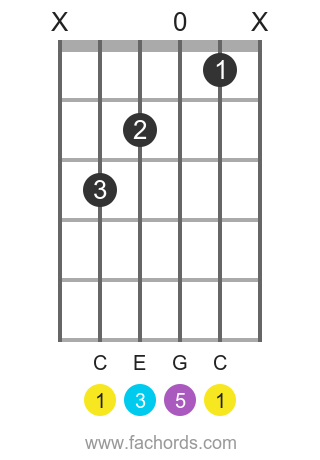
Position 7
Open
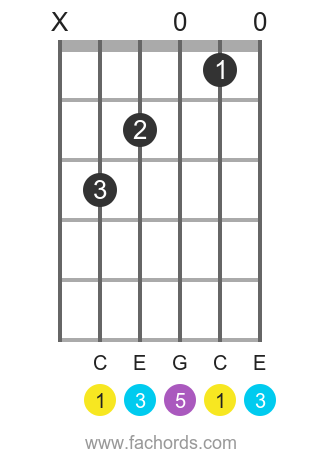
Position 8
Open
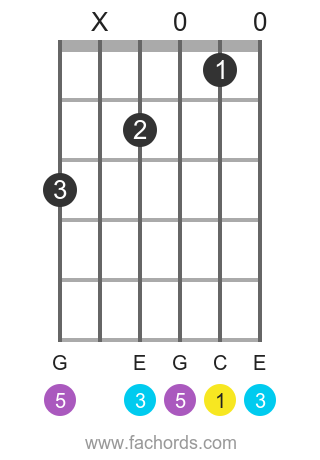
Position 9
Open
Position 10
Open
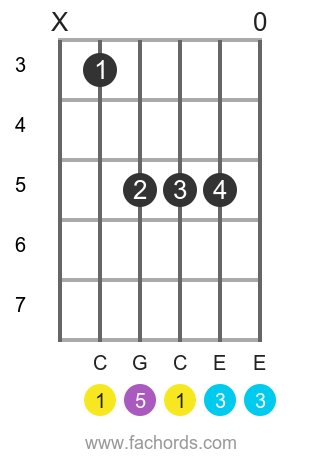
Position 11
Barre
Movable
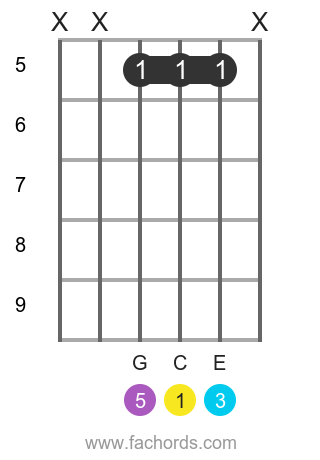
Position 12
Open
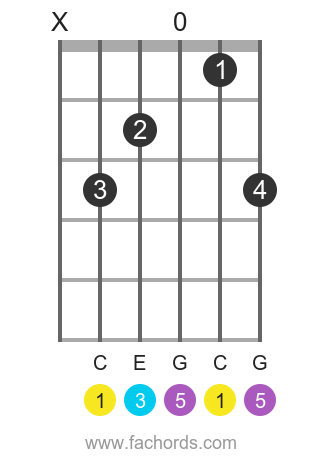
Position 13
Open
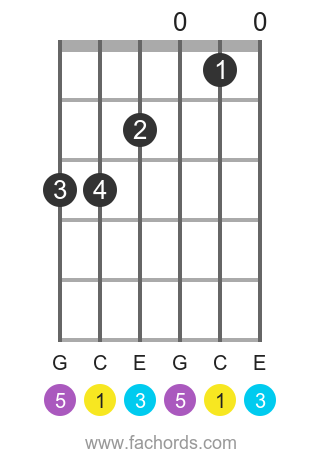
Position 14
Barre
Movable
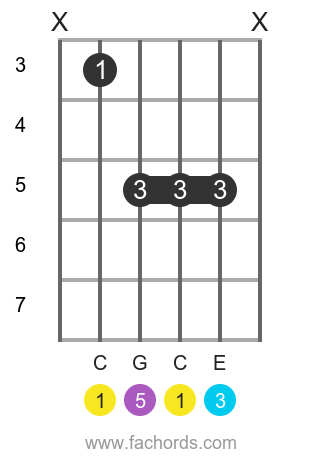
Position 15
Barre
Movable
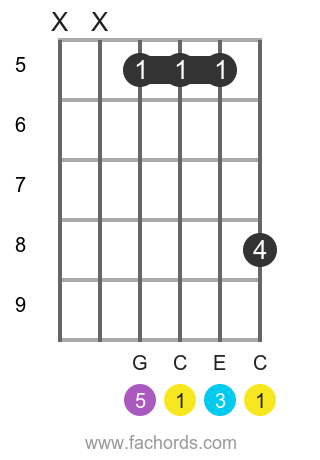
Position 16
Barre
Movable
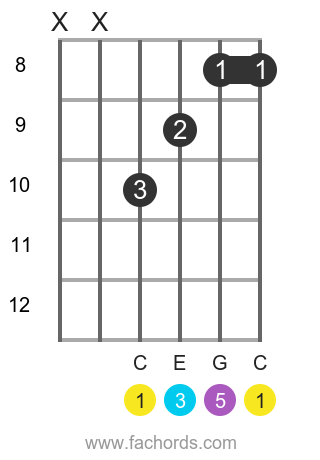
Position 17
Barre
Movable
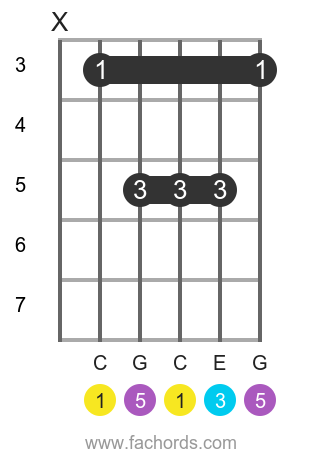
Position 18
Barre
Movable
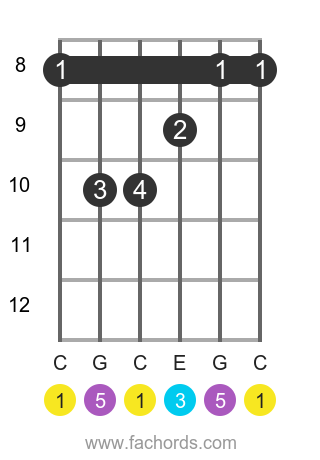
 Find more shapes in our all guitar chords online library. If you
prefer a printable pdf, download
the Free Guitar Chords Chart Pdf
Find more shapes in our all guitar chords online library. If you
prefer a printable pdf, download
the Free Guitar Chords Chart Pdf
You can also use this accessible Cmaj chord page, with written diagram instructions and screen-reader support for blind users.
FAQ
What specifically defines the C Major chord as 'major'?
The 'major' quality of the C Major chord, like all major chords, is determined by its specific intervallic structure. It consists of a root note, a major third above the root, and a perfect fifth above the root. For the C Major chord, these notes are C (root), E (major third), and G (perfect fifth).
How are the notes C, E, and G derived as the components of the C Major chord?
The notes C, E, and G are derived directly from the C Major scale. By taking the 1st (root), 3rd (major third), and 5th (perfect fifth) notes from the C Major scale (C D E F G A B C), you get C, E, and G, which form the C Major chord.
Why does the C Major chord appear in musical keys other than C Major?
The C Major chord is diatonic, meaning it naturally occurs within several musical keys, not just C Major. For example, it functions as the IV chord in the G Major key, the V chord in the F Major key, the VI chord in the E Minor key, and the III chord in the A Minor key. This happens because the notes C, E, and G are all present within the respective scales of those keys.
What types of scales are suitable for soloing or playing melodies over a C Major chord?
You can effectively play any scale over a C Major chord that contains its defining intervals: the major third (E) and the perfect fifth (G). Some excellent choices include the C Major scale, C Lydian scale, C Mixolydian scale, and the C Major Pentatonic scale.
Can you give examples of popular chord progressions that frequently use the C Major chord?
The C Major chord is a foundational element in many popular chord progressions. Some common examples include the 1-4-5 progression (C F G), the 1-6m-4-5 progression (C Am F G), and the 1-5-6m-4 progression (C G Am F).