G# maj Guitar Chord | Play, Hear and Practice Interactively
Want a structured chord roadmap instead of jumping between pages?
Go to the full guitar chords tutorial.
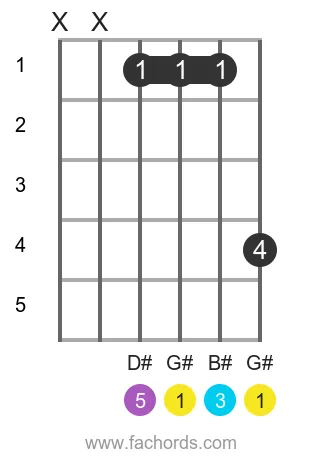
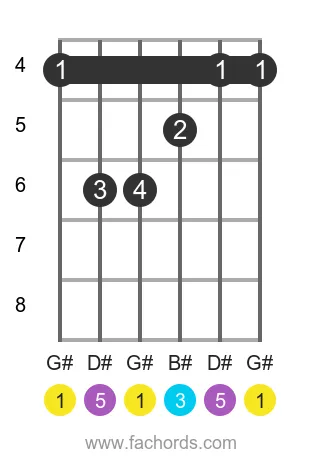
The G# maj chord, a member of the Major Chords family, is built from the notes G#, B#, and D#, representing the intervals Root (1), Major Third (3), and Perfect Fifth (5). Use the interactive fretboard tool at the top of this page to visualize countless shapes, hear the chord played as a strum or arpeggio, and get instant feedback on your playing with the real-time microphone feature.
As a fundamental major chord, the G# maj forms the backbone of countless songs, providing a bright and stable sound. Understanding how these notes combine is crucial; delve deeper into chord theory with our tutorial on Chord Construction. Many G# maj shapes are movable and require barre technique; our guide on Guitar Bar Chords can help you master them. Once you're comfortable with the fingerings, focus on making your transitions smooth with tips from Improve Chords Change.
Scroll down to discover numerous G# maj chord diagrams, ordered from the simplest open positions to more advanced movable shapes, alongside music theory insights, popular songs featuring this chord, and keys where it commonly appears. But before you explore the static diagrams, we encourage you to spend a few minutes with the interactive tool above. Strum the chord, listen closely, and let the real-time feedback guide your practice – it's the fastest way to embed the sound and feel of the G# maj chord into your muscle memory.
G# major guitar chord is also written as G#, G#maj, G#M or G#Δ.
G# maj chord Notes:
Chord Formula:
G# Maj Guitar Chord Diagrams
Position 1
Barre
Movable
Position 2
Barre
Movable
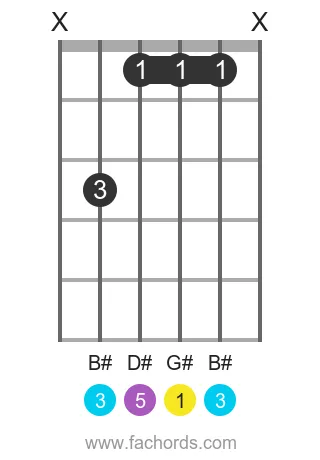
Position 3
Barre
Movable
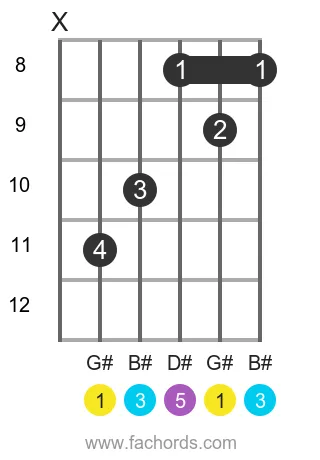
Position 4
Barre
Movable
 Find more shapes in our all guitar chords online library. If you
prefer a printable pdf, download
the Free Guitar Chords Chart Pdf
Find more shapes in our all guitar chords online library. If you
prefer a printable pdf, download
the Free Guitar Chords Chart Pdf
You can also use this accessible G#maj chord page, with written diagram instructions and screen-reader support for blind users.

Created by
Giancarlo is a musician (teaching guitar since 2000), software engineer, AI consultant and published researcher
FAQ
What specific notes form the G# Major chord?
The G# Major chord is precisely constructed from three notes: G#, B#, and D#. These notes are the fundamental building blocks of this particular chord.
What intervals are used to build the G# Major chord?
The G# Major chord is built using three specific intervals: the 1st (Root), the 3rd (Major Third), and the 5th (Perfect Fifth). In the case of G# Major, G# is the Root, B# is the Major Third, and D# is the Perfect Fifth.
Why are B# and D# used in the G# Major chord instead of C and E?
Using B# and D# specifically defines the correct theoretical intervals for a G# Major chord. B# represents the Major Third interval above G#, and D# represents the Perfect Fifth. This precise naming maintains the accurate musical relationship of the chord's construction.
How does the G# Major chord differ from other chord types like suspended or diminished?
The G# Major chord is categorized by its specific structure of a Root, Major Third, and Perfect Fifth. This distinct interval pattern differentiates it from other chord families, such as suspended chords (which alter or omit the third) or diminished chords (which have a different combination of minor thirds and diminished fifths).
What is the importance of mastering the G# Major chord for guitarists?
Mastering the G# Major chord is a vital step in a guitarist's development. It provides a foundational understanding that acts as a stepping stone, enabling you to progress more easily to learning advanced chords and complex chord progressions, ultimately enhancing your overall guitar skills.