Learn the Gdim Chord for Guitar: Theory & Application
Want a structured chord roadmap instead of jumping between pages?
Go to the full guitar chords tutorial.
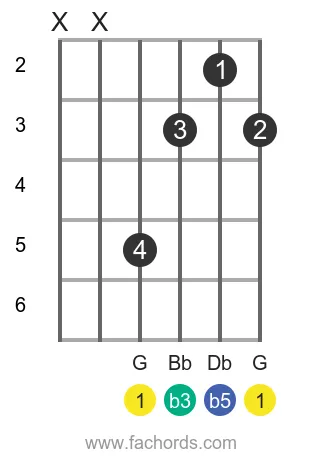
To truly understand the G dim chord, we begin by examining its fundamental construction. As a key member of the Diminished Chords family, this chord is precisely built from the notes G, Bb, and Db, corresponding to the intervals 1, b3, and b5 from its root. Grasping these intervals is crucial for mastering its unique sonic character. You can explore these relationships directly on our interactive virtual fretboard, using the chord playback feature to hear its sound. Our innovative mic feedback tool provides real-time verification of your accuracy as you play, ensuring your practice is always on point.
The inherent instability of diminished chords like the Gdim makes them powerful tools for creating tension and leading the listener to new harmonic territories. They often function as leading-tone chords, propelling the music forward. A deeper dive into the theory and application of these unique sonorities can be found in our comprehensive guide on Diminished Guitar Chords. Understanding their construction, as explained in our Chord Construction tutorial, is key to leveraging their full potential. Mastering smooth transitions into and out of such harmonically rich chords can also be enhanced by exploring tips on how to Improve Chords Change, allowing you to integrate them seamlessly into your playing.
Scroll down to find a range of Gdim chord diagrams, presented from the simplest to the more challenging voicings, along with detailed theoretical insights. Utilize the interactive fretboard above first to experiment with the chord in different keys and apply it to various songs. Consistent, disciplined practice with the visual and audio feedback provided will solidify your understanding and elevate your guitar skills.
G dim chord Notes:
Chord Structure:
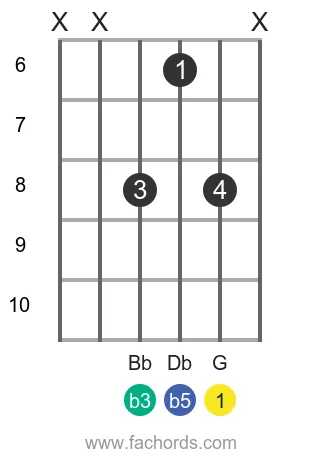
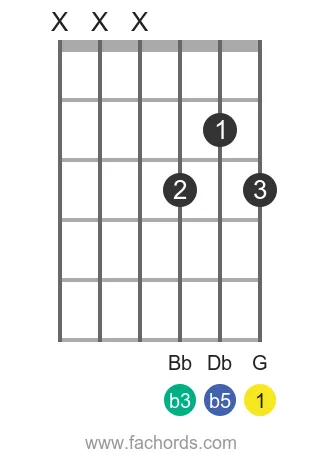
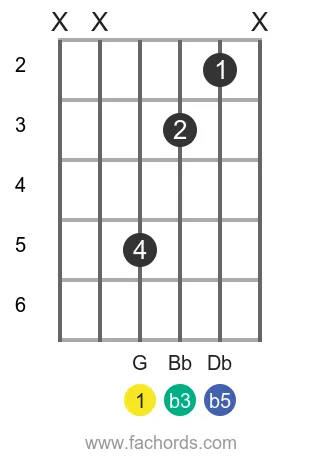
G Diminished Guitar Chord Fingers Positions
Position 1
Movable
Position 2
Movable
Position 3
Movable
Position 4
Movable
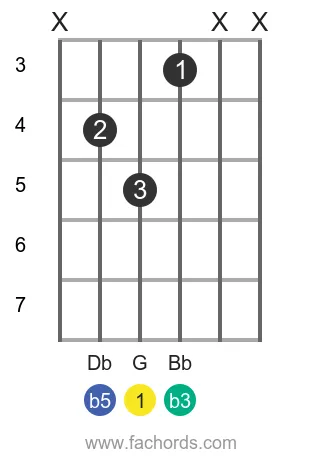
Position 5
Movable
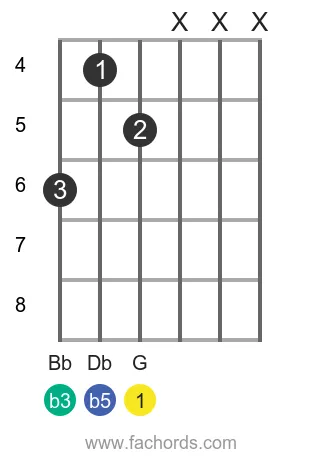
Position 6
Movable
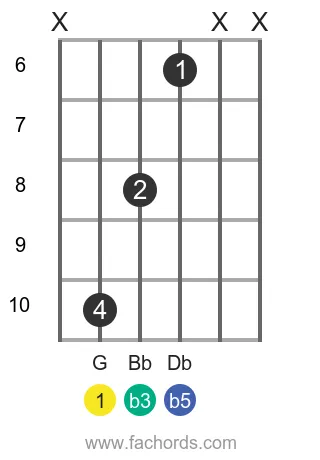
Position 7
Movable
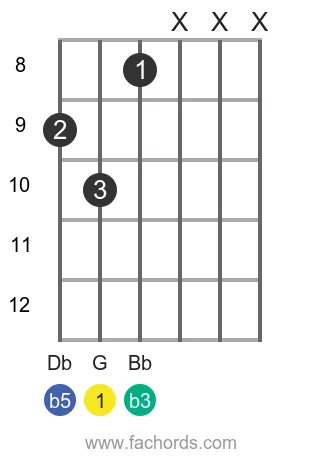
Position 8
Movable
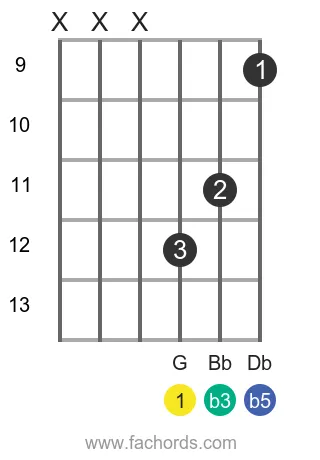
Position 9
Movable
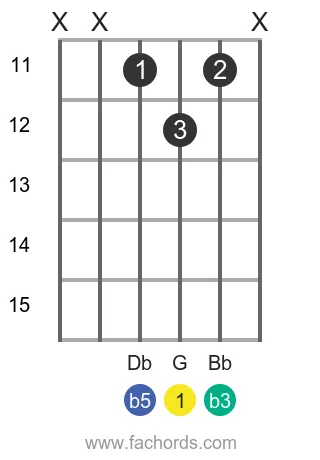
Position 10
Movable
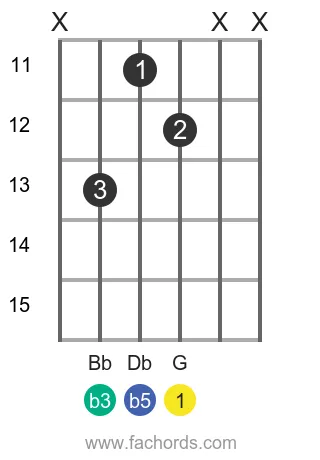
Position 11
Movable
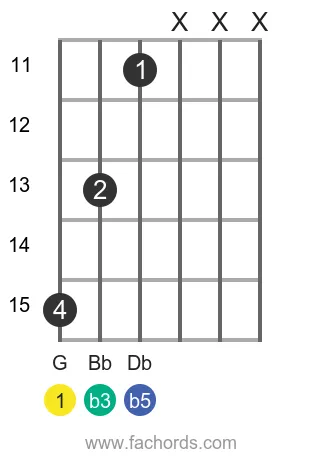
Position 12
Movable
Position 13
Movable
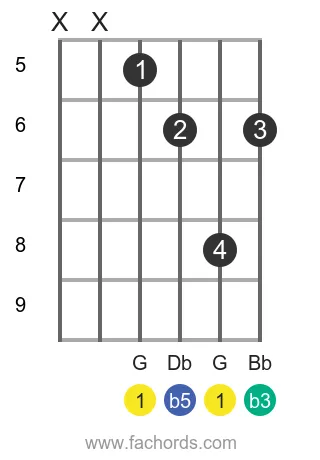
Position 14
Movable
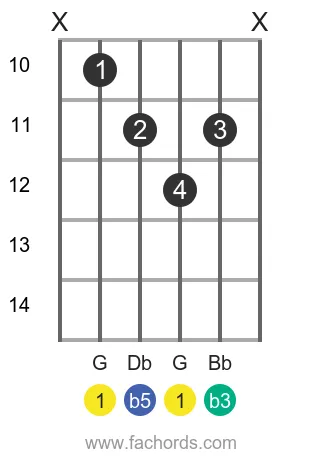
Position 15
Barre
Movable
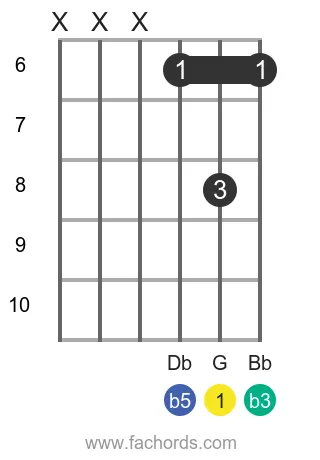
 Find more shapes in our all guitar chords online library. If you
prefer a printable pdf, download
the Free Guitar Chords Chart Pdf
Find more shapes in our all guitar chords online library. If you
prefer a printable pdf, download
the Free Guitar Chords Chart Pdf
You can also use this accessible Gdim chord page, with written diagram instructions and screen-reader support for blind users.

Created by
Giancarlo is a musician (teaching guitar since 2000), software engineer, AI consultant and published researcher
FAQ
What are the specific notes that make up the G dim chord?
The G dim chord is formed by three specific notes: G, Bb (B-flat), and Db (D-flat). These notes are derived from the root, minor third (b3), and diminished fifth (b5) intervals, respectively.
What do the intervals 1, b3, and b5 signify in the context of the G dim chord?
For the G dim chord, '1' represents the root note, which is G. 'b3' indicates a minor third interval above the root, which is Bb. 'b5' means a diminished fifth interval above the root, which is Db. These three intervals define the unique structure and sound of any diminished chord.
What gives the G dim chord its 'unique tonal quality'?
The G dim chord, like all diminished chords, gets its unique tonal quality from its specific interval structure: a root, a minor third (b3), and a diminished fifth (b5). This combination of intervals, particularly the diminished fifth, creates a characteristic sound that adds depth and complexity to music.
How does the G dim chord fit into the broader 'Diminished Chords' family?
The G dim chord is a prime example of the Diminished Chords family. All chords within this family share the same fundamental interval structure of a root, a minor third (b3), and a diminished fifth (b5). The G dim chord is simply a diminished chord built with G as its root note, exhibiting the characteristic unique tonal quality common to all diminished chords.