G# 7sus4 Guitar Chord
Chord Diagrams, Interactive Fretboard and Chord Theory
G# dominant 7th suspended 4th guitar chord is also written as G#7sus4, G#7sus or G#7(sus4).
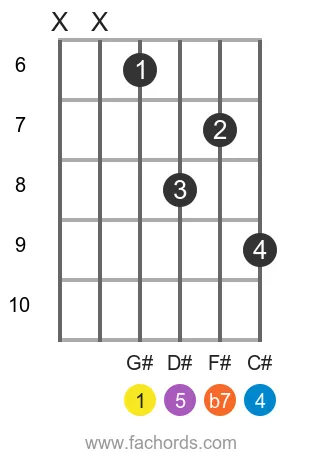
Position 1
Movable
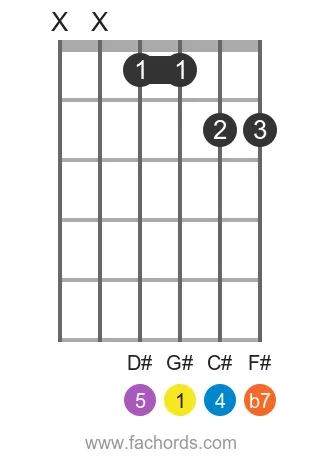
Position 2
Barre
Movable
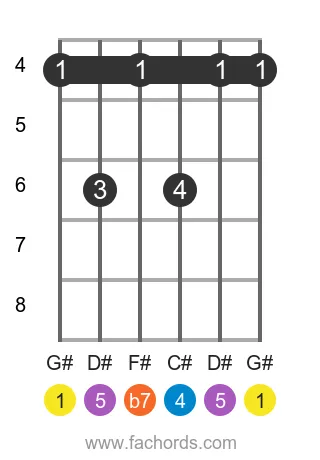
Position 3
Barre
Movable
 Find more shapes in our all guitar chords online library. If you
prefer a printable pdf, download
the Free Guitar Chords Chart Pdf
Find more shapes in our all guitar chords online library. If you
prefer a printable pdf, download
the Free Guitar Chords Chart Pdf
You can also use this accessible G#7sus4 chord page, with written diagram instructions and screen-reader support for blind users.
G#7sus4 Guitar Chord | Play, Hear and Practice Interactively
Want a structured chord roadmap instead of jumping between pages?
Go to the full guitar chords tutorial.
The G#7sus4 chord is a fascinating part of the suspended chords family, creating a rich sound by replacing the third with a perfect fourth. This dominant chord is composed of the notes G#, C#, D#, and F#, built from the intervals Root (1), Perfect Fourth (4), Perfect Fifth (5), and Minor Seventh (b7). Use the interactive fretboard tool at the top of this page to visualize every fingering, listen to the chord played as a strum or arpeggio, and check your own playing with the real-time microphone feedback – the tool will tell you if you're nailing it.
The unique combination of tones in the G#7sus4 chord provides a certain tension and release, creating interesting dynamics often found in dominant chord progressions. To dive deeper into the theory of how chords are built by stacking intervals, explore our Chord Construction tutorial. Understanding how to use this chord's characteristic tension is key, and our guide on Suspended Chords will illuminate its role. Since it's also a dominant chord, you can learn more about its function in music by checking out our Dominant Chord tutorial. For smooth playing, improving your chord changes will make a big difference.
Scroll down this page to discover a wealth of resources, including chord diagrams ranked from easiest open positions to more challenging forms, in-depth music theory explanations, songs that feature the G#7sus4 chord, and the various keys where it shines. Before you explore the diagrams, spend a few moments with the interactive tool above. Set a comfortable BPM with the drum tool, strum the chord, and let the mic feedback confirm your finger placement and accuracy. This hands-on, real-time practice is the fastest and most effective way to truly master the G#7sus4 chord.
G# 7sus4 chord Notes:
How the Dominant Seventh Suspended Fourth chord is built:
Play This Chord With Other Roots
C 7sus4 | D 7sus4 | E 7sus4 | F 7sus4 | G 7sus4 | A 7sus4 | B 7sus4 | C#7sus4 | D#7sus4 | F#7sus4 | G#7sus4 | A#7sus4 | Ab7sus4 | Bb7sus4 | Db7sus4 | Eb7sus4 | Gb7sus4

Created by
Giancarlo is a musician (teaching guitar since 2000), software engineer, AI consultant and published researcher
FAQ
What does 'sus4' mean in the G#7sus4 chord name?
The 'sus4' in G#7sus4 indicates that the third of the chord has been replaced by a perfect fourth. This alteration creates a distinctive 'suspended' sound, characterized by tension that often seeks resolution.
What notes make up the G#7sus4 chord?
The G#7sus4 chord is composed of four specific notes: G#, C#, D#, and F#. These notes are derived from its interval structure built upon the root note G#.
How are the intervals 1, 4, 5, and b7 applied to form the G#7sus4 chord?
Starting from the root note G#, these intervals stack up to create the chord: the '1' is the Root (G#), the '4' is the Perfect Fourth (C#), the '5' is the Perfect Fifth (D#), and the 'b7' is the Minor Seventh (F#). This specific combination of intervals defines the G#7sus4 chord.
What is the musical function or purpose of the G#7sus4 chord?
The G#7sus4 is a dominant chord, meaning its primary function is to create tension and a sense of expectation that naturally leads to a resolution. It provides a unique rich and harmonious sound, often used in chord progressions to pull strongly towards the tonic or root chord of a key.
What is the key difference between a G#7sus4 chord and a standard G#7 chord?
The key difference lies in the third of the chord. A standard G#7 chord contains a major third, while the G#7sus4 chord replaces this third with a perfect fourth. This change removes the major/minor quality typically defined by the third, creating the characteristic 'suspended' tension of the sus4 chord.