Mastering D Minor Chord: An Interactive Guitar Guide
Want a structured chord roadmap instead of jumping between pages?
Go to the full guitar chords tutorial.
The D minor (Dm) chord is fundamentally constructed from the intervals 1 (Root), b3 (Minor Third), and 5 (Perfect Fifth). This essential member of the Minor Chords family comprises the notes D, F, and A, giving it its distinct melancholic character. To truly grasp its harmonic structure, engage with our interactive virtual fretboard, which allows for visual exploration and playback of this chord. You can even receive instant verification of your accuracy using the built-in mic feedback feature, ensuring your practice is always precise.
As a minor chord, the D minor naturally evokes a sense of introspection, sadness, or intensity, making it a foundational element in countless songs across various genres. Understanding how such chords are built can deepen your musical insight. We delve into the theory of chord formation in our dedicated guide on Chord Construction. For guitarists aiming to refine their playing, focusing on smooth transitions is key, and our tips on how to Improve Chords Change will prove invaluable as you integrate D minor into your repertoire.
To facilitate your disciplined practice, we provide a range of chord diagrams, organized from the easiest to the more challenging voicings. Explore the practical applications of D minor through various songs and discover its role in different musical keys. Before diving into static charts, we encourage you to utilize the interactive fretboard and its playback feature to internalize the sound and feel of the chord. This systematic approach, blending theory with hands-on engagement, is crucial for true mastery.
Notes in the D m chord:
How the Minor chord is built:
The D Minor Chord | Keys, Fingerings and Progressions
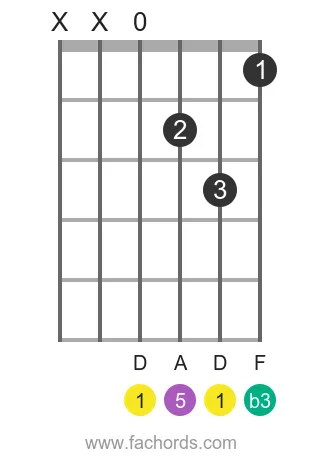
The standard way to play the D minor chord is a 3 finger shape with the open D string
Finger Placement:
- Index finger: 1st fret of the high E (1st) string.
- Middle finger: 2nd fret of the G (3rd) string.
- Ring finger: 3rd fret of the B (2nd) string.
Strum from the D (4th) string down to the high E (1st) string.
It's important to avoid playing the A (5th) and low E (6th) strings.

Keys With The D Minor Chord
C Major Key
The most common place in which you'll find the D minor chord is the C major scale.
Here the D minor is at the 2nd degree, acting as supertonic.
| Key | I | ii | iii | IV | V | vi | vii |
|---|---|---|---|---|---|---|---|
| C | C | Dm | Em | F | G | Am | B dim |
F Major Key
In the F Major key, Dm is the relative minor, placed at 6th degree.
| Key | I | ii | iii | IV | V | vi | vii |
|---|---|---|---|---|---|---|---|
| F | F | Gm | Am | Bb | C | Dm | E dim |
Bb Major Key
The B-flat major is among the most popular keys for concert bands, that include instruments like the clarinet, saxophone, and soprano trumpet.
It's rarely used on guitar, anyway the Dm is located at the 3rd degree of this key.
| Key | I | ii | iii | IV | V | vi | vii |
|---|---|---|---|---|---|---|---|
| Bb | Bb | Cm | Dm | Eb | F | Gm | A dim |
A Minor Key
This is a great key to play the D minor chord. In fact, the minor version of the 1-4-5 progression, is Am, Dm and Em.
Give it a try to fell how it sounds cool!
| Key | i | ii | III | iv | v | VI | VII |
|---|---|---|---|---|---|---|---|
| A | Am | B dim | C | Dm | Em | F | G |
G Minor Key
In the G minor key the D m chord act as dominant. Try again the 1-4-5 progression, which is Gm, Cm and Dm in this case.
| Key | i | ii | III | iv | v | VI | VII |
|---|---|---|---|---|---|---|---|
| G | Gm | A dim | Bb | Cm | Dm | Eb | F |
Popular Progressions With The D Minor Chord
The Dm chord is present in many songs and progressions, here a list of cool sequences you can try:
- i-iv-VII: Dm, Gm and C, in the key of D minor
- i-iv-V: Dm, Gm, A, in the key of D minor
- I-vi-ii-V: C, Am, Dm, G, in the key of C major
You find more chord progressions in all keys in my complete ebook 52 Chord Progressions | Learn How To Connect Chords and Create Great Songs.
D Minor Guitar Chord Voicings
Position 1
Movable
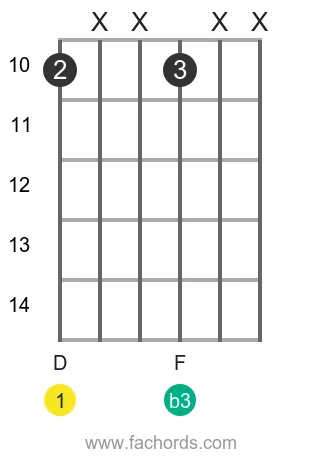
Position 2
Movable
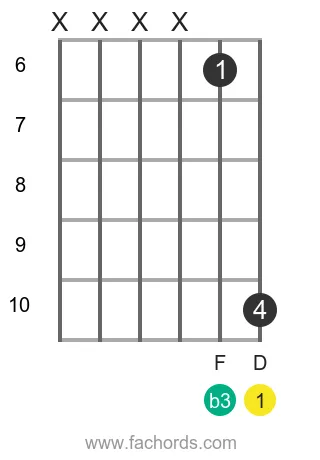
Position 3
Open
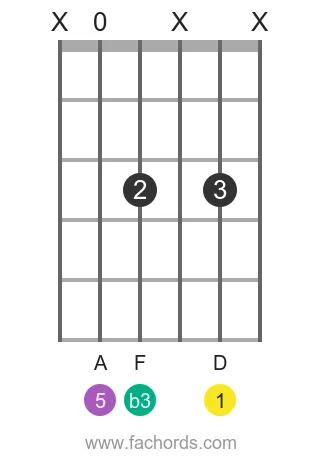
Position 4
Movable
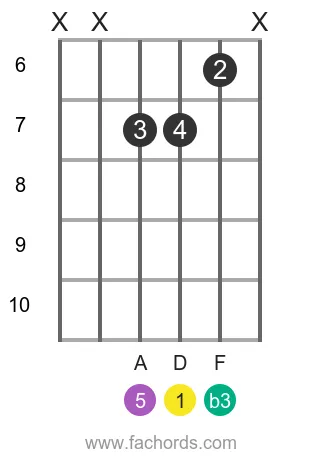
Position 5
Movable
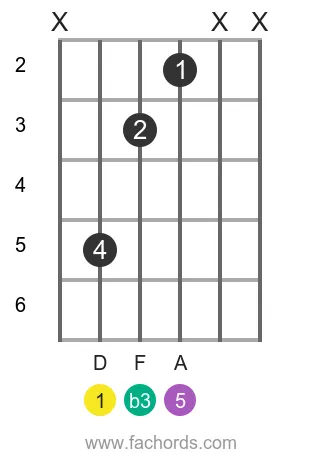
Position 6
Movable
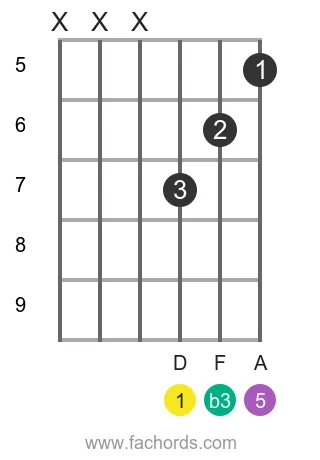
Position 7
Open
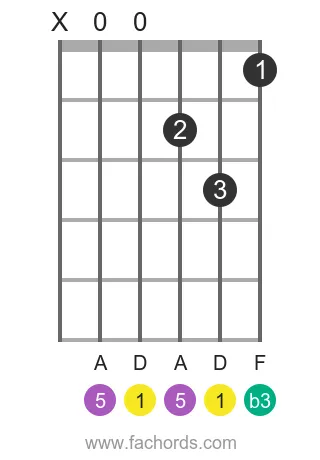
Position 8
Open
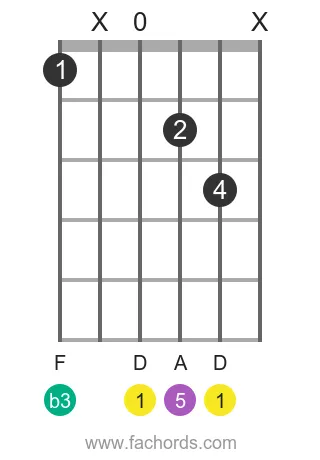
Position 9
Open
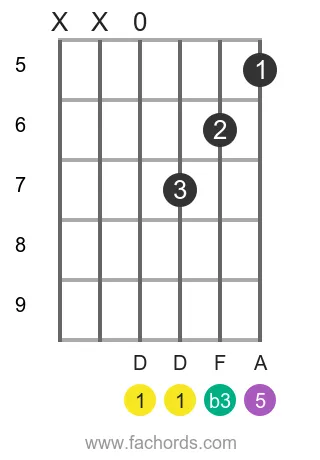
Position 10
Open
Position 11
Movable
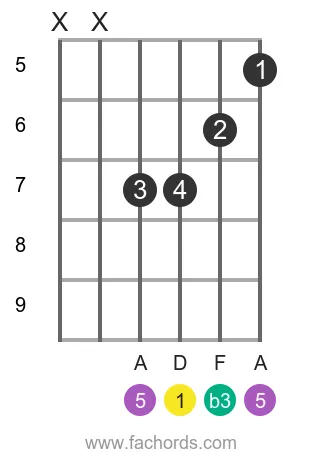
Position 12
Movable
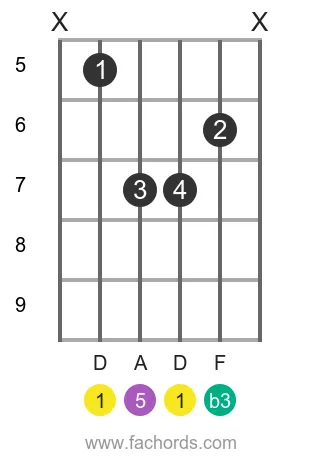
Position 13
Barre
Open
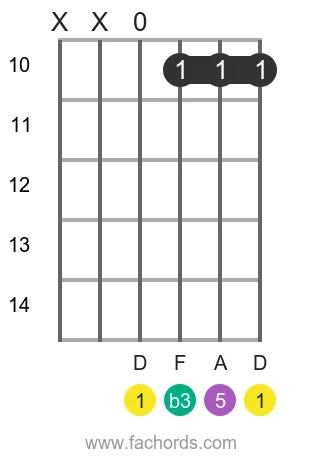
Position 14
Barre
Open
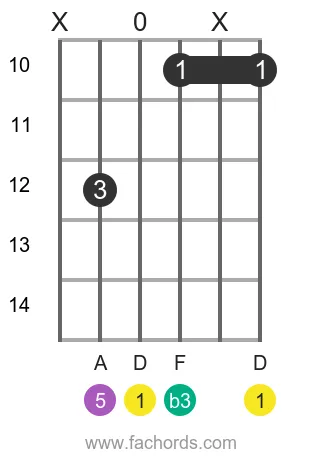
Position 15
Barre
Movable
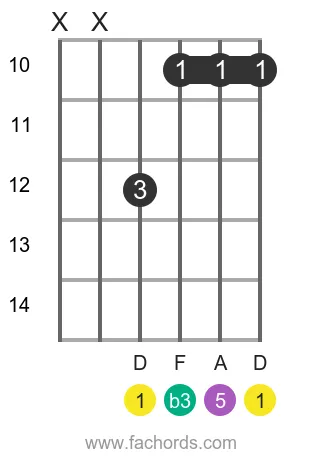
Position 16
Barre
Movable
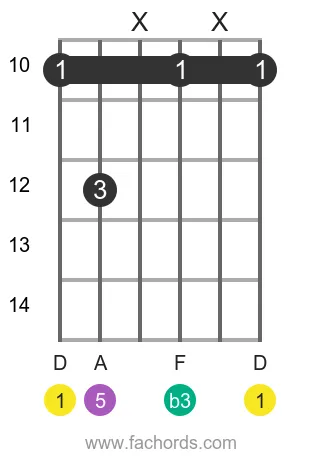
Position 17
Barre
Movable
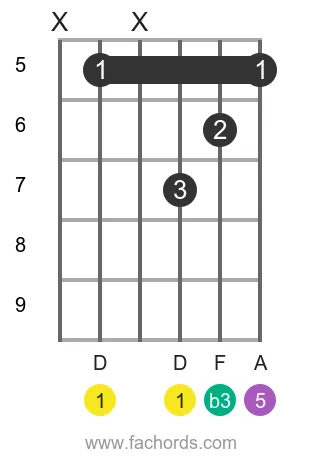
Position 18
Barre
Movable
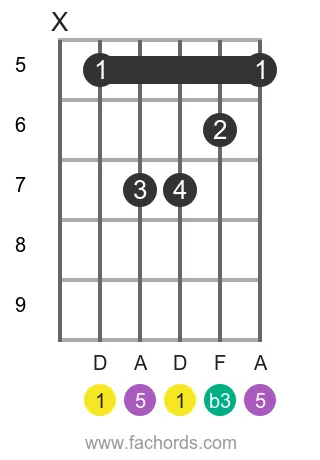
Position 19
Barre
Movable
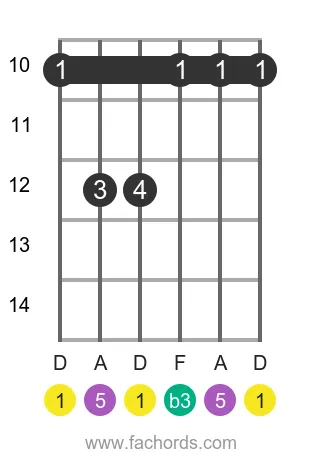
 Find more shapes in our all guitar chords online library. If you
prefer a printable pdf, download
the Free Guitar Chords Chart Pdf
Find more shapes in our all guitar chords online library. If you
prefer a printable pdf, download
the Free Guitar Chords Chart Pdf
You can also use this accessible Dm chord page, with written diagram instructions and screen-reader support for blind users.
FAQ
What notes and intervals make up the D minor (Dm) chord?
The D minor chord is composed of the notes D, F, and A. These correspond to the intervals of the 1 (Root), b3 (Minor Third), and 5 (Perfect Fifth) respectively, which define its minor quality.
How do I finger the standard D minor chord on the guitar?
To play the standard D minor chord, place your index finger on the 1st fret of the high E (1st) string, your middle finger on the 2nd fret of the G (3rd) string, and your ring finger on the 3rd fret of the B (2nd) string. The open D (4th) string is also played.
Which strings should I strum when playing the D minor chord?
When playing the standard D minor chord, you should strum from the D (4th) string down to the high E (1st) string. It is important to avoid playing the A (5th) and low E (6th) strings to ensure the chord sounds clear.
Why does the D minor chord sound melancholic or intense?
The melancholic or intense atmosphere of the D minor chord is primarily due to the presence of the minor third (b3) interval. This specific interval relationship between the root (D) and the third (F) creates the characteristic minor quality.
In what common major and minor keys is the D minor chord typically found?
The D minor chord is a common chord found in several keys. It functions as the ii chord in C Major, the vi chord (relative minor) in F Major, the iii chord in Bb Major, the iv chord in A Minor, and the v chord (dominant) in G Minor.
What are some popular chord progressions that include the D minor chord?
Some popular chord progressions featuring the D minor chord are: i-iv-VII (Dm, Gm, C) in the key of D minor, i-iv-V (Dm, Gm, A) also in D minor, and I-vi-ii-V (C, Am, Dm, G) in the key of C major.
