Explore D7sus4 Chord for Guitar with Interactive Tools
Want a structured chord roadmap instead of jumping between pages?
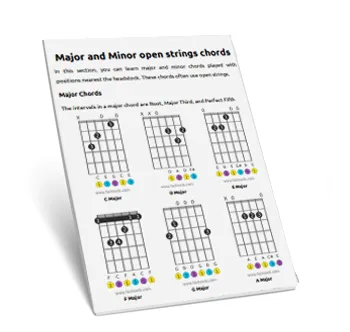
Download the step-by-step Guitar Chord Ebook
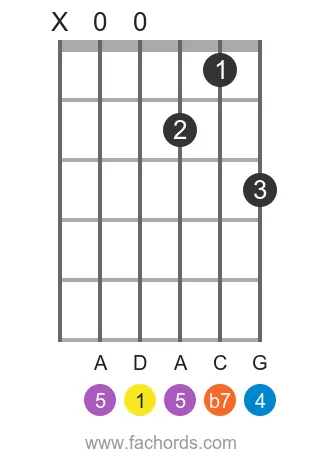
Dive into the evocative sound of the D7sus4 chord, a versatile suspended dominant chord often found adding a unique, unresolved tension in jazz, fusion, and even rock. This chord is built from the notes D, G, A, and C, corresponding to the intervals 1, 4, 5, and b7 (Root, Perfect Fourth, Perfect Fifth, and Minor Seventh). Our interactive fretboard acts as your personal exploration lab; play along with the chord's arpeggio playback or a full chord, and get instant feedback on your accuracy through your microphone, ensuring you hit every note perfectly.
The D7sus4 is a fascinating member of the suspended chords family, characterized by the absence of a major or minor third, which lends it an open and often ethereal quality. Instead of the third, a perfect fourth is present, creating that distinctive 'suspended' tension. The inclusion of the minor seventh interval also classifies it as a type of dominant chord, giving it a strong pull towards resolution, despite its suspended nature. To delve deeper into how these elements combine, explore our comprehensive guide on chord construction.
Before delving into the theoretical intricacies or exploring chord diagrams (ranked from easiest to most challenging), we encourage you to first experiment with the interactive tool above. Get a feel for the D7sus4 chord, try out different fretboard patterns, and hear how it sounds in various keys. This hands-on approach will prepare you to apply this knowledge to your songwriting and playing, allowing you to incorporate its unique voice into your own songs.
D 7sus4 chord Notes:
Tones in the Dominant Seventh Suspended Fourth chord:
D Dominant Seventh Suspended Fourth Guitar Chord Diagrams
Position 1
Open
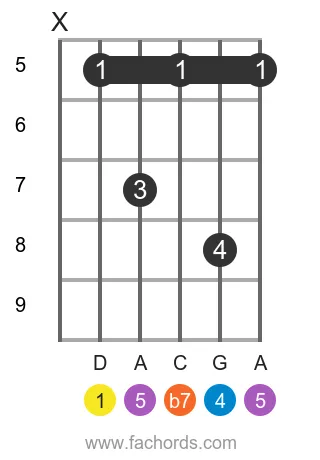
Position 2
Barre
Movable
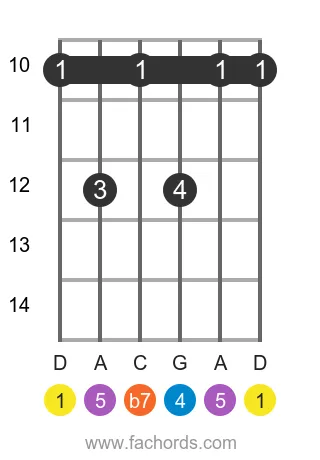
Position 3
Barre
Movable
 Find more shapes in our all guitar chords online library. If you
prefer a printable pdf, download
the Free Guitar Chords Chart Pdf
Find more shapes in our all guitar chords online library. If you
prefer a printable pdf, download
the Free Guitar Chords Chart Pdf
You can also use this accessible D7sus4 chord page, with written diagram instructions and screen-reader support for blind users.
FAQ
What defines the D7sus4 chord as a 'suspended' chord?
The D7sus4 chord is defined as a suspended chord because it omits the major or minor third interval, which is typically found in standard chords. Instead, it features a perfect fourth above the root, which gives it an open and often 'unresolved' sound.
What are the specific notes and intervals that make up the D7sus4 chord?
The D7sus4 chord is composed of the notes D, G, A, and C. These notes correspond to the intervals of the Root (D), Perfect Fourth (G), Perfect Fifth (A), and Minor Seventh (C) relative to the root note D.
How can the D7sus4 chord be both a suspended chord and a dominant chord?
The D7sus4 is considered a suspended chord because it replaces the third with a perfect fourth, creating its characteristic open sound. It is also classified as a type of dominant chord due to the presence of the minor seventh (b7) interval, which creates a strong harmonic pull typically associated with dominant functions.
What does the 'b7' interval signify in the D7sus4 chord?
The 'b7' in D7sus4 stands for a minor seventh interval. This means that the seventh note of the major scale (which would be a major seventh) is lowered by a half step. In the key of D, a major seventh would be C#, but for D7sus4, it is C (a minor seventh), contributing to the chord's dominant quality.
What kind of sound or musical effect does the D7sus4 chord typically create?
The D7sus4 chord typically produces an open, often 'unresolved' sound due to the absence of a major or minor third. This creates a sense of tension and expectation, especially with the added dominant pull from the minor seventh. It often leads musically to another chord, providing a feeling of forward motion.