Practice D#7sus4 Guitar Chord with Interactive Tools
Want a structured chord roadmap instead of jumping between pages?
Go to the full guitar chords tutorial.
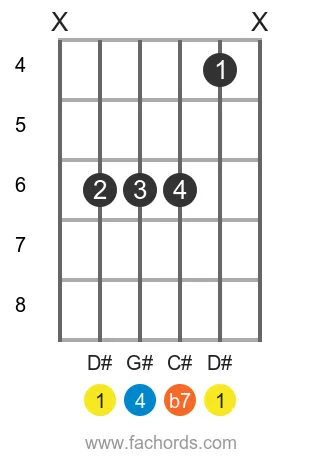
Ready to tackle the D#7sus4 chord? Jump straight into our interactive fretboard and test your accuracy! Our real-time mic feedback listens as you play, guiding you to perfect your finger placement for this unique suspended chord. The D#7sus4 replaces the typical third with a perfect fourth, creating its distinct sound from the notes D#, G#, A#, and C#. These correspond to the intervals Root (1), Perfect Fourth (4), Perfect Fifth (5), and Minor Seventh (b7). Challenge yourself with this distinctive harmony.
Understanding the intervals and unique construction of suspended chords like the D#7sus4 is key to mastering their sound and application. This chord, with its suspended fourth, delays the resolution often found in dominant chords, creating a sense of lingering tension. Dive deeper into the concept of Suspended Chords to grasp their theoretical foundation. For a broader understanding of how chords are built, explore our comprehensive Chord Construction tutorial. If you're looking to play more smoothly, check out our guide on how to Improve Chords Change, which will help you integrate new shapes like the D#7sus4 seamlessly into your playing.
Below, you'll find comprehensive resources including chord diagrams, arranged from easy open positions to more advanced shapes, detailed music theory, popular songs that feature the D#7sus4, and the keys where this chord commonly appears. Before you dig into these resources, we challenge you to spend some quality time with the interactive tool above. Use the drum and BPM tool to set your tempo, play the chord, and let the real-time mic feedback confirm your accuracy. This disciplined, hands-on approach is the most effective way to integrate new chords into your repertoire.
Notes that compose the D# 7sus4 chord:
Tones in the Dominant Seventh Suspended Fourth chord:
D# Dominant Seventh Suspended Fourth Guitar Chord Fingers Positions
Position 1
Movable
Position 2
Barre
Movable
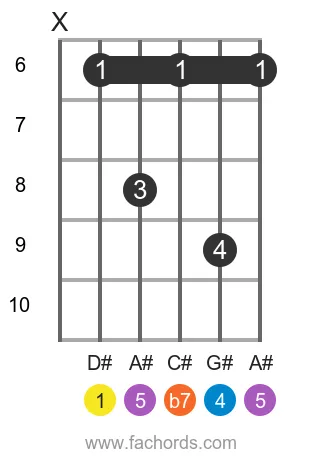
Position 3
Barre
Movable
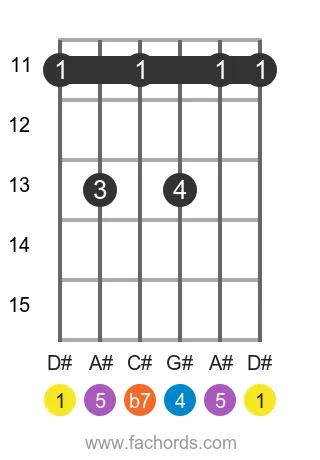
 Find more shapes in our all guitar chords online library. If you
prefer a printable pdf, download
the Free Guitar Chords Chart Pdf
Find more shapes in our all guitar chords online library. If you
prefer a printable pdf, download
the Free Guitar Chords Chart Pdf
You can also use this accessible D#7sus4 chord page, with written diagram instructions and screen-reader support for blind users.

FAQ
What are the specific notes that make up the D#7sus4 chord?
The D#7sus4 chord is constructed from the notes D#, G#, A#, and C#. D# serves as the root, G# is the perfect fourth, A# is the perfect fifth, and C# is the minor seventh.
Why is the D#7sus4 considered a 'suspended' chord?
The D#7sus4 is a suspended chord because it does not contain a major or minor third. Instead, the third is replaced by a perfect fourth (G# in this case), giving the chord a unique, often unresolved, or 'suspended' sound.
What do the 'sus4' and '7' components signify in the D#7sus4 chord name?
In the D#7sus4 chord, 'sus4' indicates that the third of the chord has been suspended and replaced by a perfect fourth. The '7' denotes the inclusion of a minor seventh interval in the chord structure.
What are the musical intervals that define the D#7sus4 chord structure?
The D#7sus4 chord is built using the intervals of a Root (1), a Perfect Fourth (4), a Perfect Fifth (5), and a Minor Seventh (b7). These intervals are crucial for understanding its unique sound and fretboard placement.
How does the D#7sus4 chord's sound differ from basic major or minor chords?
The D#7sus4 chord produces a distinct sonic color compared to basic major or minor chords because it lacks a major or minor third. This absence creates an open, often ambiguous or 'hanging' quality, which is neither definitively happy nor sad, adding unique flavor to your playing.
What skill level is typically recommended for learning the D#7sus4 chord?
The D#7sus4 chord is generally considered suitable for intermediate guitar playing. Its construction involves understanding intervals beyond basic major and minor triads, making it more complex than foundational chords.
