Bb aug Guitar Chord | Play, Hear and Practice Interactively
Want a structured chord roadmap instead of jumping between pages?
Go to the full guitar chords tutorial.
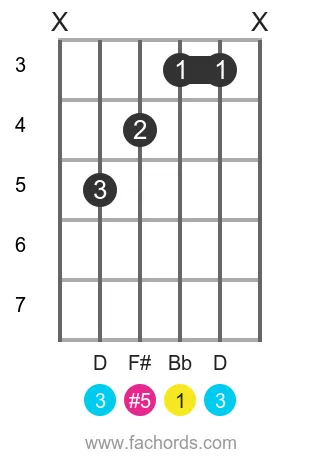
The Bb aug chord, a unique member of the Augmented Chords family, is constructed from the notes Bb, D, and F#. These correspond to the musical intervals of Root (1), Major Third (3), and Augmented Fifth (#5). Use the interactive fretboard tool at the top of this page to visually explore every possible fingering, listen to the chord as a strum or arpeggio, and get instant guidance on your playing with real-time microphone feedback — the tool will help you nail it.
The symmetrical structure of the Bb aug chord means its inversions are also augmented chords, offering intriguing harmonic possibilities. To delve deeper into the theory behind this fascinating chord structure, explore our guide on Chord Construction. Understanding how these intervals create its distinct, tension-filled sound is key. Practicing your chord changes will help you integrate it smoothly into your playing, and for a full grasp of its symmetrical nature, review our tutorial on Understanding Chord Inversions.
Below, you'll find various Bb aug chord diagrams, ranging from easy open positions to full barre shapes, along with insightful music theory, popular songs that feature this chord, and the keys where it commonly appears. Before you dive into the static diagrams, we encourage you to spend a few minutes with the interactive tool above. Set your tempo with the drum and BPM tool, strum the chord, and let the mic feedback confirm your finger placement. This hands-on approach is the most effective way to truly learn and internalize this unique chord.
Bb augmented guitar chord is also written as Bbaug, Bb+, Bb(#5) or Bbmaj(#5).
Notes that compose the Bb aug chord:
How to create the Augmented Fifth chord:
Bb Aug Guitar Chord Diagrams
Position 1 Movable
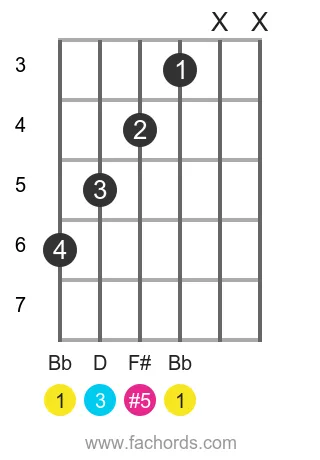
Finger Positions
- Mute the B string
- Mute the high E string
- Place your index finger (1) on the fret 3 of the G string
- Place your middle finger (2) on the fret 4 of the D string
- Place your ring finger (3) on the fret 5 of the A string
- Place your pinky finger (4) on the fret 6 of the low E string
Position 2 Movable
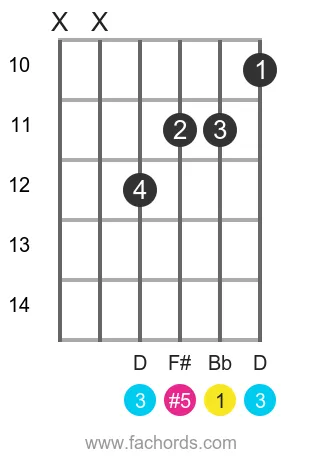
Finger Positions
- Mute the low E string
- Mute the A string
- Place your index finger (1) on the fret 10 of the high E string
- Place your middle finger (2) on the fret 11 of the G string
- Place your ring finger (3) on the fret 11 of the B string
- Place your pinky finger (4) on the fret 12 of the D string
Position 3 Barre Movable
Finger Positions
- Mute the low E string
- Mute the high E string
- Place your index finger (1) on the fret 3 of the G and B strings at the same time
- Place your middle finger (2) on the fret 4 of the D string
- Place your ring finger (3) on the fret 5 of the A string
 Find more shapes in our all guitar chords online library. If you
prefer a printable pdf, download
the Free Guitar Chords Chart Pdf

Created by
Giancarlo is a musician (teaching guitar since 2000), software engineer, AI consultant and published researcher
FAQ
What specifically defines the Bb aug chord as an 'augmented chord'?
The Bb aug chord belongs to the family of Augmented Chords because of its unique interval structure. It is built using a Root, a Major Third, and specifically an Augmented Fifth (1, 3, #5). This augmented fifth interval is what gives the chord its characteristic 'augmented' quality.
What are the exact notes that make up the Bb aug chord?
The Bb aug chord is composed of three specific notes: Bb (the root note), D (which is the major third above Bb), and F# (which is the augmented fifth above Bb). Together, these notes create the full sound of the Bb augmented chord.
What does '#5' mean when describing the intervals of the Bb aug chord?
The '#5' in the Bb aug chord's intervals (1, 3, #5) stands for an 'Augmented Fifth'. This means that the natural or perfect fifth degree from the root note (which would be F for Bb) has been raised by a half-step, becoming F#. This raised fifth is a defining characteristic of all augmented chords.
What kind of sound should I expect from the Bb aug chord?
The Bb aug chord, like other augmented chords, is known for its 'rich and full sound.' It often conveys a sense of tension, brightness, or a dreamy quality that can feel unresolved, distinct from the more stable sounds of major or minor chords. This unique sound makes it useful for adding color or leading into other chords.