A7sus4 Guitar Chord | Play, Hear and Practice Interactively
Want a structured chord roadmap instead of jumping between pages?
Go to the full guitar chords tutorial.
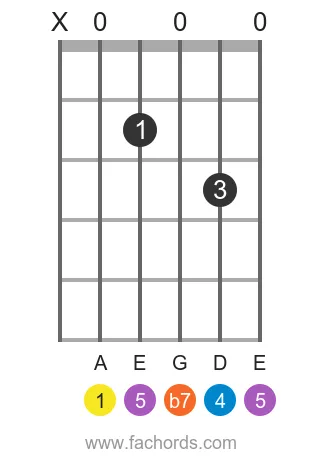
The A7sus4 chord is a fascinating member of the suspended chords family, unique for its lack of a third. It is composed of the notes A, D, E, and G, corresponding to the intervals Root (1), Perfect Fourth (4), Perfect Fifth (5), and Minor Seventh (b7). Use the interactive virtual fretboard tool at the top of this page to visualize every fingering, listen to the chord played as a strum or arpeggio, and perfect your technique with real-time microphone feedback – the tool will highlight any missed notes.
The A7sus4 offers a unique, open sound due to its suspended fourth, and as a type of dominant chord, it carries a strong sense of tension ready for resolution. To fully grasp how these intervals create this distinctive sound, deepen your understanding with our Chord Construction tutorial. Discover more about its characteristic sound and usage in our guide to Suspended Chords, and explore its role within the larger family of Dominant Chords.
Below, you'll discover comprehensive resources including multiple chord diagrams, ordered from the simplest open positions to more advanced movable shapes, alongside in-depth music theory explanations, popular songs featuring the A7sus4, and the musical keys where it commonly appears. Before you dive into the diagrams, make sure to spend some time with the interactive tool above. Use the drum and BPM practice tool to set your rhythm, strum the chord, and let the real-time feedback guide your hands. This active practice loop is the most effective way to internalize new chords quickly.
A dominant 7th suspended 4th guitar chord is also written as A7sus4, A7sus or A7(sus4).
Notes of the A 7sus4 chord:
Tones of the Dominant Seventh Suspended Fourth chord:
A 7sus4 Guitar Chord Diagrams
Position 1
Open
Position 2
Barre
Open
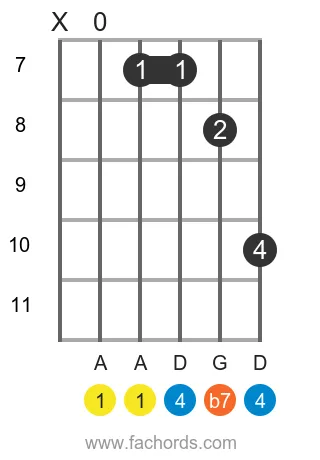
Position 3
Barre
Movable
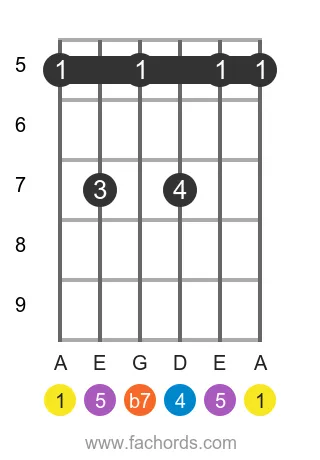
 Find more shapes in our all guitar chords online library. If you
prefer a printable pdf, download
the Free Guitar Chords Chart Pdf
Find more shapes in our all guitar chords online library. If you
prefer a printable pdf, download
the Free Guitar Chords Chart Pdf
You can also use this accessible A7sus4 chord page, with written diagram instructions and screen-reader support for blind users.


Created by
Giancarlo is a musician (teaching guitar since 2000), software engineer, AI consultant and published researcher
FAQ
What notes make up the A7sus4 chord?
The A7sus4 chord is composed of four specific notes: A, D, E, and G. These are the foundational pitches you'll play on your guitar to form this chord.
What intervals are present in an A7sus4 chord?
The A7sus4 chord consists of the Root (A), the Perfect Fourth (D), the Perfect Fifth (E), and the Minor Seventh (G). These are commonly referred to as the 1, 4, 5, and b7 intervals.
Why is the A7sus4 called a 'suspended' chord?
The A7sus4 is classified as a suspended chord because it does not contain a major or minor third. Instead, the perfect fourth (D) replaces the third, creating a unique harmonic quality that feels 'suspended' or unresolved.
What is the key difference between an A7sus4 and a regular A7 chord?
The primary difference lies in the third interval. An A7sus4 chord substitutes the major third with a perfect fourth, whereas a regular A7 chord includes a major third (C#) along with its root, perfect fifth, and minor seventh.
Is the A7sus4 chord considered a dominant chord?
Yes, the A7sus4 chord is a type of dominant chord. Dominant chords are characterized by their inherent musical tension, which typically creates a strong pull towards resolution, often to the tonic chord.
What does 'sus4' mean in the context of the A7sus4 chord?
The 'sus4' in A7sus4 stands for 'suspended fourth.' It indicates that the chord's third (major or minor) has been replaced by a perfect fourth, giving the chord its distinct, open, and often unresolved sound.
