A# 7sus4 Guitar Chord
Chord Diagrams, Interactive Fretboard and Chord Theory
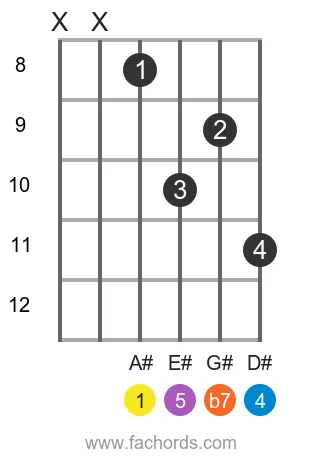
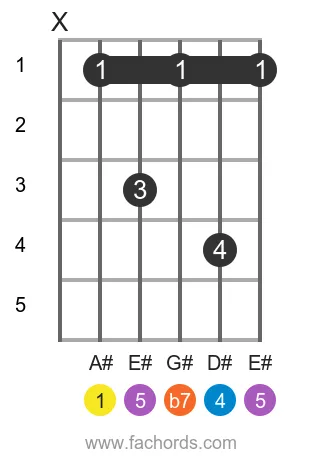
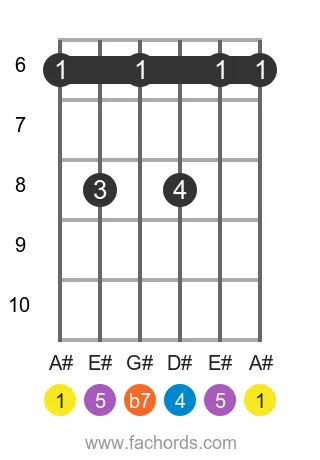
A# dominant 7th suspended 4th guitar chord is also written as A#7sus4, A#7sus or A#7(sus4).
Position 1
Movable
Position 2
Barre
Movable
Position 3
Barre
Movable
 Find more shapes in our all guitar chords online library. If you
prefer a printable pdf, download
the Free Guitar Chords Chart Pdf
Find more shapes in our all guitar chords online library. If you
prefer a printable pdf, download
the Free Guitar Chords Chart Pdf
You can also use this accessible A#7sus4 chord page, with written diagram instructions and screen-reader support for blind users.
Explore A#7sus4 Guitar Chord Shapes with Interactive Fretboard Feedback
Want a structured chord roadmap instead of jumping between pages?
Go to the full guitar chords tutorial.
Dive into the spatial layout of the A#7sus4 chord across the fretboard and instantly visualize its unique geometry on our interactive virtual fretboard tool. Observe how its notes – A#, D#, E#, and G# – form the intervals of a Root (1), Perfect Fourth (4), Perfect Fifth (5), and Minor Seventh (b7). This powerful tool lets you play the chord as a strum or arpeggio and, crucially, provides real-time mic feedback, verifying your finger placement and ensuring you're hitting the notes precisely. This chord, blending both suspended and dominant characteristics, offers a distinct sound as you explore its positions.
The distinctive sound of the A#7sus4 chord arises from the absence of a major or minor third, imparting an open, unresolved quality typical of Suspended Chords. However, its inclusion of a minor seventh also firmly places it within the realm of Dominant Chords, hinting at a potential for tension and resolution. To deepen your understanding of how such complex chords are constructed, explore our comprehensive Chord Construction guide. Mastering its unique feel is key to smoothly integrating it into your playing, so consider our tips to Improve Chords Change.
As you scroll down, you'll find various A#7sus4 chord diagrams, presented from the simplest open positions to more intricate movable shapes. Beyond the visual charts, we provide essential music theory insights, examples of songs that utilize this chord, and common musical keys where it naturally occurs. But before you commit these static patterns to memory, make sure to engage with the interactive tool above. Use it to explore the different shapes, adjust the BPM with the drum tool, and utilize the mic feedback to physically experience and confirm each position, rather than just memorizing a diagram.
A# 7sus4 chord Notes:
Chord Formula:
Play This Chord With Other Roots
C 7sus4 | D 7sus4 | E 7sus4 | F 7sus4 | G 7sus4 | A 7sus4 | B 7sus4 | C#7sus4 | D#7sus4 | F#7sus4 | G#7sus4 | A#7sus4 | Ab7sus4 | Bb7sus4 | Db7sus4 | Eb7sus4 | Gb7sus4


Created by
Giancarlo is a musician (teaching guitar since 2000), software engineer, AI consultant and published researcher
FAQ
What makes the A# 7sus4 chord sound "unresolved"?
The A# 7sus4 chord lacks a major or minor third. Instead, it incorporates a perfect fourth, which creates a harmonic tension that makes the chord feel like it wants to move or resolve to a more stable chord.
How can the A# 7sus4 chord be both a suspended chord and a dominant chord?
It is classified as a suspended chord because it replaces the major or minor third with a perfect fourth, giving it its characteristic unresolved sound. It is simultaneously considered a dominant chord due to the inclusion of a minor seventh (b7) interval, which is a defining feature of dominant harmony.
What are the specific notes and intervals that form the A# 7sus4 chord?
The A# 7sus4 chord is built from the notes A#, D#, E#, and G#. These notes correspond to the intervals of the Root (1), Perfect Fourth (4), Perfect Fifth (5), and Minor Seventh (b7) respectively.
Why is E# listed as a note in the A# 7sus4 chord?
The A# 7sus4 chord contains the notes A#, D#, E#, and G#. E# is the correct theoretical spelling for the perfect fifth interval (5) when starting from the root A#, maintaining the standard interval stacking for chord construction.
What distinguishes an A# 7sus4 chord from a regular A# sus4 chord?
The key difference is the presence of the minor seventh (b7) interval in the A# 7sus4 chord. A regular A# sus4 chord typically consists only of the root, perfect fourth, and perfect fifth (1, 4, 5), whereas the 7sus4 adds that characteristic minor seventh to its structure.
