The Minor Scale On Guitar
Learn How To Play The Aeolian Mode
The Aeolian mode, also known as the natural minor scale, is one of the most essential scales for guitarists. It's the go-to scale for melancholic, introspective, and deep-sounding music across rock, blues, metal, and pop. In this tutorial we'll cover its theory, fretboard patterns, chords, and real song examples so you can start using it right away.
Minor Scale - Interactive Guitar Fretboard
Use the tool below to learn various fretboard fingerings for the minor scale:
What is the Aeolian Scale?
Remember a mode is also a scale, and in the modern sense it is simply a major scale started on another scale degree.
First, we take our basic C major scale:
C D E F G A B C
Depending on where we start on that scale will determine our mode as seen in this chart here. When we start on the 6th degree, it is called the Aeolian mode.
- Ionian C
- Dorian D
- Phrygian E
- Lydian F
- Mixolydian G
- Aeolian A
- Locrian B
The C major or Ionian scale has the same notes as the A Aeolian.
But if you play them both on your guitar, you will see they invoke completely different emotions.
While the minor mode can be used in a variety of genres, songs in this mode will never really be uplifting and joyful.
The rhythms and tempos can give minor songs a drive or a rocking sound, but you will notice the subject matter or topic of the song is still not positive.
Aeolian doesn't equal a constant dreadful mood, but if you just met the person of your dreams, this is the wrong mode to use in a song!
A B C D E F G A
If there is a modern thoughtful, deep, or melancholy tune that you like, there is a good chance it has some Aeolian mode in it. Just remember when dealing with song examples, that things don't always fit perfectly. Many guitarists and songwriters don't know theory, and they just went with what sounded sad!
The Submediant: Scale Formula
The 6th scale degree is known as the submediant and its scale formula is:
Whole-Half-Whole-Whole-Half-Whole-Whole
or it is easier to just flatten the 3, 6, and 7:
With all those minor notes it is guaranteed that our song will not be happy.
If you want to compose dystopian yet beautiful guitar-oriented rock music, the Aeolian mode is a good friend. (If you want a more creepy or spookier vibe, use the Phrygian mode!)
There are two other types of minor scales with a slightly different formula: the harmonic minor scale and the melodic minor scale.
Aeolian Scales: The b3, b6 and b7
The Aeolian is like the Dorian, but with a minor 6th, giving it a sadder and more contemplative vibe.
Dorian songs are often more upbeat and groovier with their minor feel. That bluesy or funky vibe is a sign it may be Dorian, and yes, sometimes we see both (like in Eleanor Rigby).
If you want to find what mode a song is in, first locate the key. From there identify which scale degrees are raised or lowered.
If you see b3, b6, and b7 notes, it is in natural minor. Be sure not to confuse it with the melodic minor or harmonic minor scales as they are different (and they are both covered in separate articles).
Understanding Relative Scales
Relative scales are pairs of major and minor scales that share the same key signature but have different root notes.
The concept of relative scales is pivotal in understanding the relationship between scales and how they interact within compositions.
The A minor scale is the relative minor of the C major scale. This means both scales contain the same notes but start from different root notes.
- For A minor, the notes are A, B, C, D, E, F, and G, starting on A.
- For C major, the notes are C, D, E, F, G, A, and B, starting on C.
So, by looking at those note sequences, it's easy to say:
The natural minor scale starts from the 6th degree of its corresponding major scale.
The significance of this relationship lies in their shared notes and chords, allowing for seamless substitution and modulations between the two in musical pieces.
Here are the notes of the A minor scale:
Minor Scale Guitar Patterns
Here below you find the most common ways to play a minor scale on guitar; the examples are in A minor but you can move the shapes up and down the neck to get a new root.
You find more scale diagrams across all the fretboard in the ebook Scales Over Chords | Learn How To Play The Right Scales Over Any Chord
A Minor Scale On One String
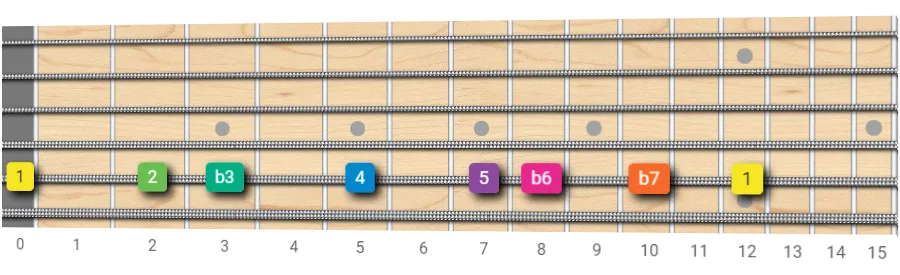
A Minor Scale - Root on the 6th string
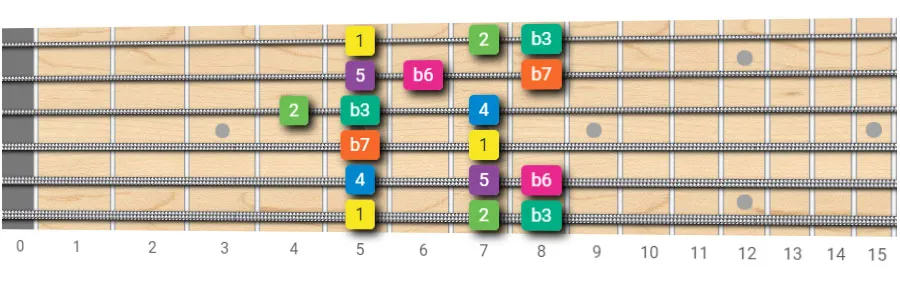
A Minor Scale - Root on the 6th string - 3 Notes Per String
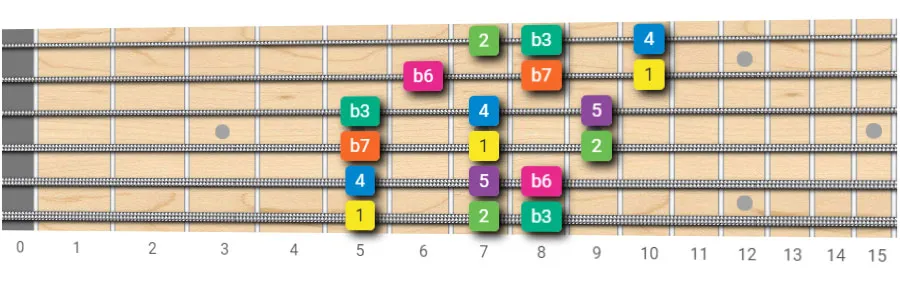
A Minor Scale - Root on the 5th string
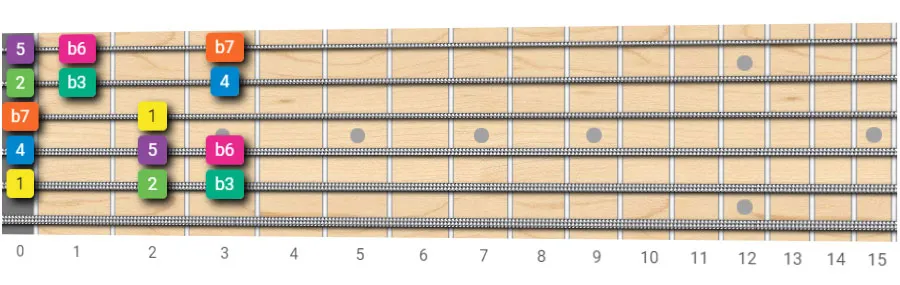
A Minor Scale - Root on the 5th string - 3 Notes Per String
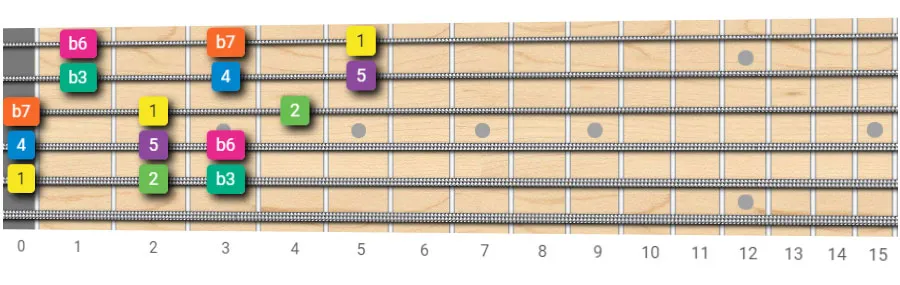
A Minor Scale - Root on the 3rd string - 1 Octave Pattern
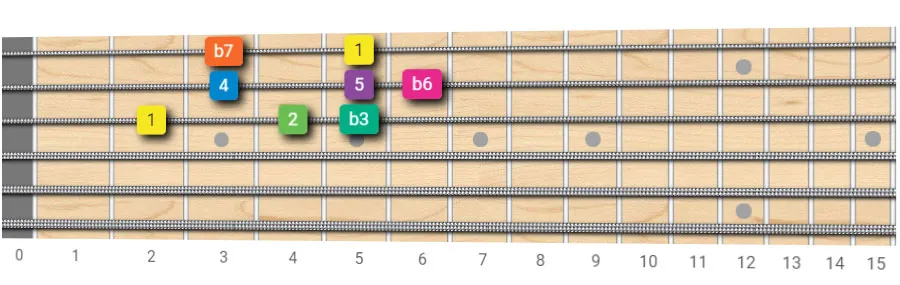
Minor Scale Notes in All Keys
Below are Aeolian scales in all keys:
Notes in the C Minor Scale
C - D - Eb - F - G - Ab - Bb
Notes in the G Minor Scale
G - A - Bb - C - D - Eb - F
Notes in the D Minor Scale
D - E - F - G - A - Bb - C
Notes in the A Minor Scale
A - B - C - D - E - F - G
Notes in the E Minor Scale
E - F# - G - A - B - C - D
Notes in the B Minor Scale
B - C# - D - E - F# - G - A
Notes in the F# Minor Scale
F# - G# - A - B - C# - D - E
Notes in the Gb Minor Scale
Gb - Ab - Bbb - Cb - Db - Ebb - Fb
Notes in the C# Minor Scale
C# - D# - E - F# - G# - A - B
Notes in the Db Minor Scale
Db - Eb - Fb - Gb - Ab - Bbb - Cb
Notes in the G# Minor Scale
G# - A# - B - C# - D# - E - F#
Notes in the Ab Minor Scale
Ab - Bb - Cb - Db - Eb - Fb - Gb
Notes in the D# Minor Scale
D# - E# - F# - G# - A# - B - C#
Notes in the Eb Minor Scale
Eb - F - Gb - Ab - Bb - Cb - Db
Notes in the A# Minor Scale
A# - B# - C# - D# - E# - F# - G#
Notes in the Bb Minor Scale
Bb - C - Db - Eb - F - Gb - Ab
Notes in the F Minor Scale
F - G - Ab - Bb - C - Db - Eb
Chords and Progressions in the Minor Scale
As always, we use the scale formula to determine what chords will work, and we can build these types of chords with that scale.
Then, with these chords, we can create progressions.
In Roman Numbers Notation, the chords in the Aeolian Scale are:
i - ii(dim) - bIII - iv - v - bVI - bVII
The diminished isn't that useful but the rest of these chords will be found throughout Aeolian songs.
A progression like i-bVII-bIII-bVI, or some variation is common in songs like "Crazy Train" which uses F#m-D-A-E throughout much of the F# Aeolian song.
Besides those chords you can use the scale to see what other chords might work.
The sus2 and sus4 are common along with min7 and 7b5.
And it is normal for the III and VII to be maj7. If you see a V7 chord that means they put some of the harmonic minor scale in with the natural.
Common Minor Progressions
There are progressions that use i-iv-v like "Ain't No Sunshine" and "Losing My Religion".
Often the minor progressions can be even simpler like i-bVII in "Somebody I Used to Know". In "All Along the Watchtower" we have a progression of i-bVII-bVI repeated through the whole song.
Another popular chord progression in Aeolian is i-bIII-bVII-bVI (Am-C-G-F) like in the songs "Sound of Silence" and "Counting Stars".
Or jumble those chords for i-bVI-bIII-bVII or Em-C-G-D for "Zombie".
Chords Generated from A Minor
By stacking thirds on each scale degree of A minor, we form the following chords:
- A minor: A, C, E
- B diminished: B, D, F
- C major: C, E, G
- D minor: D, F, A
- E minor: E, G, B
- F major: F, A, C
- G major: G, B, D
Notice that the chords in this scale are the same as those in the C major scale, but in different order.
I IV V Progression in A Minor
In music theory, the I IV V progression is a common chord progression that forms the basis of countless songs. In the key of A minor, this progression is:
- I (Am): A minor chord
- IV (Dm): D minor chord
- V (Em): E minor chord
This progression highlights the natural minor feel, providing a melancholic and introspective mood typical of minor keys.
In contrast, the I IV V progression in the C major scale (the relative major of A minor) consists of C, F, and G major chords, which feels brighter and more resolved, offering a stark emotional and tonal contrast.
Notable Song Examples
Beethoven was partially inspired by wind harps when he wrote "Moonlight Sonata", which is in C#m.
In modern music we see lots of Em and Am in songs like "Not a Second Time" and "Part of Me".
A great example of Fm is "Hello".
And "Sultans of Swing" is in Dm with a i-bVII-bVI-V7 (the last V7 being harmonic minor but still fitting with Dm).
Some guitarists will use a mode just for a solo or riff section. It makes an easy solo to play when you stick with notes that are guaranteed to fit.
When you are dealing with rock, blues, and minor chords the Aeolian is one of the potential scales to try first. Some songs that have modal solos are:
Conclusion
Just remember that not all minor songs are in natural minor the whole time; others can use the melodic and harmonic minor. Minor key songs usually have a mix of one of those scales with the Aeolian mode.
Understanding the minor scale, its chords, and progressions, as well as its relationship with the major scale, is fundamental for guitarists. It enriches your musicality, allowing you to navigate between major and minor tonalities with ease, and provides a foundation for composing and improvising across a wide range of musical genres.
But in general, like the Ionian mode, you will find many places to use it. That's all for today. Download the free ebooks and get notified on new tutorials by subscribing here.

Created by
Giancarlo is a musician (teaching guitar since 2000), software engineer, AI consultant and published researcher
FAQ
What is the Aeolian mode, and how does it relate to the natural minor scale?
The Aeolian mode is simply another name for the natural minor scale. It is derived from a major scale by starting on its 6th degree. For example, playing the C major scale notes (C D E F G A B C) but starting and ending on A results in the A Aeolian mode, which is the A natural minor scale.
What gives the Aeolian mode its distinctive 'sad' or 'melancholy' emotional quality?
The Aeolian mode's characteristic sad or melancholy feeling comes from its specific intervallic structure, particularly the flattened 3rd, 6th, and 7th degrees (b3, b6, b7) relative to a major scale. These 'minor' intervals are what create its distinct contemplative and often somber sound, making it unsuitable for overtly joyful or uplifting tunes.
How do I identify or construct the Aeolian mode using scale degrees or intervals?
You can identify the Aeolian mode by observing its characteristic flattened 3rd, 6th, and 7th degrees. Relative to a major scale, the Aeolian mode has the scale formula of Whole-Half-Whole-Whole-Half-Whole-Whole steps. For example, if you start with a C major scale, the A Aeolian (natural minor) scale will have a C (b3), F (b6), and G (b7) when counted from A as the root.
What is the primary difference between the Aeolian mode and the Dorian mode?
Both Aeolian and Dorian are minor modes, but their key difference lies in the 6th degree. The Aeolian mode has a minor 6th (b6), which contributes to its sadder, more contemplative feel. In contrast, the Dorian mode has a natural or major 6th, giving it a slightly more upbeat, groovier, and often bluesy or funky character compared to the Aeolian mode.
What are common chords and progressions used when playing in the Aeolian mode?
In the Aeolian mode, common chords include the minor tonic (i), minor 4th (iv), minor 5th (v), flat 3rd major (bIII), flat 6th major (bVI), and flat 7th major (bVII). Common progressions often feature these chords, such as i-bVII-bIII-bVI, i-iv-v, i-bVII, or i-bIII-bVII-bVI. Additionally, suspended 2nd (sus2), suspended 4th (sus4), minor 7th (min7), and 7b5 chords can also be utilized.
When is the Aeolian mode particularly useful for guitarists in songwriting or solos?
The Aeolian mode is ideal for conveying thoughtful, deep, or melancholy moods in songwriting. It's frequently used in rock, blues, and other genres that lean into minor keys, especially for composing 'dystopian yet beautiful' music. For solos or riffs, using the Aeolian mode ensures that your notes will naturally fit the established minor harmony, making it a reliable choice for expressive improvisation.
Is the Aeolian mode the only 'minor scale' I should know on guitar?
No, while the Aeolian mode is often referred to as the 'natural minor scale' and is fundamental, it's not the only minor scale. Other important minor scales for guitarists include the harmonic minor and melodic minor scales. Many minor key songs will actually mix elements of the Aeolian mode with notes from these other minor scales to create different emotional nuances, particularly if you hear a major V7 chord in a minor progression.