Train Your Gmaj7 Chord Skills with Interactive Feedback
Want a structured chord roadmap instead of jumping between pages?
Go to the full guitar chords tutorial.
The G major seventh chord (Gmaj7) is spelled G, B, D and F#. The F# sits a semitone below the octave of the root.
There are 21 voicings on this page, nine of them with open strings and seven using a barre. All of its notes fall inside the G major scale, which makes that scale a natural source of melody notes. The reasoning behind the spelling is covered in guitar music theory.
Press play on the fretboard player at the top to hear Gmaj7 strummed and as an arpeggio.
G major 7th guitar chord is also written as Gmaj7, GM7, GΔ7 or Gma7.
G maj7 chord Notes:
How to create the Major Seventh chord:
G Maj7 Guitar Chord Diagrams
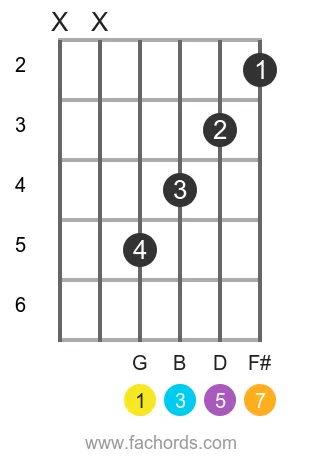
Position 1 Movable
Finger Positions
- Mute the low E string
- Mute the A string
- Place your index finger (1) on the fret 2 of the high E string
- Place your middle finger (2) on the fret 3 of the B string
- Place your ring finger (3) on the fret 4 of the G string
- Place your pinky finger (4) on the fret 5 of the D string
Position 2 Barre Movable
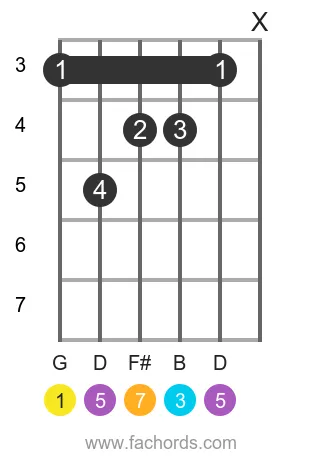
Finger Positions
- Mute the high E string
- Place your index finger (1) on the fret 3 of the low E and B strings at the same time
- Place your middle finger (2) on the fret 4 of the D string
- Place your ring finger (3) on the fret 4 of the G string
- Place your pinky finger (4) on the fret 5 of the A string
Position 3 Barre Movable
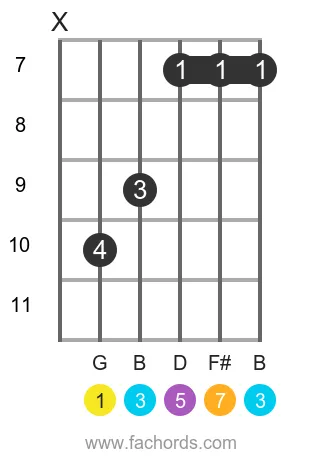
Finger Positions
- Mute the low E string
- Place your index finger (1) on the fret 7 of the G, B and high E strings at the same time
- Place your ring finger (3) on the fret 9 of the D string
- Place your pinky finger (4) on the fret 10 of the A string
Position 4 Movable
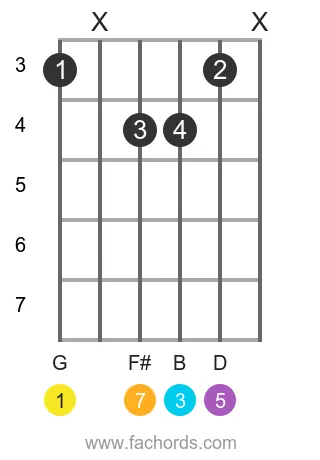
Finger Positions
- Mute the A string
- Mute the high E string
- Place your index finger (1) on the fret 3 of the low E string
- Place your middle finger (2) on the fret 3 of the B string
- Place your ring finger (3) on the fret 4 of the D string
- Place your pinky finger (4) on the fret 4 of the G string
Position 5 Movable

Finger Positions
- Mute the low E string
- Mute the high E string
- Place your index finger (1) on the fret 10 of the A string
- Place your middle finger (2) on the fret 11 of the G string
- Place your ring finger (3) on the fret 12 of the D string
- Place your pinky finger (4) on the fret 12 of the B string
Position 6 Open
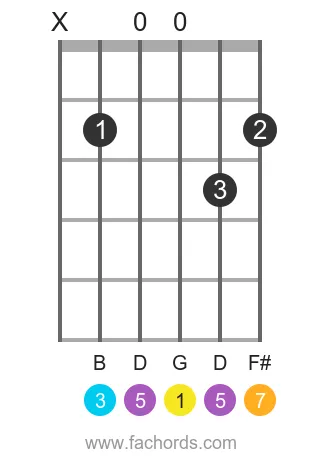
Finger Positions
- Mute the low E string
- Let the D string play without pressing any fret
- Let the G string play without pressing any fret
- Place your index finger (1) on the fret 2 of the A string
- Place your middle finger (2) on the fret 2 of the high E string
- Place your ring finger (3) on the fret 3 of the B string
Position 7 Open
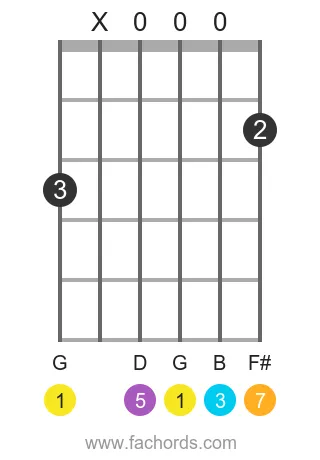
Finger Positions
- Mute the A string
- Let the D string play without pressing any fret
- Let the G string play without pressing any fret
- Let the B string play without pressing any fret
- Place your middle finger (2) on the fret 2 of the high E string
- Place your ring finger (3) on the fret 3 of the low E string
Position 8 Open
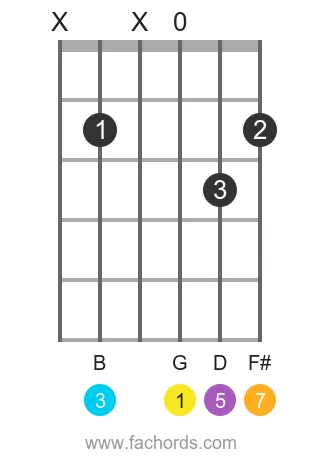
Finger Positions
- Mute the low E string
- Mute the D string
- Let the G string play without pressing any fret
- Place your index finger (1) on the fret 2 of the A string
- Place your middle finger (2) on the fret 2 of the high E string
- Place your ring finger (3) on the fret 3 of the B string
Position 9 Movable
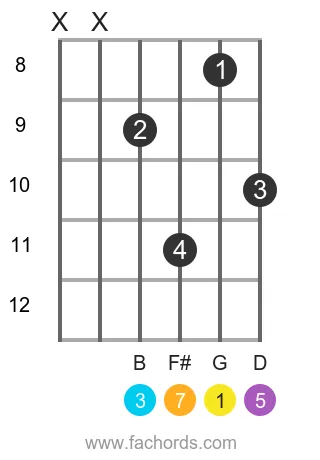
Finger Positions
- Mute the low E string
- Mute the A string
- Place your index finger (1) on the fret 8 of the B string
- Place your middle finger (2) on the fret 9 of the D string
- Place your ring finger (3) on the fret 10 of the high E string
- Place your pinky finger (4) on the fret 11 of the G string
Position 10 Barre Movable
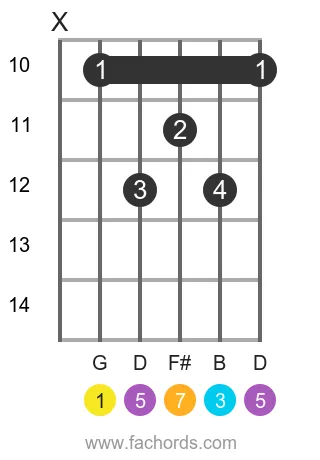
Finger Positions
- Mute the low E string
- Place your index finger (1) on the fret 10 of the A and high E strings at the same time
- Place your middle finger (2) on the fret 11 of the G string
- Place your ring finger (3) on the fret 12 of the D string
- Place your pinky finger (4) on the fret 12 of the B string
Position 11 Barre Movable

Finger Positions
- Mute the low E string
- Mute the A string
- Place your index finger (1) on the fret 5 of the D string
- Place your pinky finger (4) on the fret 7 of the G, B and high E strings at the same time
Position 12 Movable

Finger Positions
- Mute the A string
- Mute the high E string
- Place your index finger (1) on the fret 5 of the D string
- Place your middle finger (2) on the fret 7 of the low E string
- Place your ring finger (3) on the fret 7 of the G string
- Place your pinky finger (4) on the fret 7 of the B string
Position 13 Open
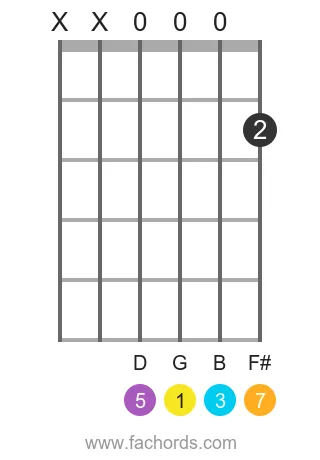
Finger Positions
- Mute the low E string
- Mute the A string
- Let the D string play without pressing any fret
- Let the G string play without pressing any fret
- Let the B string play without pressing any fret
- Place your middle finger (2) on the fret 2 of the high E string
Position 14 Open

Finger Positions
- Mute the low E string
- Let the G string play without pressing any fret
- Let the B string play without pressing any fret
- Place your index finger (1) on the fret 3 of the high E string
- Place your middle finger (2) on the fret 4 of the D string
- Place your ring finger (3) on the fret 5 of the A string
Position 15 Open

Finger Positions
- Let the D string play without pressing any fret
- Let the G string play without pressing any fret
- Let the B string play without pressing any fret
- Place your index finger (1) on the fret 2 of the low E string
- Place your middle finger (2) on the fret 2 of the A string
- Place your ring finger (3) on the fret 2 of the high E string
Position 16 Barre Open
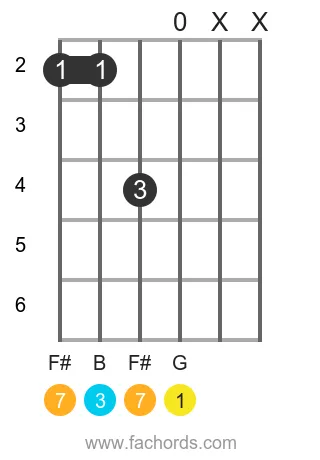
Finger Positions
- Let the G string play without pressing any fret
- Mute the B string
- Mute the high E string
- Place your index finger (1) on the fret 2 of the low E and A strings at the same time
- Place your ring finger (3) on the fret 4 of the D string
Position 17 Movable
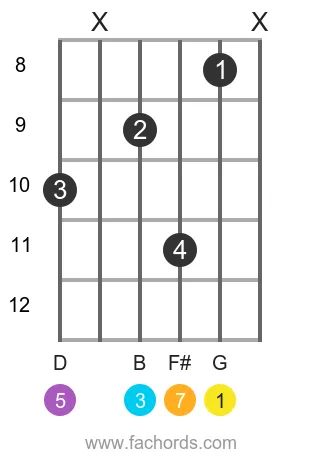
Finger Positions
- Mute the A string
- Mute the high E string
- Place your index finger (1) on the fret 8 of the B string
- Place your middle finger (2) on the fret 9 of the D string
- Place your ring finger (3) on the fret 10 of the low E string
- Place your pinky finger (4) on the fret 11 of the G string
Position 18 Barre Movable
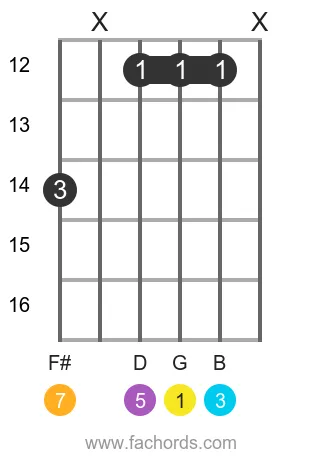
Finger Positions
- Mute the A string
- Mute the high E string
- Place your index finger (1) on the fret 12 of the D, G and B strings at the same time
- Place your ring finger (3) on the fret 14 of the low E string
Position 19 Open
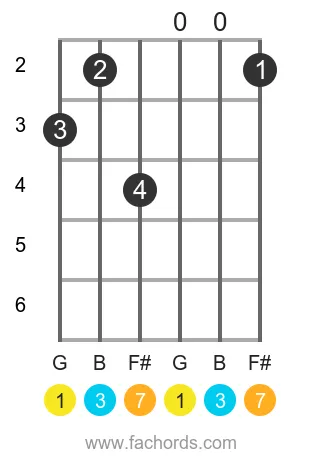
Finger Positions
- Let the G string play without pressing any fret
- Let the B string play without pressing any fret
- Place your index finger (1) on the fret 2 of the high E string
- Place your middle finger (2) on the fret 2 of the A string
- Place your ring finger (3) on the fret 3 of the low E string
- Place your pinky finger (4) on the fret 4 of the D string
Position 20 Barre Movable
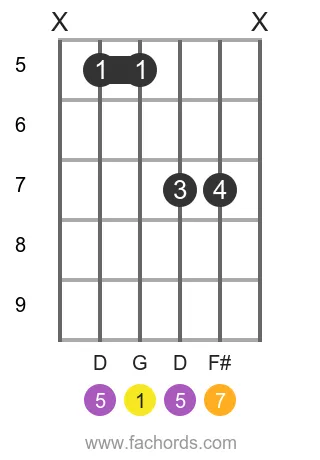
Finger Positions
- Mute the low E string
- Mute the high E string
- Place your index finger (1) on the fret 5 of the A and D strings at the same time
- Place your ring finger (3) on the fret 7 of the G string
- Place your pinky finger (4) on the fret 7 of the B string
Position 21 Open
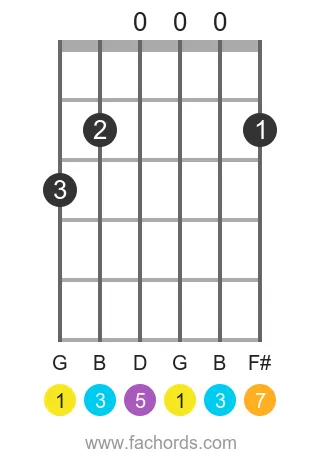
Finger Positions
- Let the D string play without pressing any fret
- Let the G string play without pressing any fret
- Let the B string play without pressing any fret
- Place your index finger (1) on the fret 2 of the high E string
- Place your middle finger (2) on the fret 2 of the A string
- Place your ring finger (3) on the fret 3 of the low E string
 Find more shapes in our all guitar chords online library. If you
prefer a printable pdf, download
the Free Guitar Chords Chart Pdf

Created by
Giancarlo is a musician (teaching guitar since 2000), software engineer, AI consultant and published researcher
FAQ
What notes make up G major seventh?
G major seventh contains G, B, D and F#. F# is the major seventh, one semitone short of the octave of G.
How many voicings does Gmaj7 have?
Gmaj7 has 21 voicings, 9 with open strings and 7 with a barre. The highest one reaches the 14th fret.
Which keys feature Gmaj7 as a main chord?
Gmaj7 is the I chord of G major and the IV chord of D major. Both scales contain G, B, D and F#.
What is the difference between Gmaj7 and G7?
Gmaj7 uses F#, a major seventh. G7 uses F, a minor seventh one semitone lower, which gives it a dominant function.