G# aug Guitar Chord | Play, Hear and Practice Interactively
Want a structured chord roadmap instead of jumping between pages?
Go to the full guitar chords tutorial.
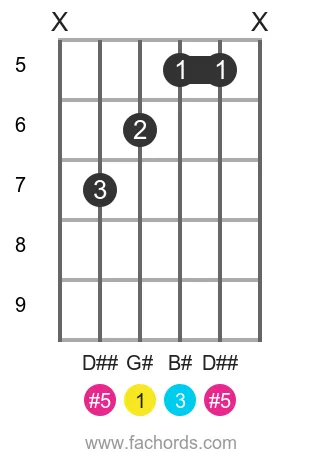
G#aug is the G# augmented chord: G#, B# and D##, built as root, major third and raised fifth.
Melodies over G#aug can draw on the G# whole-tone scale, which contains every note of the chord. All 3 voicings are fretted and none rings an open string; one is a barre shape. G#aug and Abaug are enharmonic twins: two names for the same pitches. Spelling it correctly takes B# and D##, which is why the same sound is also written Abaug.
The augmented triad is symmetrical, so only four different ones exist, and each can be named from any of its three notes. Strum a shape in front of your microphone and the chord player at the top shows which strings ring and which are muted.
G# augmented guitar chord is also written as G#aug, G#+, G#(#5) or G#maj(#5).
G# aug chord Notes:
How to create the Augmented Fifth chord:
Formula: 1 3 #5
G# Aug Guitar Chord Diagrams
Position 1 Barre Movable
Finger Positions
- Mute the low E string
- Mute the high E string
- Place your index finger (1) on the fret 5 of the G and B strings at the same time
- Place your middle finger (2) on the fret 6 of the D string
- Place your ring finger (3) on the fret 7 of the A string
Position 2 Movable
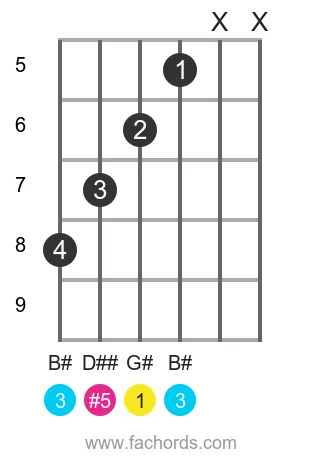
Finger Positions
- Mute the B string
- Mute the high E string
- Place your index finger (1) on the fret 5 of the G string
- Place your middle finger (2) on the fret 6 of the D string
- Place your ring finger (3) on the fret 7 of the A string
- Place your pinky finger (4) on the fret 8 of the low E string
Position 3 Movable
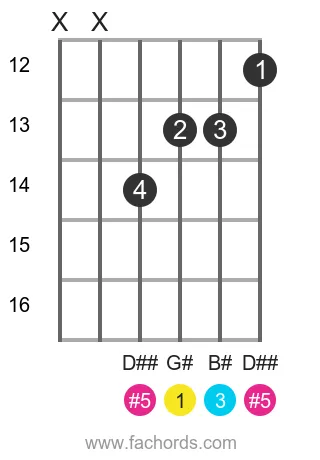
Finger Positions
- Mute the low E string
- Mute the A string
- Place your index finger (1) on the fret 12 of the high E string
- Place your middle finger (2) on the fret 13 of the G string
- Place your ring finger (3) on the fret 13 of the B string
- Place your pinky finger (4) on the fret 14 of the D string
 Find more shapes in our all guitar chords online library. If you
prefer a printable pdf, download
the Free Guitar Chords Chart Pdf
Find more shapes in our all guitar chords online library. If you
prefer a printable pdf, download
the Free Guitar Chords Chart Pdf

Created by
Giancarlo is a musician (teaching guitar since 2000), software engineer, AI consultant and published researcher
FAQ
Which notes form the G#aug chord?
G#aug is spelled G#, B# and D##. These are the root, a major third and a raised fifth. B# sounds like C and D## sounds like E.
Is G#aug the same chord as Abaug?
Yes. G#aug and Abaug are two spellings of the same sound. Abaug, spelled Ab, C and E, avoids double sharps and is easier to read.
Why is the G# augmented chord spelled with B# and D##?
Chord letters run G, B, D. The major third of G# is B#, and the raised fifth is D##. Writing C and E would be the same sound but break the spelling pattern.
What scale suits G#aug?
The G# whole-tone scale, G#, A#, B#, C##, D##, F#, contains all three chord tones, since the chord uses every second note of the scale.
How many G#aug voicings can be played?
There are 3 voicings, 1 of them using a barre. None uses an open string. They run from fret 5 to fret 14.