Master the F# Minor Guitar Chord Interactively
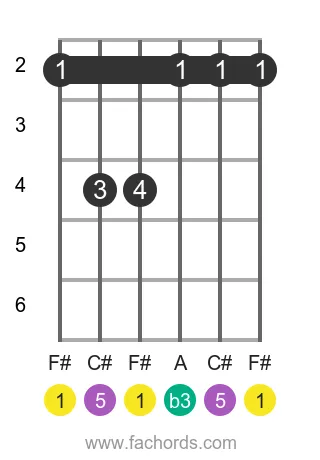
Five voicings of the F#m chord (F# minor) are listed here, three of them barre shapes and none with an open string. Its notes are F#, A and C#.
It turns up as the vi chord in A major, the ii chord in E major and the iii chord in D major. If you are unsure why the A makes it minor, intervals on the fretboard show the minor third between F# and A and the major third that F# major would use instead. The F# minor scale contains all three notes.
Use the fretboard at the top to hear F#m strummed and then as an arpeggio.
F# minor guitar chord is also written as F#m, F#min, F#- or F#mi.
Notes in the F# m chord:
Chord Structure:
Formula: 1 b3 5
F# M Chord Interactive Fretboard
Want a structured chord roadmap instead of jumping between pages?
Go to the full guitar chords tutorial.
F# M Guitar Chord Diagrams
Position 1 Barre Movable
Finger Positions
- Place your index finger (1) on the fret 2 of the low E, G, B and high E strings at the same time
- Place your ring finger (3) on the fret 4 of the A string
- Place your pinky finger (4) on the fret 4 of the D string
Position 2 Movable
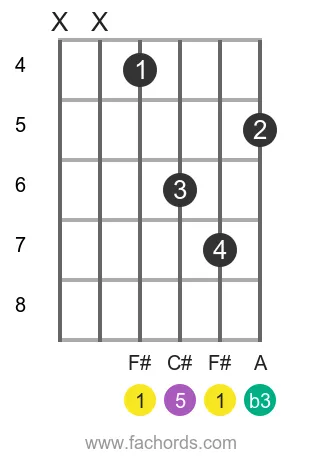
Finger Positions
- Mute the low E string
- Mute the A string
- Place your index finger (1) on the fret 4 of the D string
- Place your middle finger (2) on the fret 5 of the high E string
- Place your ring finger (3) on the fret 6 of the G string
- Place your pinky finger (4) on the fret 7 of the B string
Position 3 Barre Movable
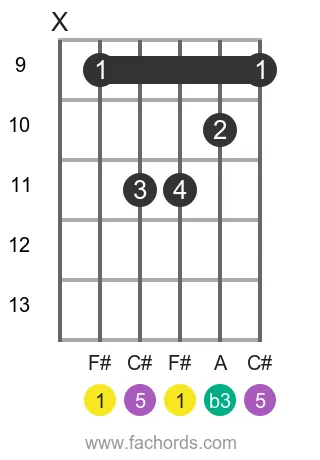
Finger Positions
- Mute the low E string
- Place your index finger (1) on the fret 9 of the A and high E strings at the same time
- Place your middle finger (2) on the fret 10 of the B string
- Place your ring finger (3) on the fret 11 of the D string
- Place your pinky finger (4) on the fret 11 of the G string
Position 4 Movable
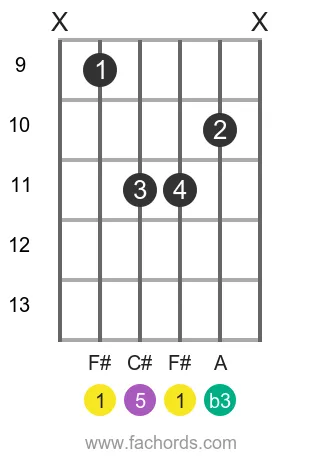
Finger Positions
- Mute the low E string
- Mute the high E string
- Place your index finger (1) on the fret 9 of the A string
- Place your middle finger (2) on the fret 10 of the B string
- Place your ring finger (3) on the fret 11 of the D string
- Place your pinky finger (4) on the fret 11 of the G string
Position 5 Barre Movable
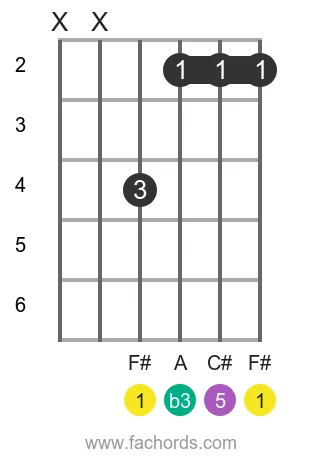
Finger Positions
- Mute the low E string
- Mute the A string
- Place your index finger (1) on the fret 2 of the G, B and high E strings at the same time
- Place your ring finger (3) on the fret 4 of the D string
 Find more shapes in our all guitar chords online library. If you
prefer a printable pdf, download
the Free Guitar Chords Chart Pdf
Find more shapes in our all guitar chords online library. If you
prefer a printable pdf, download
the Free Guitar Chords Chart Pdf
Play This Chord With Other Roots
C m | D m | E m | F m | G m | A m | B m | C#m | D#m | F#m | G#m | A#m | Abm | Bbm | Dbm | Ebm | Gbm
The F# Minor Chord | Keys, Songs and Harmonic Function
The most common way to play a F# minor chord is to move the well-known F minor chord one fret up the neck (remember, sharp, or '#', means 1 semitone up)
That's the beauty of bar chords; as they are movable: learning one shape allows you to play 12 different chords. You just need to shift that shape up or down the fretboard.
However, bar chords for beginners could be hard, so here below we show two easier ways.
How To Play The F# Minor Chord - Easy Version
 This version is still a bar shape but it's easier, at the index finger has to press only 3 frets.
You could even drop the note on the 6th string (F#) and still have a F# minor chord, because all the 3 notes in the minor triad are present.
How To Play The F# Minor Chord - Super Easy Version
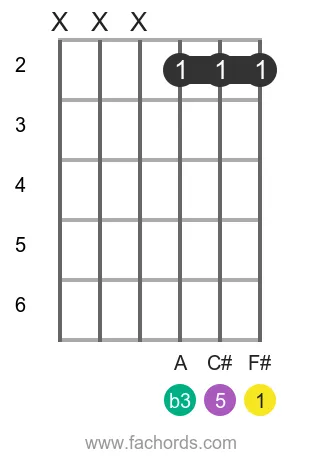 This is a super easy shape that you can fret with a 3-string barrè, or using index, middle, and ring fingers.
Actually, this is the first inversion of the F# minor chord, because the 3rd is the lowest note, but it still sounds ok.
F# Minor Key | Scale And Chords
The notes of F# minor scale are:
F# G# A B C# D E
So, if you take the first, third and fifth notes, you get F#, A and C#, as stated before.
If you repeat the same process for each note in the scale, you can build all the chords in the F sharp minor key.
The table below shows you the resulting chords.
Common Keys With The F# Minor Chord
Finally, here we show the most common keys that have F# minor chord.
E Major Key
In the E major key the F# minor chord is the Supertonic (2nd degree)
D Major Key
The key in which we find the F# minor chord as Mediant (3rd degree) is the D major.
A Major Key
The F# minor key is the relative minor of the A major key, so we find the F# minor chord at the 6th degree.
Songs with the F# minor chord
Three famous songs that use the F# minor chord are Crazy Train by Ozzy, which is in F# minor key, Wonderwall by Oasis, and I believe in a thing called love by Darkness, in F# minor key as well.
This ends our F# minor chord tutorial for guitar, for more resources about chords, check my complete ebook Chords Domination | Play Any Chord You Want Across All The Fretboard.

Created by
Giancarlo is a musician (teaching guitar since 2000), software engineer, AI consultant and published researcher
FAQ
What notes does F#m contain?
F#, A and C#. They are the root, the minor third and the perfect fifth of F# minor.
Which scale goes with F#m?
The F# minor scale: F#, G#, A, B, C#, D and E. All three chord notes are in it, along with the other scale notes that fit between them.
Is F#m the same as Gbm?
Yes, Gbm has Gb, Bbb and Db. These are the same pitches as F#, A and C#, so F#m is easier to read.
In which keys does F# minor appear?
It is the vi chord in A major, the ii chord in E major and the iii chord in D major, and the i chord in F# minor.
How many voicings of F#m can you play on guitar?
Five voicings are listed, three of them using a barre and none using open strings. They lie between fret 2 and fret 11.