Ebaug#11 Guitar Chord | Play, Hear and Practice Interactively
Want a structured chord roadmap instead of jumping between pages?
Go to the full guitar chords tutorial.
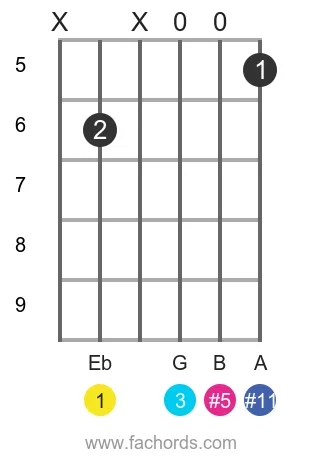
The Ebaug#11 chord, a unique member of the Augmented Chords family, is constructed from the notes Eb, G, B, and A. These correspond to the intervals Root (1), Major Third (3), Augmented Fifth (#5), and Augmented Fourth (#11). Use the interactive fretboard tool at the top of the page to explore these voicings, listen to the chord played as a strum or arpeggio, and get instant feedback on your accuracy with the real-time mic feedback.
The unique sound of the Ebaug#11 chord comes from its distinct interval structure, creating a rich and often dissonant yet captivating harmony. To deepen your understanding of how such complex chords are built, explore our Chord Construction tutorial. Mastering these intricate voicings can significantly enhance your playing; our guide on Improve Chords Change will help you integrate it smoothly. For those looking to unlock even more melodic possibilities, learning about Understanding Chord Inversions can open up new fretboard positions and sounds for this chord.
Below, you'll discover a comprehensive collection of Ebaug#11 chord diagrams, arranged from the simplest open positions to more challenging movable shapes. We also delve into the underlying music theory, highlight songs that feature this chord, and identify the musical keys where it frequently appears. But before you scroll down, take advantage of the interactive tool above: set a rhythm with the drum & BPM tool, practice strumming the chord, and use the mic feedback to refine your technique. This hands-on approach is the most effective way to learn and internalize new chords.
Eb +(#11) chord Notes:
Chord Structure:
Fingerings for the Eb Augmented Fifth Sharp Eleventh added guitar chord
Position 1
Open
Position 2
Open

 Find more shapes in our all guitar chords online library. If you
prefer a printable pdf, download
the Free Guitar Chords Chart Pdf
Find more shapes in our all guitar chords online library. If you
prefer a printable pdf, download
the Free Guitar Chords Chart Pdf
You can also use this accessible Eb+(#11) chord page, with written diagram instructions and screen-reader support for blind users.
FAQ
What notes comprise the Eb+(#11) chord?
The Eb+(#11) chord is composed of the notes Eb, G, B, and A. These four notes are the fundamental building blocks of this specific chord.
What are the defining intervals of the Eb+(#11) chord?
The Eb+(#11) chord is built using the intervals 1, 3, #5, and #11. When expressed with their full names, these correspond to the Root, Major Third, Augmented Fifth, and Augmented Fourth, respectively.
Why is the Eb+(#11) classified as an Augmented Chord?
The Eb+(#11) chord belongs to the Augmented Chords family primarily because it contains an Augmented Fifth (#5) interval. This specific interval gives the chord its characteristic augmented quality.
What does the '#11' specifically refer to in the Eb+(#11) chord?
In the Eb+(#11) chord, the '#11' interval refers to the note A. This note is also identified as an Augmented Fourth when considered within the basic octave, but is called #11 to indicate it's an extended harmony.
Why is the Eb+(#11) chord not considered a beginner's chord?
The Eb+(#11) chord is described as not being a beginner's chord because it involves a more complex combination of notes and intervals than basic major or minor triads. It's typically introduced when a guitarist is ready to explore more advanced harmonic concepts and genres.
How does the Augmented Fourth relate to the #11 interval in the Eb+(#11) chord?
According to the chord's definition, the #11 interval is the same as the Augmented Fourth. The note A, which is the #11 in an Eb+(#11) chord, is the Augmented Fourth interval from the root Eb.