Eb9(#5) Guitar Chord | Play, Hear and Master Interactively
Want a structured chord roadmap instead of jumping between pages?
Download the step-by-step Guitar Chord Ebook
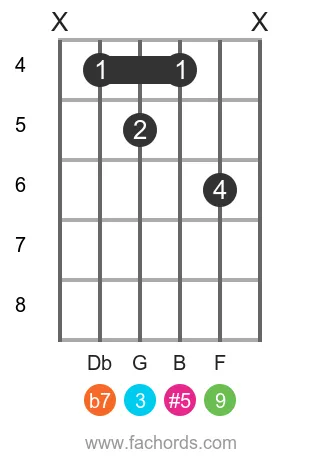
The Eb9(#5) guitar chord is a captivating dominant 9th chord featuring an augmented fifth. Its unique sound comes from the notes: Eb, G, B, Db, and F, which correspond to the intervals Root (1), Major Third (3), Augmented Fifth (#5), Minor Seventh (b7), and Major Ninth (9). Unlock this chord instantly with the interactive fretboard tool at the top of this page. You can visualize every fingering, hear the chord played as a strum or arpeggio, and even get real-time microphone feedback to ensure your fingers are perfectly placed.
Often used in jazz, funk, and R&B, the augmented fifth in the Eb9(#5) creates a distinctive, sometimes unsettling, yet rich harmonic color. Understanding how this chord is built by stacking intervals is key to mastering it across the fretboard. Dive deeper into the theory with our comprehensive guide on Ninth Chords and learn the foundational principles of Chord Construction. If you find some of the larger voicings challenging, our tutorial on Guitar Bar Chords can provide helpful techniques. And once you've got the shapes down, practice smooth transitions with tips from Improve Chords Change.
Below, you'll find a curated selection of Eb9(#5) chord diagrams, presented from the simplest open positions to more advanced movable shapes. We'll also explore the musical theory behind this chord, suggest songs where it shines, and identify common keys where it fits beautifully. Before you explore these visual aids, take a moment to engage with the interactive tool above. Use the drum machine to set a comfortable BPM, practice playing the chord, and let the instant mic feedback refine your technique. This hands-on approach is the most effective way to integrate the Eb9(#5) into your guitar playing.
Notes that compose the Eb 9(#5) chord:
Chord Formula:
Eb9(#5) Guitar Chord Shapes
Position 1
Barre
Movable
 Find more shapes in our all guitar chords online library. If you
prefer a printable pdf, download
the Free Guitar Chords Chart Pdf
Find more shapes in our all guitar chords online library. If you
prefer a printable pdf, download
the Free Guitar Chords Chart Pdf
You can also use this accessible Eb9(#5) chord page, with written diagram instructions and screen-reader support for blind users.
FAQ
What makes the Eb9(#5) chord an augmented chord?
The Eb9(#5) chord is classified as an augmented chord due to the presence of the #5 (Augmented Fifth) interval within its structure. This specific interval (B in the key of Eb) gives the chord its characteristic augmented quality, which is fundamental to its distinctive sound.
What do the numbers and symbols in the Eb9(#5) chord name represent?
In Eb9(#5), 'Eb' is the root note. The '9' indicates that the chord includes a Major Ninth (F) interval, in addition to the root, major third (G), and minor seventh (Db). The '(#5)' specifically denotes an Augmented Fifth (B), which replaces the natural fifth, defining the chord's augmented character.
What kind of sound does the Eb9(#5) chord produce?
The Eb9(#5) chord produces a distinctive and complex sound. This unique quality comes from its specific combination of notes (Eb, G, B, Db, F) and intervals (Root, Major Third, Augmented Fifth, Minor Seventh, Major Ninth). The augmented fifth, combined with the minor seventh and major ninth, creates tension and a rich harmonic texture.
When might I use an Eb9(#5) chord in my music?
The Eb9(#5) chord, while more complex, can open up new musical possibilities. Its distinctive and rich sound is particularly well-suited for adding color and tension, especially in genres that frequently utilize jazz chord progressions, where extended and altered dominant chords are common for creating sophisticated harmonies.