Learn the D#maj Guitar Chord: Theory & Interactive Practice
Want a structured chord roadmap instead of jumping between pages?
Go to the full guitar chords tutorial.
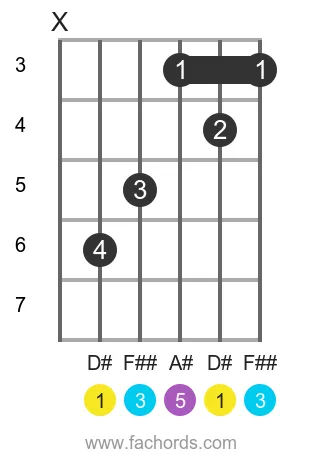
The D# maj chord, a fundamental member of the Major Chords family, is precisely constructed from the notes D#, F##, and A#. These specific tones represent the essential intervals of 1 (Root), 3 (Major Third), and 5 (Perfect Fifth). To deeply understand this structure and apply it to your playing, utilize the powerful interactive fretboard tool at the top of this page. This tool allows you to visually explore countless fingerings, hear the chord played accurately, and receive instant verification of your execution with real-time microphone feedback.
As a major chord, the D# maj chord provides a bright, stable, and foundational sound, serving as a harmonic cornerstone in countless musical pieces. A thorough understanding of its construction is vital for any guitarist; explore this further with our comprehensive guide on Chord Construction. Many common voicings for the D# maj chord often involve demanding barre fingerings; if these present a challenge, our detailed Guitar Bar Chords tutorial can significantly aid your progress. Moreover, cultivating smooth transitions between chords is crucial for fluent playing, and our expert tips to Improve Chords Change will help you achieve musical fluidity.
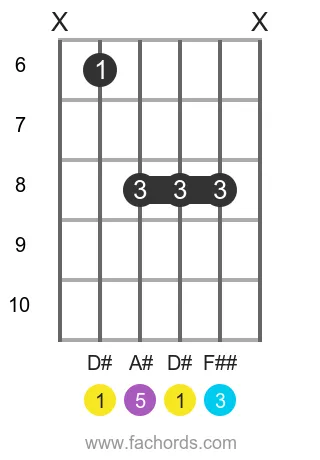
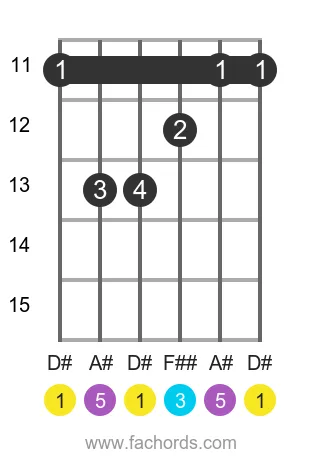
Further down this page, you will find a comprehensive collection of D# maj chord diagrams, thoughtfully ranked from the most accessible open positions to more advanced barre shapes. We also delve into the essential music theory underpinning this chord, offer practical examples of songs where it shines, and list the common keys in which it frequently appears. However, for truly effective and disciplined practice, we strongly recommend you first engage with the interactive tool above! Set your desired tempo using the integrated drum machine, strum the chord, and allow the precision of the mic feedback to immediately confirm your finger placement and execution. This focused, immediate engagement is invaluable for solidifying your understanding and integrating the D# maj chord into your practical playing repertoire.
Notes that compose the D# maj chord:
Tones of the Major chord:
Guitar Patterns for the D# Major chord
Position 1
Barre
Movable
Position 2
Barre
Movable
Position 3
Barre
Movable
 Find more shapes in our all guitar chords online library. If you
prefer a printable pdf, download
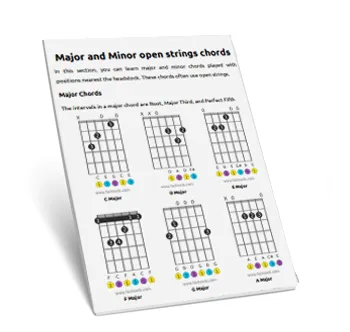
the Free Guitar Chords Chart Pdf
Find more shapes in our all guitar chords online library. If you
prefer a printable pdf, download
the Free Guitar Chords Chart Pdf
You can also use this accessible D#maj chord page, with written diagram instructions and screen-reader support for blind users.
FAQ
What notes are used to build the D# major chord?
The D# major chord is constructed using three specific notes: D# (the root), F## (F double-sharp), and A# (A sharp). These notes represent the fundamental intervals of a major chord.
Why does the D# major chord include an F double-sharp (F##) instead of another note?
The F## is used to correctly represent the major third interval from the root note D#. Although F## sounds enharmonically equivalent to G natural, maintaining the F## clarifies its function as the third degree of the D# major scale, preserving the standard 1, 3, 5 interval structure for a major chord.
What do the 1, 3, and 5 intervals mean in the context of the D# major chord?
The numbers 1, 3, and 5 refer to the scale degrees of the D# major scale that form the chord. '1' is the root note (D#), '3' is the major third interval (F##), and '5' is the perfect fifth interval (A#). These three intervals are the essential components that define any major chord.
When can I use the D# major chord in my guitar playing?
Once you have mastered the D# major chord, you can incorporate it into many different musical styles. Major chords like D# are frequently found in common chord progressions, which makes them useful for playing existing songs and for creating your own music.