Master the C# aug Guitar Chord with Interactive Practice
Want a structured chord roadmap instead of jumping between pages?
Go to the full guitar chords tutorial.
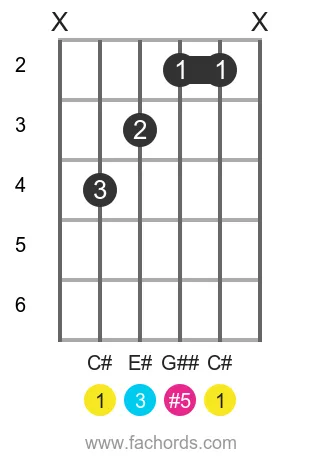
Unlocking a distinctive, often suspenseful sonic palette, the C# aug chord adds a unique flavor to your compositions. This intriguing sound comes from its construction: C#, E#, and G##, which are the Root (1), Major Third (3), and Augmented Fifth (#5). Dive into its possibilities using our interactive fretboard tool, where you can instantly visualize fingerings, hear it played as a strum or arpeggio, and ensure your precision with real-time microphone feedback.
The unique, somewhat suspended sound of augmented chords comes from that sharpened fifth, creating a tension that often resolves in interesting ways. Understanding how these intervals are stacked is fundamental to mastering any chord. Our Chord Construction tutorial provides a deep dive into building chords from intervals. As you learn new voicings for the C# aug, consider how Understanding Chord Inversions can unlock even more musical possibilities and help you smoothly Improve Chords Change in your playing. For advanced voicings, especially those using Guitar Bar Chords, the interactive fretboard becomes an invaluable guide.
Below, you'll discover a comprehensive collection of C# aug chord diagrams, ranging from the easiest open positions to more advanced barre shapes. We'll also cover the music theory behind this chord, provide examples of songs where it shines, and show you the common keys in which it appears. But before you delve into the static diagrams, take a moment to engage directly with the interactive tool above. Strum the chord, set your preferred BPM with the drum tool, and let the real-time mic feedback guide your hands. Experience the sound and feel first, then analyze the details.
C# augmented guitar chord is also written as C#aug, C#+, C#(#5) or C#maj(#5).
Notes of the C# aug chord:
Chord Structure:
C# Aug Guitar Chord Diagrams
Position 1 Movable
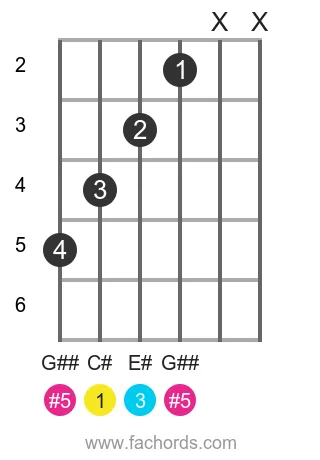
Finger Positions
- Mute the B string
- Mute the high E string
- Place your index finger (1) on the fret 2 of the G string
- Place your middle finger (2) on the fret 3 of the D string
- Place your ring finger (3) on the fret 4 of the A string
- Place your pinky finger (4) on the fret 5 of the low E string
Position 2 Movable
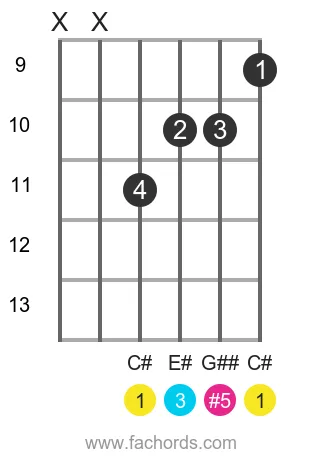
Finger Positions
- Mute the low E string
- Mute the A string
- Place your index finger (1) on the fret 9 of the high E string
- Place your middle finger (2) on the fret 10 of the G string
- Place your ring finger (3) on the fret 10 of the B string
- Place your pinky finger (4) on the fret 11 of the D string
Position 3 Barre Movable
Finger Positions
- Mute the low E string
- Mute the high E string
- Place your index finger (1) on the fret 2 of the G and B strings at the same time
- Place your middle finger (2) on the fret 3 of the D string
- Place your ring finger (3) on the fret 4 of the A string
 Find more shapes in our all guitar chords online library. If you
prefer a printable pdf, download
the Free Guitar Chords Chart Pdf
Find more shapes in our all guitar chords online library. If you
prefer a printable pdf, download
the Free Guitar Chords Chart Pdf


Created by
Giancarlo is a musician (teaching guitar since 2000), software engineer, AI consultant and published researcher
FAQ
What does the 'aug' in C# aug chord signify?
The 'aug' stands for 'augmented,' indicating that this is an Augmented Chord. This means the chord is built with a specific intervallic structure of a root, a major third, and an augmented fifth, giving it a distinct theoretical identity and characteristic sound.
Why does the C# aug chord use E# and G## as notes instead of F and A?
The C# aug chord uses E# and G## to accurately reflect its intervallic construction: a root (C#), a major third (E#), and an augmented fifth (G##). While F and A are enharmonically equivalent to E# and G## respectively, using E# and G## correctly names the intervals according to music theory rules, which is essential for understanding chord construction by stacking intervals.
How are the intervals 1, 3, and #5 applied to build the C# aug chord?
These numbers refer to the specific intervals built above the root (C#) to form the chord. '1' is the root itself (C#), '3' represents a major third above the root (E#), and '#5' indicates an augmented fifth above the root (G##). These three specific intervals are the defining components that create any augmented chord.
What makes an augmented chord unique compared to other chord types?
An augmented chord is uniquely defined by its specific interval structure: a root, a major third, and crucially, an *augmented* fifth. This augmented fifth interval creates a distinctive, often dissonant or 'unresolved' quality that sets it apart from major or minor chords, which typically contain a perfect fifth.
What is the characteristic sound of the C# aug chord?
The C# aug chord has a distinctively 'unique sound' often described as suspenseful, unstable, or 'lifting.' This quality comes from the augmented fifth interval, which creates a tension that often suggests a desire to resolve or move to another chord, making it a useful transitional chord in music.
