Understand and Play the Bmaj Chord on Guitar
Want a structured chord roadmap instead of jumping between pages?
Go to the full guitar chords tutorial.
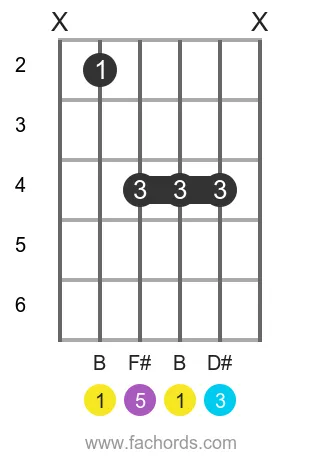
The Bmaj chord is fundamentally built upon the intervals 1 (Root), 3 (Major Third), and 5 (Perfect Fifth), forming a stable and resonant sound characteristic of the Major Chords family. These specific intervals translate to the notes B, D#, and F# on your fretboard. To truly internalize this structure, our interactive virtual fretboard allows you to visualize each note's position, and you can verify your playing accuracy in real-time with our innovative mic feedback, ensuring precise execution of every Bmaj voicing.
Understanding the construction of a major chord, like the Bmaj chord, reveals its role as a fundamental tonal center in countless compositions, providing a sense of resolution and stability. This deep understanding of its harmonic function is crucial for any guitarist. For a broader perspective on how chords are formed, explore our detailed guide on Chord Construction. Additionally, if you're looking to smoothly transition between this foundational major chord and others, our tips on Improving Chord Changes can significantly enhance your fluidity.
Scroll down this page to discover various Bmaj chord diagrams, arranged from the most accessible shapes to more challenging voicings. Each diagram will reinforce the theoretical concepts you've learned. Utilize our virtual fretboard to practice these positions thoroughly, applying the underlying theory to real-world songs across different keys. Consistent practice with our interactive tools will build your disciplined command over this essential chord.
Notes that compose the B maj chord:
Formula of the Major chord:
Guitar Patterns for the Bmaj chord
Position 1
Movable
Position 2
Barre
Movable
Position 3
Barre
Movable
 Find more shapes in our all guitar chords online library. If you
prefer a printable pdf, download
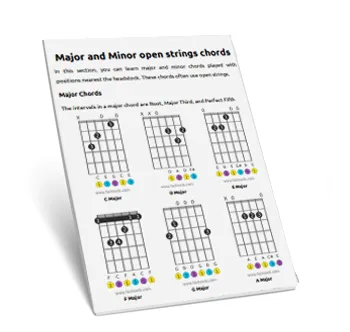
the Free Guitar Chords Chart Pdf
Find more shapes in our all guitar chords online library. If you
prefer a printable pdf, download
the Free Guitar Chords Chart Pdf
You can also use this accessible Bmaj chord page, with written diagram instructions and screen-reader support for blind users.

Created by
Giancarlo is a musician (teaching guitar since 2000), software engineer, AI consultant and published researcher
FAQ
What notes make up the B Major chord on guitar?
For the B Major chord, the specific notes are B, D#, and F#. The B note is the foundational 'root', D# is the 'major third' above the root, and F# is the 'perfect fifth' above the root. These three notes together create its distinct major sound.
What do 'Root,' 'Major Third,' and 'Perfect Fifth' mean in the B Major chord?
In the context of the B Major chord, the 'Root' is the note B itself, which is the starting point and name of the chord. The 'Major Third' (D#) is the third note of the B major scale, and it's what gives the chord its 'major' quality. The 'Perfect Fifth' (F#) is the fifth note of the B major scale. These three specific notes, played together, form the complete B Major triad.
How can chord diagrams help me learn to play the B Major chord?
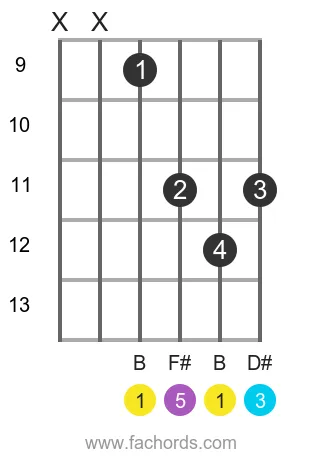
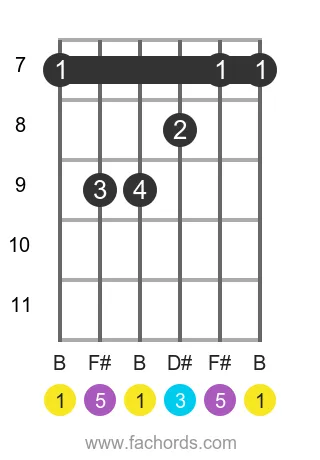
Chord diagrams provide a visual map of where to place your fingers on the guitar fretboard to form the B Major chord. They clearly indicate which strings to fret, which specific frets to use for the notes B, D#, and F#, and which strings to avoid or mute. This visual representation is an essential tool for learning the physical shape and precise finger placement for the chord.
What family of chords does the B Major chord belong to?
The B Major chord belongs to the 'Major Chords family.' This classification means it shares the fundamental interval structure of a Root, Major Third, and Perfect Fifth with all other major chords, giving it a bright and resolved sound.