Building Riffs With Triads
How To Build Creative Progressions Using 3 Notes Chords
In this tutorial, I will show you how to use triads to create exciting lines that move horizontally across the fretboard. Open chords are great but to be more creative, using triads can be a great option:
First, please have a look at the video below, you'll find the discussion later on this page:
Video Guitar Tabs
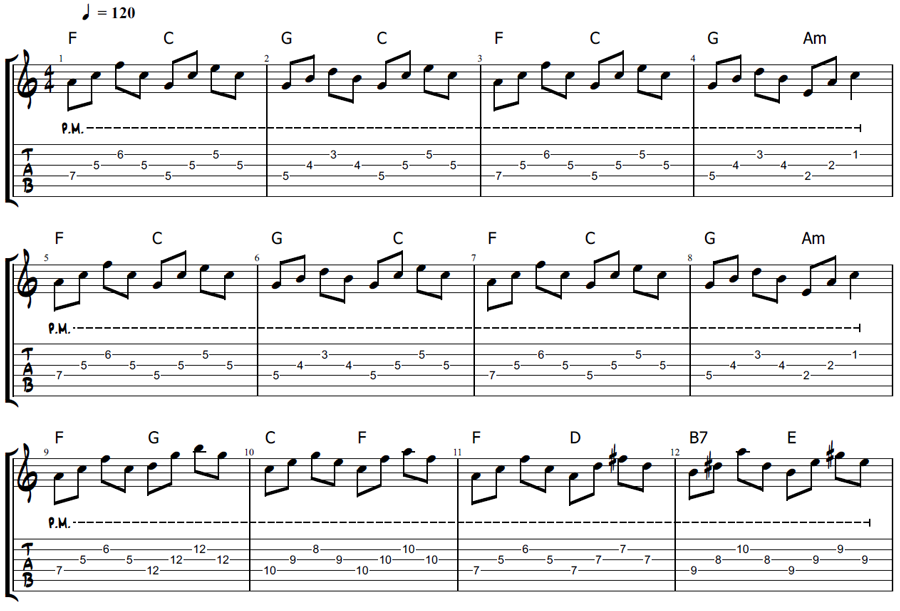
Creating Progressions With Guitar Triads
We already have discussed about triads on guitar in my past tutorials, but here's a quick recap.
Triads are three-note chords that form the foundation of harmony in music. They consist of a root note, a third interval, and a fifth interval above the root.
Depending on the quality of the third (minor or major) and the fifth (augmented, perfect or diminished) a triad can be major, minor, diminished or augmented.
Triads are often used in rhythm guitar playing to provide harmonic support.
By knowing different triad shapes and their positions across the entire fretboard, guitarists can create interesting chord progressions and variations while strumming or fingerpicking.
In the sequence above, I play guitar triads in arpeggio style (one note at a time), using palm muting to gently mute the notes and create a nice rhythmic effect.
A bit of delay creates an additional nice sonic texture!
Harmonic Analysis
The foundation progression for the riff is: IV I V I in the key of C, which is F, C, G and C.
On bar 4 and 8, C is substituted by its relative minor, Am, which creates a nice effect.
Here's below the chords in the key of C:
| Key | I | ii | iii | IV | V | vi | vii |
|---|---|---|---|---|---|---|---|
| C | Dm | Em | F | G | Am | B dim |
So far so good, from bar 1 to bar 10 we use only diatonic triads without any uncommon situation.
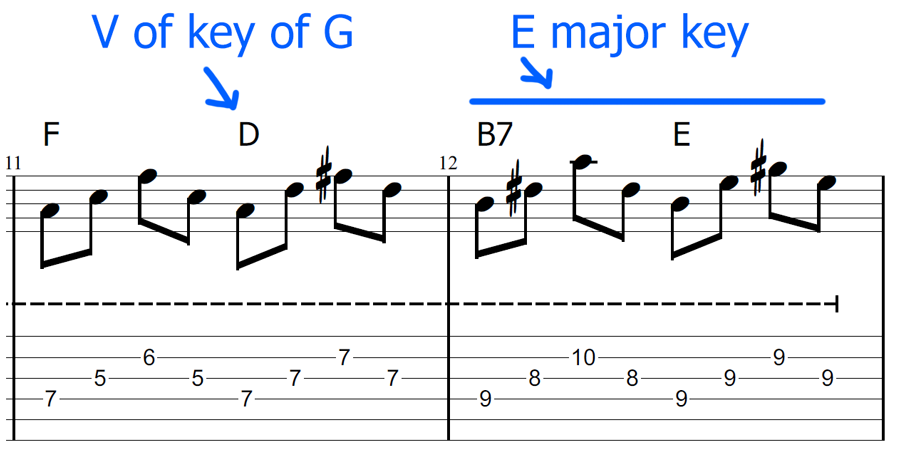
Things get more interesting from bar 11.
Across the Circle of Fifths, the nearest key to C is the key of G, which has an F# instead of F.
So, by simply raising F to F#, we can move from the key of C to the key of G.
Moreover, F# is the third of the D major chord, which in the key of G is minor:
- D minor: D F A
- D major: D F# A
So, by playing a D major chord in the second half of bar 11, we modulate to the key of G, leaving the key of C.
And then, from D major, we switch to B7 (played with a shell chord shape), which is the dominant V chord of the key of E major.
Notice the pleasant effect sound by the final B7 to E major cadence (V -> I).
Here's below the chords in the key of E major:
| Key | I | ii | iii | IV | V | vi | vii |
|---|---|---|---|---|---|---|---|
| E | F#m | G#m | A | B | C#m | D# dim |
So, to recap, we use diatonic triads in the key of C from bar 1 to 10, then, from bar 11, we perform a couple of modulations, landing to the key of E:
Building Songs With Triads - Conclusions
Ok, we have just seen how to turn a common, potentially boring progression into something more interesting.
Triads can be a great option to have in your songwriting toolkit.
By moving horizontally across the fretboard, and don't limit yourself to position near the headstock, you can come up with creative solutions.
Here are the free downloads for this lesson:
That's it! To stay updated on new tutorials, subscribe here.
FAQ
How does this tutorial suggest using guitar triads differently from typical chord playing?
This tutorial teaches using triads in an 'arpeggio style', playing one note at a time, to create melodic lines that move horizontally across the fretboard. This approach focuses on building dynamic riffs and leads, rather than just strumming triads as harmonic support for rhythm guitar.
What does it mean to 'move horizontally across the fretboard' with triads?
Moving horizontally means playing different inversions or shapes of a triad, or related triads, by shifting up and down a single string or across a few adjacent strings, rather than staying within a fixed fretboard position. This technique allows for greater melodic fluidity and varied voicings in your guitar riffs.
How does the riff demonstrate modulating to a new key using triads?
The riff modulates from the key of C to the key of G by introducing an F# note, specifically within a D major chord. This D major acts as a pivot, leading into the new key. It then further modulates to E major by using a B7 chord, which functions as the dominant V chord that strongly resolves to the E major (I) chord.
Why is the C major chord sometimes substituted with A minor in the progression?
The C major chord is substituted with its relative minor, Am, in certain parts of the progression to create a 'nice effect.' This adds a different harmonic color and a subtle minor feel within the overall major progression, making the sequence more interesting and varied without drastically changing the harmony.
What is the purpose of using palm muting and delay in this triad-based riff?
Palm muting is applied to gently mute the notes, which helps to define each individual note of the arpeggiated triads and creates a rhythmic, percussive texture. Delay is added to enhance the overall 'sonic texture,' providing a sense of space and sustain that complements the melodic lines.
What are 'diatonic triads' in the context of this lesson's harmonic analysis?
Diatonic triads are the three-note chords (major, minor, or diminished) that are naturally derived from the notes of a specific musical scale. In the harmonic analysis, they are mentioned to indicate that the initial part of the riff uses only the chords that belong to the key of C major, before any modulations introduce notes or chords from other keys.