Guitar Scales: The Complete Guide with Interactive Tool
Free scale finder, charts, modes, exercises and theory for every guitar scale you'll ever need
This is a complete guide to guitar scales, packed with everything you need to learn and practice scale patterns across the fretboard.
You'll find an interactive scale finder tool that lets you explore fretboard diagrams for any scale or arpeggio in any key, with audio playback and real-time pitch detection.
Below that, we cover the most common guitar scales with diagrams, a full reference table of all scales, essential music theory behind scale construction and formulas, plus practical exercises and tips on how to use scales in songs and solos.
Guitar Scale Finder - Interactive Tool
How To Use The Scale Generator Tool
The Guitar Scale Finder is a free browser-based tool that lets you explore fretboard patterns for a wide range of scales and arpeggios by selecting a key, scale type, and shape (4-fret box, 3 notes per string, or all frets), with notes color-coded by scale degree so you can see each tone's intervallic role at a glance.
It includes audio playback with adjustable BPM, a built-in drum track, and a root bass note for a fuller practice experience, plus a compare mode that overlays two scales on the same fretboard to reveal shared and differing tones.
Additional features include real-time microphone pitch detection that highlights the notes you play, an interactive piano keyboard, support for alternate tunings (Drop D, DADGAD, Open G and more) and a left-handed mode, a scale structure table, and options to download or share your fretboard patterns.
Music Theory: What Is A Guitar Scale?
Quick answer: A guitar scale is an ordered sequence of notes played one at a time, from a root note up to the same note one octave higher. Each scale type, Major, Minor, Pentatonic, Blues, the seven modes, has a unique formula of intervals that gives it its characteristic sound. The fastest way to learn a scale is to pick a root, memorize its box shape on the fretboard, and play it along with the audio.
Scales are not the same as chords. When we practice scales we play them one note at a time, unlike a chord in which you play all the tones simultaneously.
We can consider a scale as a way to go from one note (say C) to the same note one octave upper (one octave is 12 frets on guitar)
Let's see this example on the guitar: take the C note at the 3rd fret of the A string , and the C one octave upper, at the 15th fret of the same string.
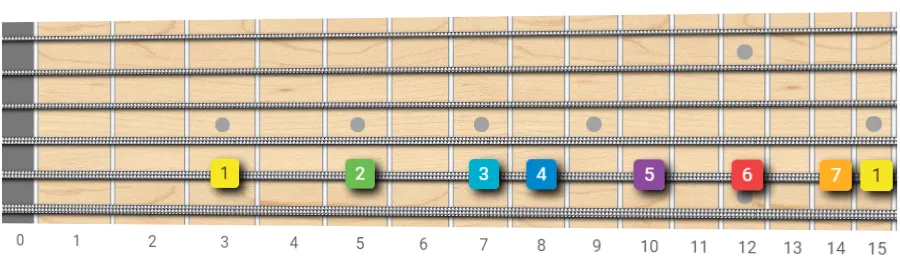
A scale is a way to go from one note to the same note one octave upper
If you count the number of the frets between the lower C and the higher C, you get 12. So this confirms that an octave spans 12 frets .
We have multiple ways to go from the lower C to the upper. We could play the frets 3, 5, 7, 8, 10, 12, 15, 15 or play only 3, 7, 9, 11, 15 or even play all the frets between the two C (that would be a chromatic scale)
Of course, this holds true for ascending and descending both (from the lower C to the upper and from the upper to the lower)
Basic Scale Theory
The most important thing you must understand is that scales are not patterns. See a scale as a sound: each scale type has its own characteristic sound. Patterns are just ways to play scales on the guitar fretboard, due to the nature of the instrument.
The relationship between each selected fret determines the scale structure and thus its name. We can create scales of all of types.
Each scale type has its own unique combination of distances between the frets in the octave. This is called scale formula.
In music theory, frets translate to semitones or half-steps. On guitar, it's safe to consider frets, semitones and half-steps the same measure.
Usually, there are 7 notes to each scale within a one-octave range, but not always: pentatonic scales have 5 notes, and there are even scales, like bebop scales, that have 8 notes!
Considering that the scale doesn't change with an octave change we don't need to repeat it past 7 notes.
A C scale will always end and start on a C, and the same for each successive note. So a C major scale spanning 2 octaves is simply:
C D E F G A B C D E F G A B C
Remember: Scale Patterns are Movable!
Did you notice that the C major scale pattern above is just four frets wide? We call these box shapes, they span 4, 5 or 6 frets.
The reason why guitarists prefer to play scales along these box patterns are that the motion is more efficient: 1 finger for each fret (we're going to see this topic in the following)
The great thing about a guitar scales box is that it will work anywhere you place it on the guitar as long as you follow the pattern.
Each scale type has a specific box pattern which can be shifted to other keys. So, for example, if we want to play a D major scale , we move up the C scale pattern by two frets. Want an F major scale? Move the C pattern up by 5 frets!
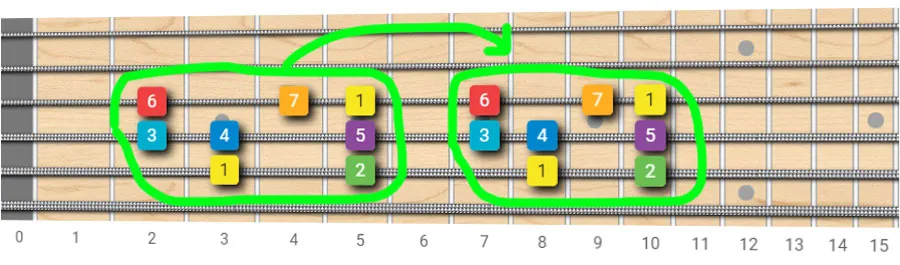
To play the F major scale, we move the C major scale pattern five frets up, so that the root of the pattern (yellow note) is F
If you want to understand better how and why the frets are placed across the strings, have a look at the guitar notes tutorial .
Key takeaways
- A scale is a sound, not a shape, the same scale can be played in dozens of fretboard patterns.
- Most modern guitar music lives inside five scales: Major, Minor, Major Pentatonic, Minor Pentatonic and Blues.
- Box patterns are movable: shift the C major box up two frets and you have D major.
- The seven modes (Ionian, Dorian, Phrygian, Lydian, Mixolydian, Aeolian, Locrian) all share the same notes but start on a different degree.
- Use scale formulas (1-b3-4-5-b7 for minor pentatonic, etc.) to memorize scales by interval rather than by rote.
- Match scales to chords: major over major, minor pentatonic over minor and dominant, modes over richer harmony.
Most Common Guitar Scales
Here below you find the diagrams and explanations for some of the most used guitar scales.
If need help to understand these diagrams, have a look at my how to read music for guitar tutorial.
Major Scale
The major scale is the foundation of Western Music so here it's the first in the list.
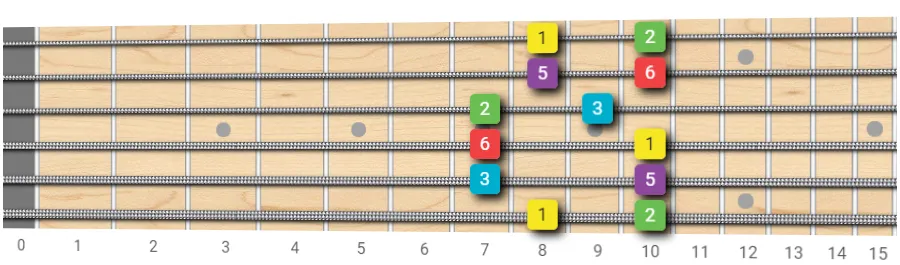
Major Pentatonic Scale
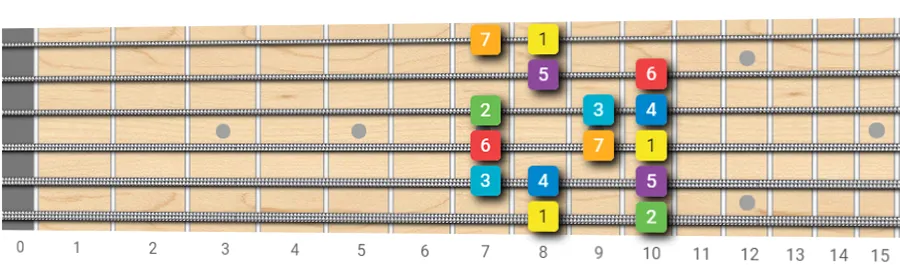
Pentatonic scales are composed of 5 notes (penta) and the Major pentatonic is a Major scale without the 4th and the 7th.
Minor Pentatonic Scale
The Minor pentatonic is another 5 notes scale.
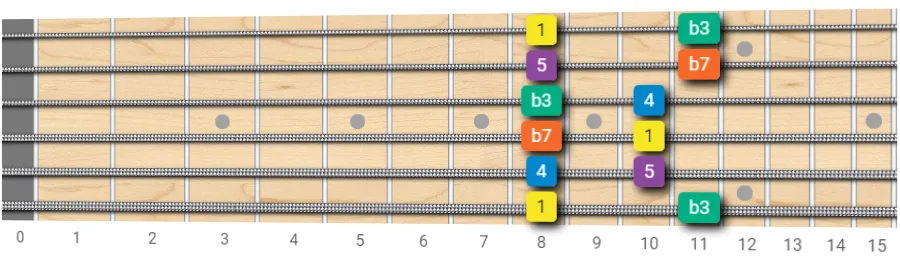
Good to know: if you play the minor pentatonic in the key of E, we have a particularly easy fingering because we can use open strings.
The same concept can be applied to open major scales
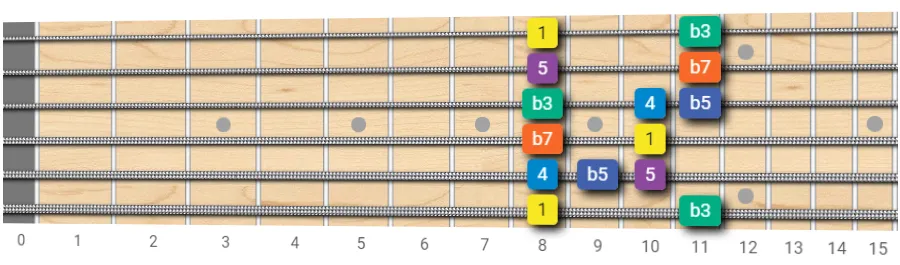
Blues Scale
The Blues scale is a Minor pentatonic with a flattened 5th added. It has a unique sound that you immediately recognize.
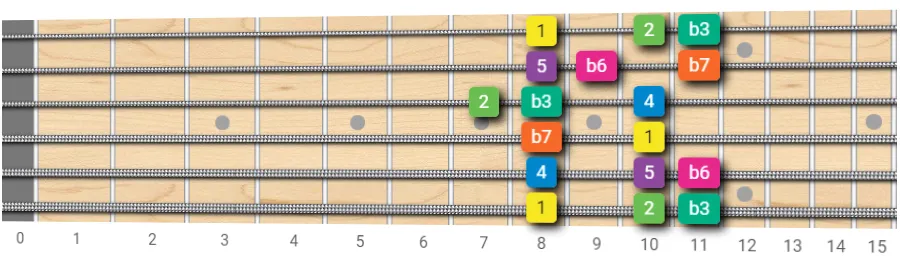
Minor Scale
The minor scale is another important scale to learn, and it's relative to the major scale.
Dorian Scale
The Dorian scale is massively used in Jazz and Rock; it's a variation of the minor scale.
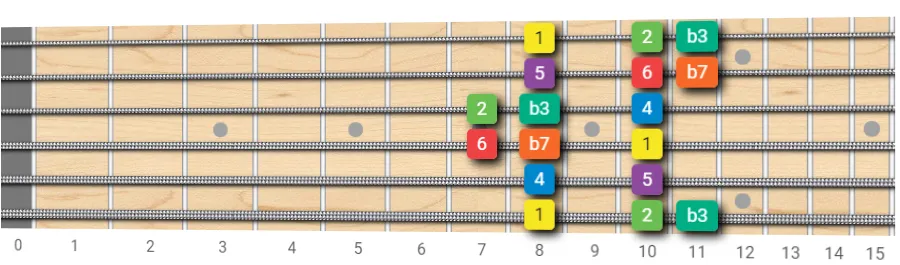
Mixolydian Scale
The Mixolydian scale is a Major scale with a flattened 7th, it has a Bluesy feeling.
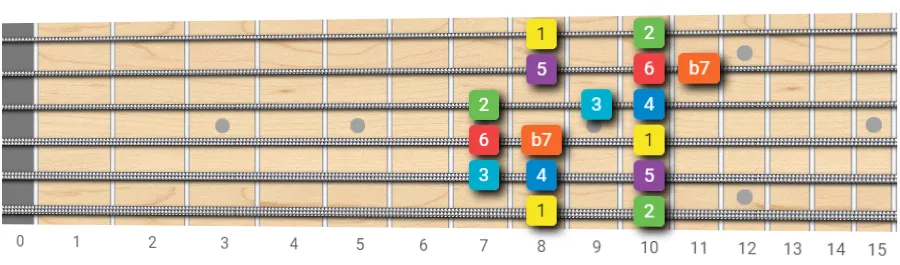
Lydian Scale
The Lydian scale, thanks to its raised 4th, has an unique dreamy effect.
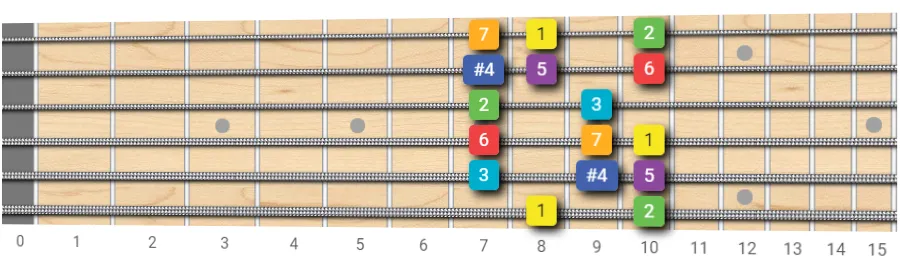
Drill down: You find many more guitar scale diagrams in my complete ebook Scales Over Chords.
All Guitar Scales Table
The tables below show you the formula for most of the existing guitar scales, and a link to drill down and learn fretboard patterns, chords from scale, how to use a scale and so forth.
To get the most of these scale formula tables, be sure to know what is an interval!
Common Scales
| Scale | Formula |
|---|---|
| Major Scale |
1
b2
2
b3
3
4
b5
5
#5
6
b7
7
|
| Minor Scale |
1
b2
2
b3
3
4
b5
5
b6
6
b7
7
|
| Major Pentatonic Scale |
1
b2
2
b3
3
4
b5
5
#5
6
b7
7
|
| Minor Pentatonic Scale |
1
b2
2
b3
3
4
b5
5
#5
6
b7
7
|
| Major Blues Scale |
1
b2
2
b3
3
4
b5
5
#5
6
b7
7
|
| Minor Blues Scale |
1
b2
2
b3
3
4
b5
5
#5
6
b7
7
|
Modes from the Major Scale
| Scale | Formula |
|---|---|
| Major Scale (Ionian) |
1
b2
2
b3
3
4
b5
5
#5
6
b7
7
|
| Dorian Scale |
1
b2
2
b3
3
4
b5
5
#5
6
b7
7
|
| Phrygian Scale |
1
b2
2
b3
3
4
b5
5
b6
6
b7
7
|
| Lydian Scale |
1
b2
2
b3
3
4
#4
5
#5
6
b7
7
|
| Mixolydian Scale |
1
b2
2
b3
3
4
b5
5
#5
6
b7
7
|
| Minor Scale (Aeolian) |
1
b2
2
b3
3
4
b5
5
b6
6
b7
7
|
| Locrian Scale |
1
b2
2
b3
3
4
b5
5
b6
6
b7
7
|
| Harmonic Major Scale |
1
b2
2
b3
3
4
b5
5
b6
6
b7
7
|
Modes From The Harmonic Minor Scale
| Scale | Formula |
|---|---|
| Harmonic Minor (Aeolian Maj 7) |
1
b2
2
b3
3
4
b5
5
b6
6
b7
7
|
| Locrian #6 Scale |
1
b2
2
b3
3
4
b5
5
#5
6
b7
7
|
| Ionian #5 Scale |
1
b2
2
b3
3
4
b5
5
#5
6
b7
7
|
| Dorian #4 Scale |
1
b2
2
b3
3
4
#4
5
#5
6
b7
7
|
| Phrygian Dominant Scale |
1
b2
2
b3
3
4
b5
5
b6
6
b7
7
|
| Lydian #2 Scale |
1
b2
2
b3
3
4
#4
5
#5
6
b7
7
|
| Super Locrian Bb7 Scale |
1
b2
2
b3
3
4
b5
5
b6
bb7
b7
7
|
Modes from The Melodic Minor Scale
| Scale | Formula |
|---|---|
| Melodic Minor Scale |
1
b2
2
b3
3
4
b5
5
#5
6
b7
7
|
| Dorian B2 Scale |
1
b2
2
b3
3
4
b5
5
#5
6
b7
7
|
| Lydian Augmented Scale |
1
b2
2
b3
3
4
#4
5
#5
6
b7
7
|
| Lydian Dominant Scale |
1
b2
2
b3
3
4
#4
5
#5
6
b7
7
|
| Mixolydian B6 Scale |
1
b2
2
b3
3
4
b5
5
b6
6
b7
7
|
| Aeolian B5 Scale |
1
b2
2
b3
3
4
b5
5
b6
6
b7
7
|
| Super Locrian Scale |
1
b2
2
b3
3
4
b5
5
b6
6
b7
7
|
Symmetrical And Diminished Scales
| Scale | Formula |
|---|---|
| Augmented Scale |
1
b2
2
b3
3
4
b5
5
#5
6
b7
7
|
| Whole-Tone Scale |
1
b2
2
b3
3
4
#4
5
#5
6
b7
7
|
| Whole-Half Scale |
1
b2
2
b3
3
4
b5
5
b6
6
b7
7
|
| Half-Whole Scale |
1
b2
2
b3
3
4
#4
5
#5
6
b7
7
|
Exotic Scales
| Scale | Formula |
|---|---|
| Indian Scale |
1
b2
2
b3
3
4
b5
5
b6
6
b7
7
|
| Japanese Scale |
1
b2
2
b3
3
4
b5
5
b6
6
b7
7
|
| Gipsy Hungarian Scale |
1
b2
2
b3
3
4
#4
5
b6
6
b7
7
|
| Neapolitan Scale |
1
b2
2
b3
3
4
b5
5
#5
6
b7
7
|
| Persian Scale |
1
b2
2
b3
3
4
b5
5
b6
6
b7
7
|
| Jewish Scale |
1
b2
2
b3
3
4
b5
5
b6
6
b7
7
|
| Bizantine Scale |
1
b2
2
b3
3
4
b5
5
b6
6
b7
7
|
| Arabic Scale |
1
b2
2
b3
3
4
#4
5
#5
6
b7
7
|
You can even mix two scales together to generate new interesting structures, as explained in this hybrid scales tutorial.
Guitar Scales Exercises
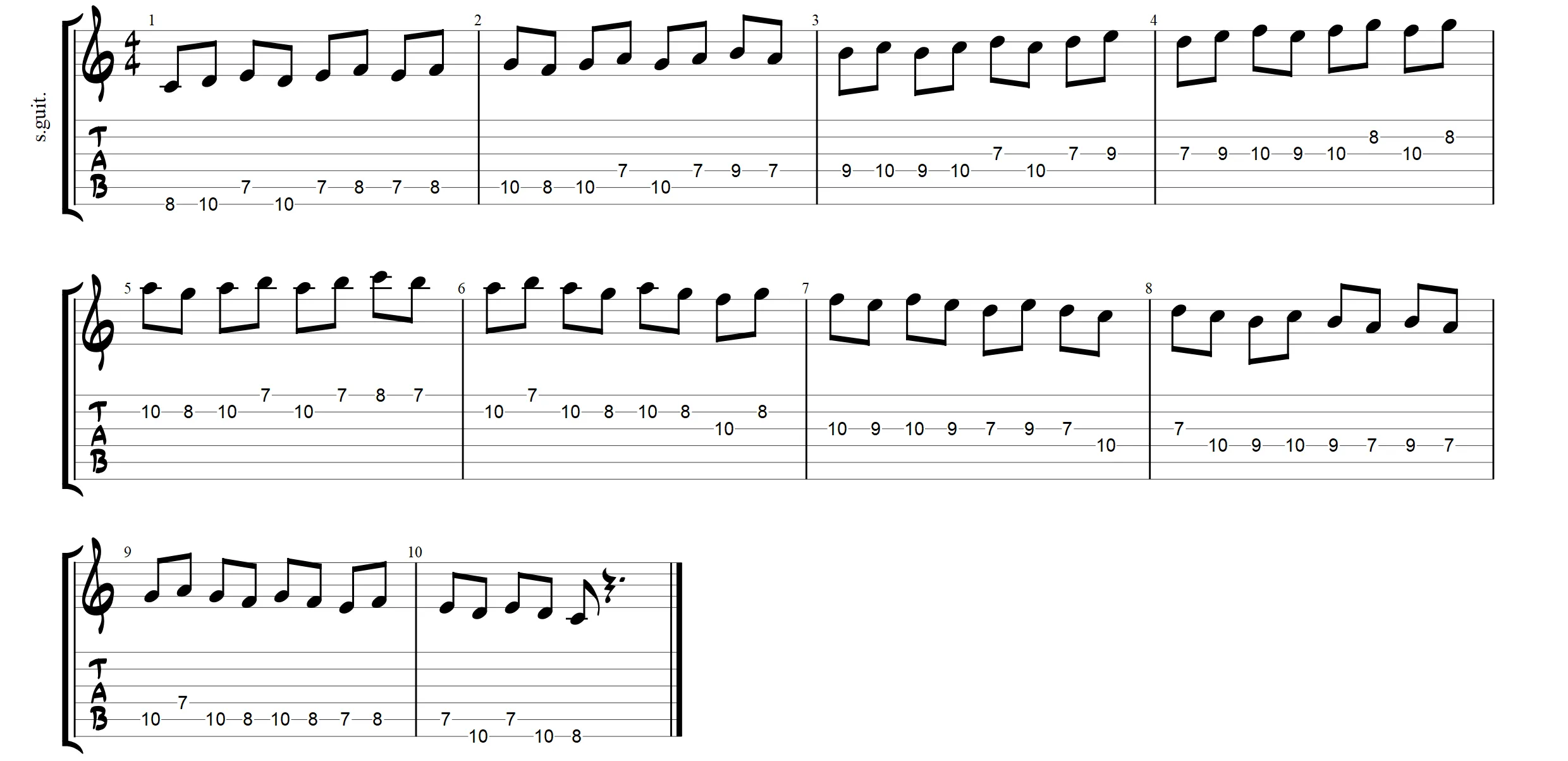
Here below you find a great exercise that will help improve your scale speed and agility. It's based on the C major scale, I suggest approaching the pattern with the medium finger at the 8th fret.
For more things to practice, go to guitar scales exercises full list.
Which Scales Should I Play Over This Chord?
 This is a common question that often confuses beginners. It's common practice to play a major scale over
a major chord, a minor scale over a minor chord, and so forth.
This is a common question that often confuses beginners. It's common practice to play a major scale over
a major chord, a minor scale over a minor chord, and so forth.
Things get complicated when the harmony becomes more complex: dominant, altered, diminished chords, to name a few.
Which scales play well over those chord types? A good approach is to check the tones that compose the chord and what scale matches well with them.
Drill down: You can learn more about this method in my scale chord application tutorial.
Guitar Scales: Frequently Asked Questions
What is a guitar scale?
A guitar scale is an ordered sequence of notes played one at a time, from a starting note (the root) up to the same note one octave higher. Each scale type has a unique formula of intervals that gives it a recognizable sound, like Major, Minor, Pentatonic or Blues.
What is the easiest guitar scale for beginners?
The minor pentatonic scale is the easiest scale for beginners. It only has five notes, sits in a single 4-fret box, and works over blues, rock and pop. Most guitarists start with the A minor pentatonic at the 5th fret.
How many guitar scales are there?
There are dozens of guitar scales in common use, but most players only need a handful. This page covers 35+ scales including Major, Minor, Major and Minor Pentatonic, Blues, the seven modes, Harmonic Minor, Melodic Minor, symmetrical scales and exotic scales like Gipsy Hungarian and Japanese.
What is the difference between a scale and a mode?
A mode is a scale derived by starting on a different degree of a parent scale. For example, the seven modes (Ionian, Dorian, Phrygian, Lydian, Mixolydian, Aeolian, Locrian) all use the notes of the same Major scale but each starts on a different note, giving each mode its own characteristic sound.
Are guitar scale patterns movable?
Yes. Guitar scale patterns are movable shapes: once you learn the box pattern for a scale you can shift it up or down the fretboard to play the same scale in any key. Move the C major box up two frets to play D major, up five frets to play F major.
Which scale should I play over a chord?
As a rule of thumb, play a major scale over a major chord, a minor scale over a minor chord, and the minor pentatonic or blues scale over dominant 7 chords. For altered, diminished and extended chords, match the scale to the chord tones, modes and the harmonic and melodic minor scales become useful.
Do I need to know music theory to learn guitar scales?
No, you can start by memorizing the box shapes and playing them over backing tracks. But learning a small amount of theory, intervals, scale degrees and formulas, makes scales far easier to remember, transpose and apply to real songs.
Does the scale finder work for left-handed guitar and alternate tunings?
Yes. The interactive scale finder includes a left-handed mode that flips the fretboard, and supports alternate tunings such as Drop D, DADGAD and Open G, so the diagrams stay accurate to your setup.
More Resources To Improve Your Guitar Scales Skills
Our introduction to guitar scales ends here.
To stay updated on new tutorials, subscribe to the free newsletter (you'll also get access to the download area with many free printable resources)
I'll leave you with some more resources to further deepen your music knowledge: