F m9 Guitar Chord
Chord Diagrams, Interactive Fretboard and Chord Theory
F minor 9th guitar chord is also written as Fm9, Fmin9 or F-9.
Position 1
Movable
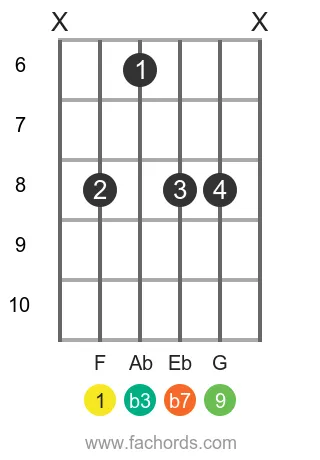
Position 2
Barre
Movable
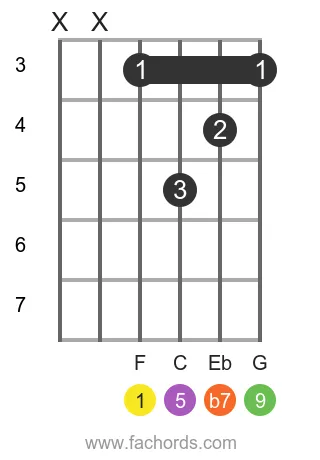
Position 3
Barre
Movable
 Find more shapes in our all guitar chords online library. If you
prefer a printable pdf, download
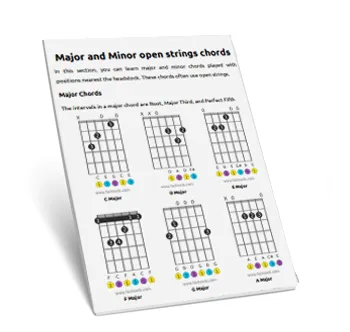
the Free Guitar Chords Chart Pdf
Find more shapes in our all guitar chords online library. If you
prefer a printable pdf, download
the Free Guitar Chords Chart Pdf
You can also use this accessible Fm9 chord page, with written diagram instructions and screen-reader support for blind users.
Practice Fm9: Master the F Minor Ninth Chord with Real-Time Feedback
Want a structured chord roadmap instead of jumping between pages?
Go to the full guitar chords tutorial.
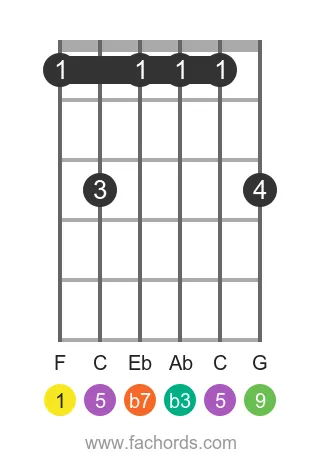
Ready to tackle the complex Fm9 chord? Use our interactive fretboard to immediately test your playing, getting instant mic feedback to confirm your accuracy. Our unique tool provides precise playback, helping you refine your finger positioning and rhythm. This rich F minor ninth chord is composed of the notes F, Ab, C, Eb, and G, built from the intervals 1 (Root), b3 (Minor Third), 5 (Perfect Fifth), b7 (Minor Seventh), and 9 (Major Ninth), offering a sophisticated sound often found in jazz and R&B.
The Fm9 chord, as a ninth chord, introduces extended harmony and rich color tones beyond a basic minor triad, adding depth and sophistication to your playing. Understanding how these extended chords are built from stacked intervals is crucial for true mastery; explore our guide on Chord Construction to deepen your theoretical knowledge. For a broader perspective on similar advanced voicings, delve into our dedicated article on Ninth Chords. Developing smooth transitions into and out of complex chords like this will elevate your performance, so consider practicing with our Improve Chords Change tutorial.
Below, you'll find comprehensive diagrams showcasing various fingerings for the Fm9 chord, ranked from the most accessible to more advanced voicings. Before diving into static charts, we encourage you to use our interactive fretboard above to truly internalize the sound and feel of this chord. Apply your new theoretical understanding to practical song contexts, ensuring you can integrate the Fm9 seamlessly into your playing across different keys. Test your skills, refine your technique, and build a strong foundation for advanced harmony.
F m9 chord Notes:
Formula of the Minor Ninth chord:
Play This Chord With Other Roots
C m9 | D m9 | E m9 | F m9 | G m9 | A m9 | B m9 | C#m9 | D#m9 | F#m9 | G#m9 | A#m9 | Abm9 | Bbm9 | Dbm9 | Ebm9 | Gbm9

Created by
Giancarlo is a musician (teaching guitar since 2000), software engineer, AI consultant and published researcher
FAQ
What notes are in an Fm9 chord?
The F minor ninth (Fm9) chord is composed of five specific notes: F, Ab, C, Eb, and G. These notes are combined to create its unique harmonic quality.
What are the intervals that make up an Fm9 chord?
The Fm9 chord is constructed using the following intervals relative to its root note (F): the Root (1), Minor Third (b3), Perfect Fifth (5), Minor Seventh (b7), and Major Ninth (9). Understanding these intervals is key to mastering the chord's structure.
Why does the Fm9 chord have a 'rich, complex sound'?
The Fm9 chord's rich and complex sound comes from the specific blend of its intervals, especially the addition of the minor seventh (b7) and major ninth (9) to the basic minor triad. These extended notes introduce additional harmonic color and depth that contribute to its sophisticated quality.
How is an Fm9 chord different from a basic F minor chord?
An F minor (Fm) chord typically consists of the Root, Minor Third, and Perfect Fifth (F, Ab, C). The F minor ninth (Fm9) chord expands on this by adding two more intervals: a Minor Seventh (Eb) and a Major Ninth (G). These additions give the Fm9 a fuller and more intricate sound compared to a simple F minor chord.
What does the 'm9' in Fm9 mean in chord notation?
In the Fm9 chord symbol, the 'm' indicates that the chord has a minor third interval, making the overall chord quality minor. The '9' signifies the inclusion of a major ninth interval in the chord structure, and implicitly, it also includes the minor seventh interval.
In what musical styles is the Fm9 chord commonly used?
The Fm9 chord is often used in more advanced music styles, particularly in jazz. Its complex and expressive harmonic qualities make it a popular choice for musicians looking to create sophisticated and nuanced chord progressions.