Practice the F9(#5) Guitar Chord with Interactive Tools
Want a structured chord roadmap instead of jumping between pages?
Go to the full guitar chords tutorial.
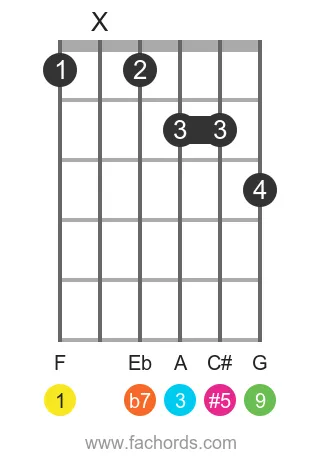
Are you ready to tackle the distinctive sound of the F 9(#5) chord? Immediately put your skills to the test with our interactive fretboard. Our real-time microphone feedback system will confirm your accuracy as you play, ensuring you nail every note. This augmented chord, comprised of the notes F, A, C#, Eb, and G, features the unique intervals of a Root (1), Major Third (3), Augmented Fifth (#5), Minor Seventh (b7), and Major Ninth (9). Use the virtual fretboard to visualize these intricate fingerings and hear the precise chord playback.
As a member of the extended harmony family, the F 9(#5) chord goes beyond basic triads by incorporating a ninth and a sharp fifth, adding rich color tones to your playing. This chord, not typically for beginners, is often found in jazz progressions and can significantly enhance your harmonic palette. To truly understand its structure, it's crucial to grasp the fundamentals of chord construction and how these unique intervals function. Expanding your knowledge of ninth chords will open up new musical avenues.
Beyond the initial exploration, scroll down to find detailed diagrams, organized from easiest to hardest, illustrating various voicings for the F 9(#5) chord. Dive deeper into the theory behind its construction and discover how it fits into different musical keys and songs. Before you review the static charts, challenge yourself to play the chord first using our interactive tool. See if you can accurately replicate its sound and feel on your guitar!
Notes that compose the F 9(#5) chord:
Tones of the Dominant Ninth Sharp Fifth chord:
F Dominant Ninth Sharp Fifth Guitar Chord Diagrams
Position 1
Barre
Movable
Position 2
Barre
Movable
 Find more shapes in our all guitar chords online library. If you
prefer a printable pdf, download
the Free Guitar Chords Chart Pdf
Find more shapes in our all guitar chords online library. If you
prefer a printable pdf, download
the Free Guitar Chords Chart Pdf
You can also use this accessible F9(#5) chord page, with written diagram instructions and screen-reader support for blind users.

Created by
Giancarlo is a musician (teaching guitar since 2000), software engineer, AI consultant and published researcher
FAQ
What are the key intervals that define the unique sound of the F9(#5) chord?
The unique sound of the F9(#5) chord is primarily defined by its Augmented Fifth (#5) and Major Ninth (9) intervals. The #5 creates a distinct tension characteristic of augmented chords, while the 9th adds an extended, complex, and often 'jazzy' color to the chord. The Minor Seventh (b7) also establishes it as a dominant-type chord.
Why is the F9(#5) chord categorized as an 'intermediate guitar chord'?
The F9(#5) chord is considered intermediate because it involves a combination of altered and extended intervals (#5, b7, 9) beyond basic triads or seventh chords. Understanding and executing these intervals requires a solid grasp of fretboard intervals and often more complex fingerings, making it a step up from beginner chords.
How does the 'augmented' part of F9(#5) relate to its construction?
The 'augmented' aspect of the F9(#5) chord comes directly from the Augmented Fifth (#5) interval in its construction. This means that the fifth note of the chord is raised by a half step compared to a standard perfect fifth, which gives the chord its characteristic tension and places it within the Augmented Chords family.
What role do the Minor Seventh (b7) and Major Ninth (9) intervals play in the F9(#5) chord?
The Minor Seventh (b7) interval is crucial as it establishes the F9(#5) as a dominant-type chord, which naturally creates a sense of wanting to resolve. The Major Ninth (9) is an extension that adds richness, harmonic depth, and a sophisticated, modern flavor, making the chord more colorful and complex than a basic augmented triad or seventh chord.
When is the F9(#5) chord typically used in musical contexts, especially in jazz?
The F9(#5) chord is frequently used in jazz chord progressions to create tension and add harmonic color. It often functions as a dominant chord that leads to a resolution, utilizing its inherent dissonance from the augmented fifth and ninth to create a more compelling movement within a progression.