Explore F#m9 Guitar Chord Shapes with Interactive Feedback
Want a structured chord roadmap instead of jumping between pages?
Go to the full guitar chords tutorial.
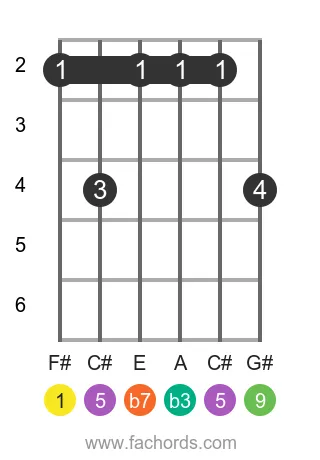
Discover the intricate geometry of the F#m9 chord across your guitar's fretboard. Visualize every fingering and explore its spatial layout using our interactive fretboard tool, which lets you instantly hear the chord played as a strum or arpeggio. Verify your finger placement with real-time microphone feedback, ensuring each note rings clear. This rich member of the Minor Chords family is built from the notes F#, A, C#, E, and G#, corresponding to the intervals Root (1), Minor Third (b3), Perfect Fifth (5), Minor Seventh (b7), and Major Ninth (9).
The F#m9 chord, with its distinctive ninth, introduces a sophisticated color to your harmonic palette, common in jazz and progressive rock. This extended harmony adds depth and complexity, creating rich soundscapes. To master such advanced voicings, understanding their foundation is key; explore our comprehensive guide on Ninth Chords. You can also dive into the fundamental principles of Chord Construction to grasp how this particular sound is built. Achieving fluid transitions between complex chords is crucial, so consider our tips to Improve Chords Change for smoother playing.
Below, you'll find a wealth of resources including detailed F#m9 chord diagrams, arranged from simple open positions to complex movable shapes, alongside in-depth music theory explanations, popular songs that feature this chord, and a list of keys where it naturally appears. Before you delve into memorizing these shapes, spend quality time exploring the interactive tool above. Set a rhythm with the drum & BPM tool, play the chord, and let the real-time feedback guide your hands. This active, exploratory approach is the most effective way to truly internalize the F#m9 chord and make its unique geometry your own.
Notes in the F# m9 chord:
Chord Structure:
F#m9 Guitar Chord Diagrams
Position 1
Movable
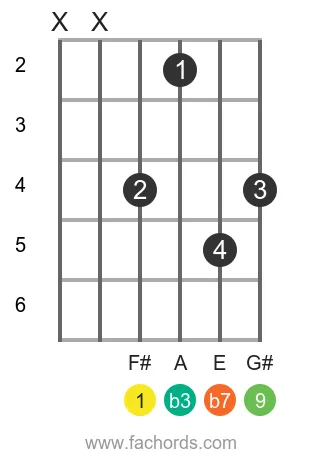
Position 2
Movable
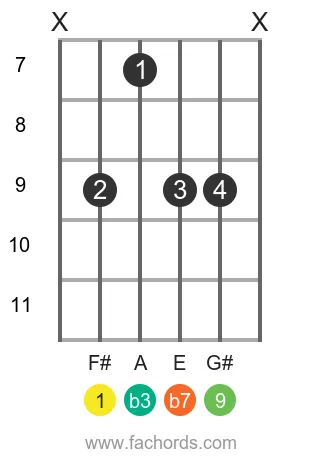
Position 3
Barre
Movable
 Find more shapes in our all guitar chords online library. If you
prefer a printable pdf, download
the Free Guitar Chords Chart Pdf
Find more shapes in our all guitar chords online library. If you
prefer a printable pdf, download
the Free Guitar Chords Chart Pdf
You can also use this accessible F#m9 chord page, with written diagram instructions and screen-reader support for blind users.
FAQ
What notes make up the F#m9 chord?
The F#m9 chord is composed of five distinct notes: F#, A, C#, E, and G#. These notes give the chord its specific sound.
What intervals are used to build the F#m9 chord?
The F#m9 chord is constructed using the intervals Root (1), Minor Third (b3), Perfect Fifth (5), Minor Seventh (b7), and Major Ninth (9). These intervals define its unique harmonic structure.
Why is the F#m9 chord considered an advanced chord?
The F#m9 chord is considered advanced because it extends beyond basic triads and seventh chords by including the Major Ninth interval. This adds complexity and sophistication, making it a valuable chord for expanding a guitarist's vocabulary.
What kind of musical sound does the F#m9 chord produce?
The F#m9 chord produces a unique sound that adds significant depth and complexity to music. It's known for its rich, expansive quality due to the inclusion of the Major Ninth.
In what musical genres is the F#m9 chord commonly found?
You will typically encounter the F#m9 chord in genres such as jazz and progressive rock. Its advanced nature and unique sound make it well-suited for these styles where more intricate harmonies are common.
What do the 'm' and '9' in 'F#m9' signify?
In F#m9, the 'm' signifies that it is a minor chord, indicating the presence of a Minor Third and a Minor Seventh interval from the root. The '9' indicates the inclusion of the Major Ninth interval, which is added to the minor seventh chord structure.
