E m9 Guitar Chord
Chord Diagrams, Interactive Fretboard and Chord Theory
E minor 9th guitar chord is also written as Em9, Emin9 or E-9.
Position 1
Open
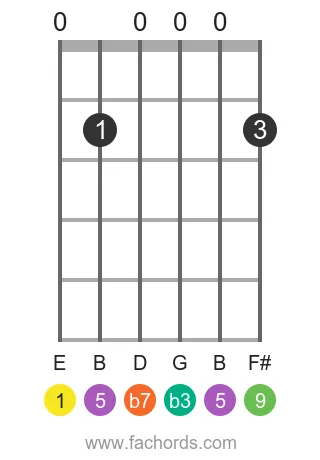
Position 2
Movable
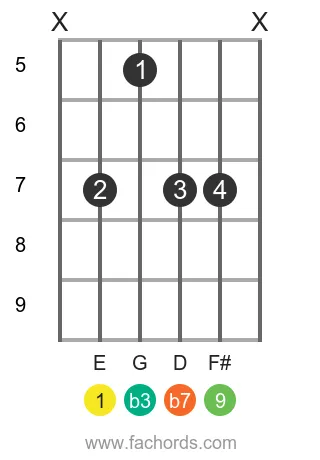
Position 3
Open
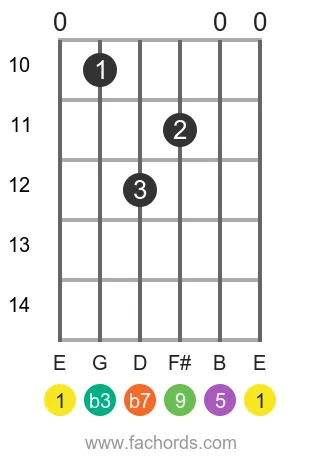
Position 4
Open
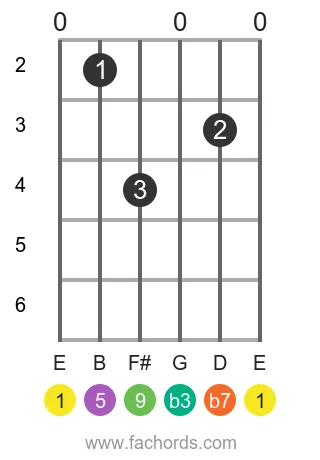
Position 5
Open
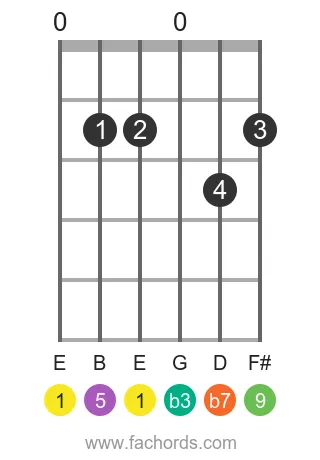
Position 6
Open
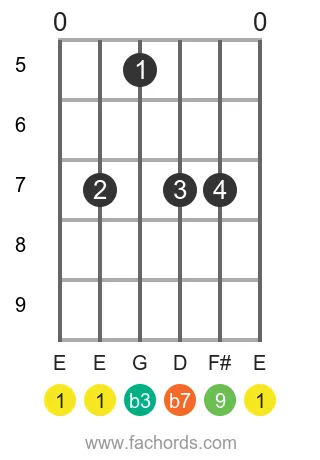
Position 7
Open
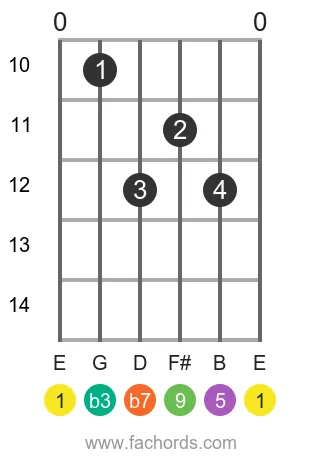
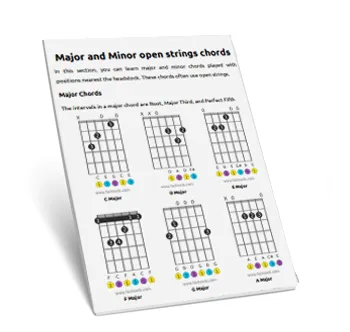
 Find more shapes in our all guitar chords online library. If you
prefer a printable pdf, download
the Free Guitar Chords Chart Pdf
Find more shapes in our all guitar chords online library. If you
prefer a printable pdf, download
the Free Guitar Chords Chart Pdf
You can also use this accessible Em9 chord page, with written diagram instructions and screen-reader support for blind users.
Practice Em9 Chord for Guitar: Charts & Interactive Lessons
Want a structured chord roadmap instead of jumping between pages?
Go to the full guitar chords tutorial.
Are you ready to truly nail the E m9 chord? This advanced minor ninth chord can be tricky, but our interactive fretboard is here to help you get it right. Play your version of the E m9 and immediately verify your accuracy with our real-time mic feedback. Composed of the notes E, G, B, D, and F#, this rich harmony is built upon the intervals of 1 (Root), b3 (Minor Third), 5 (Perfect Fifth), b7 (Minor Seventh), and 9 (Major Ninth). It's a beautiful, complex member of the Minor Chords family, ready for you to master.
The E m9 chord, as an extended ninth chord, adds a sophisticated layer of color and richness to your harmony. Understanding how these extensions work is key to unlocking new musical possibilities. This specific voicing builds upon a minor seventh chord by adding a major ninth, creating a sound often heard in jazz and neo-soul. To truly grasp how these beautiful extended chords are formed, a solid foundation in musical theory is essential. I recommend diving deeper into chord construction and exploring our dedicated ninth chords tutorial to expand your harmonic palette even further.
Below, you'll find comprehensive diagrams illustrating various fingerings for the E m9 chord, ranked from beginner-friendly to more advanced voicings. Before you dive into the theory and explore how this chord fits into different songs and keys, challenge yourself by finding these shapes on the interactive fretboard above. Use our tools to test your playing and ensure every note rings clear. Mastering this chord is an excellent step forward in your guitar journey, whether you're aspiring to play jazz or just enhance your overall musicianship.
Notes that compose the E m9 chord:
Chord Formula:
Play This Chord With Other Roots
C m9 | D m9 | E m9 | F m9 | G m9 | A m9 | B m9 | C#m9 | D#m9 | F#m9 | G#m9 | A#m9 | Abm9 | Bbm9 | Dbm9 | Ebm9 | Gbm9

Created by
Giancarlo is a musician (teaching guitar since 2000), software engineer, AI consultant and published researcher
FAQ
What notes are in an Em9 chord?
The E minor 9 (Em9) chord is constructed from the notes E, G, B, D, and F#. These represent the root, minor third, perfect fifth, minor seventh, and major ninth, respectively.
What are the specific musical intervals that define the Em9 chord?
The Em9 chord is built using these intervals relative to its root (E): the 1 (Root), b3 (Minor Third), 5 (Perfect Fifth), b7 (Minor Seventh), and 9 (Major Ninth). Understanding these intervals is crucial for comprehending the chord's structure.
How is an Em9 chord different from a basic E minor chord?
A basic E minor chord consists of the root (E), minor third (G), and perfect fifth (B). The Em9 chord expands upon this by adding two additional intervals: the minor seventh (D) and the major ninth (F#). This creates a richer and more harmonically complex sound.
Why is the Em9 chord described as having a 'rich and harmonically deep sound'?
The rich and deep sound of the Em9 chord comes from the inclusion of the minor seventh and major ninth intervals. These extensions add layers of complexity and color to the basic minor triad, creating a more sophisticated harmonic texture.
When would I typically use an Em9 chord in my guitar playing?
The Em9 is an advanced chord that significantly enhances your chord vocabulary. It is often found in jazz chord progressions and other contemporary styles where musicians seek to add sophistication, depth, and unique color to their harmonies, opening up new musical avenues.
Is the Em9 chord difficult for guitarists to learn?
While the Em9 chord is considered more advanced than standard major and minor chords, it is a rewarding chord to learn. Mastering it involves understanding its specific note composition and interval structure, and utilizing detailed chord diagrams and fretboard patterns.