Fretboard Geometry: Explore the E9#5 Guitar Chord
Want a structured chord roadmap instead of jumping between pages?
Download the step-by-step Guitar Chord Ebook
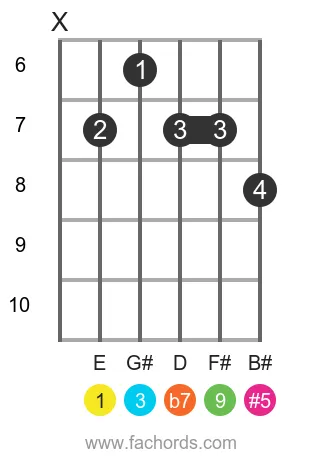
Discover the unique visual patterns of the E 9(#5) chord across your guitar fretboard. Our interactive virtual fretboard allows you to visualize and practice various voicings, ensuring you understand how this intriguing augmented chord lays out across the strings. Verify your accuracy instantly with real-time mic feedback as you play, then explore its theoretical construction: it's part of the Augmented Chords family, built from the notes E, G#, B#, D, and F#, corresponding to the 1 (Root), 3 (Major Third), #5 (Augmented Fifth), b7 (Minor Seventh), and 9 (Major Ninth) intervals.
Understanding the role of the ninth interval is key to appreciating the rich harmonic color of the E 9(#5) chord. As an extended harmony, the ninth adds a sophisticated, often jazzy, flavor beyond basic triads and seventh chords. To deepen your understanding of these advanced structures, explore our comprehensive guide on ninth guitar chords and delve into the fundamental principles of chord construction. This chord, with its augmented fifth and minor seventh, stands out in the dominant chord family, providing a unique tension that often resolves in unexpected ways.
Below, you'll find detailed diagrams illustrating different ways to finger the E 9(#5) chord, ranging from simpler voicings to more complex shapes. We'll also dive deeper into its theory and suggest musical contexts and songs where it shines. Don't just memorize patterns; use our interactive fretboard and arpeggio playback tool to truly explore these shapes across all keys, visualizing how the E9(#5) sounds and feels. Dive in and explore these unique augmented shapes before you commit them to memory!
E 9(#5) chord Notes:
Tones of the Dominant Ninth Sharp Fifth chord:
Fingerings for the E9(#5) guitar chord
Position 1
Barre
Movable
 Find more shapes in our all guitar chords online library. If you
prefer a printable pdf, download
the Free Guitar Chords Chart Pdf
Find more shapes in our all guitar chords online library. If you
prefer a printable pdf, download
the Free Guitar Chords Chart Pdf
You can also use this accessible E9(#5) chord page, with written diagram instructions and screen-reader support for blind users.

FAQ
What specifically makes the E 9(#5) chord an 'augmented' chord?
The E 9(#5) chord is classified as an augmented chord because of its Augmented Fifth interval (#5). While it also includes a Minor Seventh (b7) and a Major Ninth (9), the distinguishing feature that places it in the Augmented Chords family is the presence of the #5 interval.
What are the exact notes that make up the E 9(#5) chord?
The E 9(#5) chord is composed of five specific notes: E (Root), G# (Major Third), B# (Augmented Fifth), D (Minor Seventh), and F# (Major Ninth).
How does the E 9(#5) chord differ from a standard E9 chord?
The primary difference lies in the fifth interval. A standard E9 chord would include a natural fifth (B), while the E 9(#5) chord features an augmented fifth (B#). This altered fifth is what gives the E 9(#5) its unique 'augmented' characteristic and distinct sound, while both chords share the root, major third, minor seventh, and major ninth.
Why is the note B# used in the E 9(#5) chord instead of C?
The B# is used to maintain correct theoretical spelling based on intervals. Starting from the root E, the fifth scale degree is B. To create an augmented fifth, you raise the B by a half-step, resulting in B#. Although B# is enharmonically equivalent to C, calling it B# correctly reflects its function as the augmented fifth interval (1-#5) in relation to the E root.
In what musical situations or genres would I typically encounter or use an E 9(#5) chord?
The E 9(#5) chord is generally found in more complex musical contexts and genres. It is frequently utilized in jazz music, where its unique, tension-filled sound can add color and movement to chord progressions. It's considered a chord for exploring sounds beyond basic harmonies.
What do the '9' and '(#5)' signify in the chord name E 9(#5)?
In the E 9(#5) chord name, 'E' is the root. The '9' indicates the presence of a Major Ninth interval (F#) in addition to the root, third, and seventh. The '(#5)' explicitly signifies that the fifth interval is augmented (B#), rather than a natural (perfect) fifth (B) or a diminished fifth. This notation precisely defines the chord's unique structure.
