Eb9b5 Guitar Chord | Play, Hear and Master Interactively
Want a structured chord roadmap instead of jumping between pages?
Go to the full guitar chords tutorial.
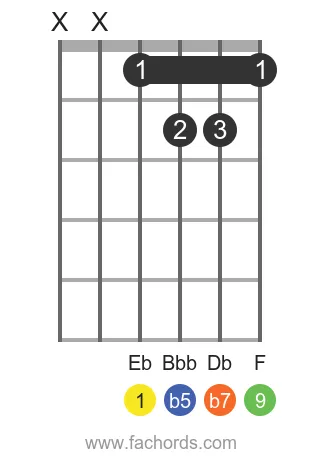
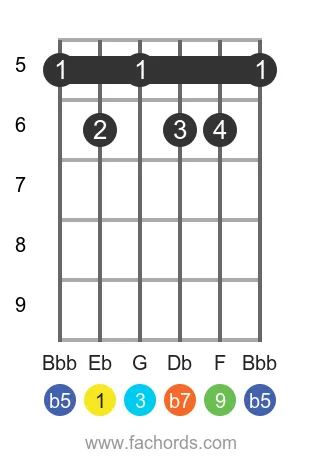
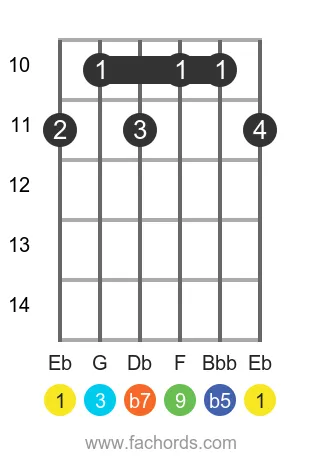
The Eb9b5 chord belongs to the Dominant Chords family, composed of the notes Eb, G, Bbb, Db, and F. These correspond to the intervals Root (1), Major Third (3), Diminished Fifth (b5), Minor Seventh (b7), and Major Ninth (9). Use the interactive fretboard tool at the top of this page to visualize every possible fingering, listen to the chord played as a strum or arpeggio, and get instant feedback on your playing accuracy with the real-time microphone feature.
This intriguing 9th chord, with its diminished fifth, offers a rich, complex sound often utilized in jazz and other sophisticated genres to create harmonic tension and color. To truly grasp its construction and role, explore our in-depth guide on Ninth Chords. Understanding the fundamental building blocks can be deepened through our Chord Construction tutorial, and you can learn more about its foundational quality in the Dominant Chord family. When you're ready to integrate it into your playing, our tips on how to Improve Chord Changes will help you play it smoothly.
Below, you'll discover a comprehensive collection of Eb9b5 chord diagrams, ranging from the easiest open positions to more advanced movable shapes, complete with music theory explanations, songs where this chord shines, and an overview of the keys where it's commonly found. Before you dive into the diagrams, make sure to spend some quality time with the interactive tool above. Set your preferred tempo with the drum and BPM tool, strum the chord, and let the mic feedback guide you. This immediate, hands-on practice is the fastest route to confidently adding the Eb9b5 to your repertoire.
Eb 9b5 chord Notes:
Tones in the Dominant Ninth Flat five chord:
Guitar Patterns for the Eb Dominant Ninth Flat five chord
Position 1
Barre
Movable
Position 2
Barre
Movable
Position 3
Barre
Movable
 Find more shapes in our all guitar chords online library. If you
prefer a printable pdf, download
the Free Guitar Chords Chart Pdf
Find more shapes in our all guitar chords online library. If you
prefer a printable pdf, download
the Free Guitar Chords Chart Pdf
You can also use this accessible Eb9b5 chord page, with written diagram instructions and screen-reader support for blind users.
FAQ
What are the essential notes and intervals that make up the Eb 9b5 chord?
The Eb 9b5 chord is composed of the notes Eb, G, Bbb, Db, and F. These notes correspond to the intervals of 1 (Root), 3 (Major Third), b5 (Diminished Fifth), b7 (Minor Seventh), and 9 (Major Ninth) respectively, relative to the root Eb.
Why is the Eb 9b5 chord categorized as a 'Dominant Chord'?
The Eb 9b5 chord belongs to the Dominant Chords family primarily because it contains a root, major third, and a minor seventh (1, 3, b7). This specific combination of intervals is characteristic of dominant chords, providing a natural tension that often resolves to a tonic.
Why is the diminished fifth interval for Eb 9b5 written as 'Bbb' instead of 'A'?
In music theory, intervals are named based on their distance from the root within a scale, not just their enharmonic equivalent. For an Eb chord, the fifth note derived from the E-flat scale is Bb. To indicate a *diminished* fifth, we flat it, resulting in Bbb (B double-flat). This maintains the correct theoretical spelling of a fifth, even though Bbb sounds the same as A.
How do the 'b5' (Diminished Fifth) and '9' (Major Ninth) intervals contribute to the sound of the Eb 9b5 chord?
The 'b5' (Diminished Fifth) creates a distinct tension and a somewhat 'altered' quality, setting it apart from standard dominant chords. The '9' (Major Ninth) adds richness and a sophisticated, extended harmony. Together, these intervals give the Eb 9b5 chord its unique and 'interesting color,' making it a useful sound in various musical contexts.
When might a guitarist use an Eb 9b5 chord in their playing?
Guitarists typically use the Eb 9b5 chord in more advanced harmonic contexts, particularly within jazz chord progressions. Its unique combination of intervals allows it to add 'interesting color' and tension, providing a sophisticated sound often found alongside other extended chords like major 7th, minor 7th, and dominant 7th types.
