Explore the D m9 Chord: Rich Tones for Your Guitar
Want a structured chord roadmap instead of jumping between pages?
Go to the full guitar chords tutorial.
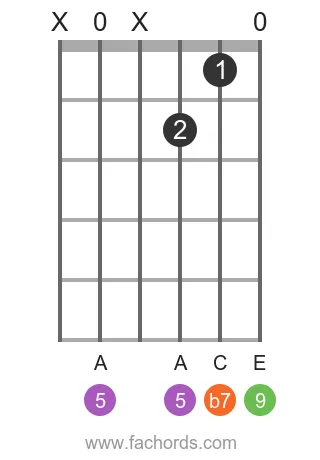
Dive into the expressive world of the D m9 chord, a rich and nuanced sound often found in jazz, R&B, and contemporary music. This intermediate minor chord is built from the notes D, F, A, C, and E, representing the intervals 1, b3, 5, b7, and 9 – the Root, Minor Third, Perfect Fifth, Minor Seventh, and Major Ninth. Our interactive fretboard is your personal exploration lab to discover its unique voice. Use the real-time mic feedback feature to accurately verify your playing and ensure every note rings true as you practice this sophisticated chord.
The addition of the ninth to a minor seventh chord extends its harmonic richness, providing a complex yet beautiful color that is highly valued in various musical styles. Understanding how these extended harmonies are built is crucial for any guitarist looking to deepen their musical vocabulary. You can explore the foundational principles of how chords are constructed by stacking intervals in our dedicated guide on Chord Construction. If you're eager to discover more sophisticated sonorities, our comprehensive resource on Ninth Chords will introduce you to a wide array of similar voicings, expanding your creative possibilities on the fretboard.
Before you analyze every nuance, start by experiencing the D m9 chord directly on our virtual fretboard. Experiment with different fingerings and listen to its sound, then check your accuracy using the mic feedback. Below, you will find comprehensive diagrams, ranked from the easiest to the most challenging, along with more in-depth theory, suggested songs where this chord shines, and ideas for using it across various musical keys. Your journey to mastering this expressive chord begins with playing.
D minor 9th guitar chord is also written as Dm9, Dmin9 or D-9.
D m9 chord Notes:
Formula of the Minor Ninth chord:
D M9 Guitar Chord Diagrams
Position 1
Open
Position 2
Movable
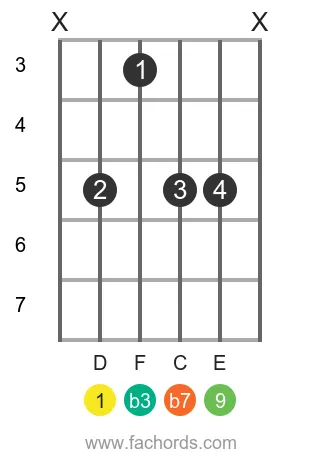
Position 3
Movable
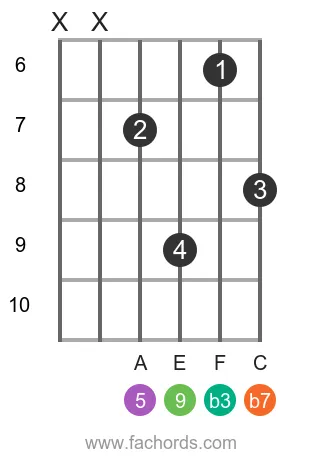
Position 4
Barre
Movable
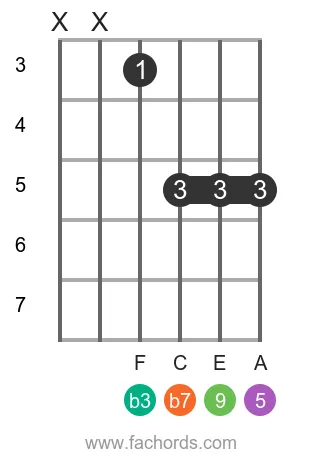
Position 5
Barre
Movable
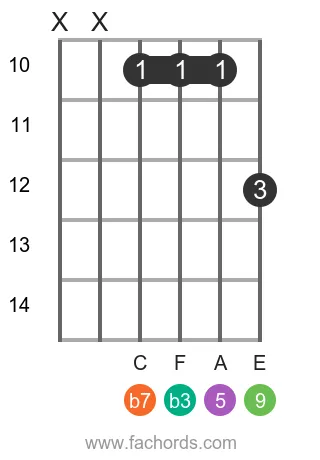
Position 6
Barre
Movable
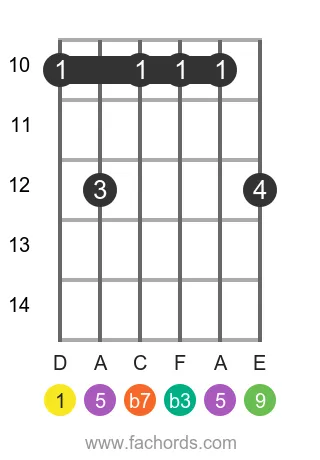
 Find more shapes in our all guitar chords online library. If you
prefer a printable pdf, download
the Free Guitar Chords Chart Pdf
Find more shapes in our all guitar chords online library. If you
prefer a printable pdf, download
the Free Guitar Chords Chart Pdf
You can also use this accessible Dm9 chord page, with written diagram instructions and screen-reader support for blind users.

Created by
Giancarlo is a musician (teaching guitar since 2000), software engineer, AI consultant and published researcher
FAQ
What notes are in a D m9 chord?
The D m9 chord is composed of five specific notes: D, F, A, C, and E. These notes combine to create its unique harmonic structure.
What are the specific intervals used to build the D m9 chord?
The D m9 chord is constructed using the intervals of the Root (1), Minor Third (b3), Perfect Fifth (5), Minor Seventh (b7), and Major Ninth (9). Understanding these intervals is key to comprehending the chord's construction.
Why is the D m9 chord considered an intermediate-level chord for guitarists?
This chord is classified as intermediate because its structure goes beyond basic major and minor chords. Its complexity stems from the specific combination of the minor third, minor seventh, and major ninth intervals.
How does the D m9 chord's sound differ from a basic D minor chord?
The D m9 chord offers a richer and more nuanced sound compared to a standard D minor chord. This enhanced quality is achieved by the inclusion of the minor seventh and major ninth intervals, which add harmonic depth.
What is the significance of the minor seventh and major ninth intervals in the D m9 chord?
The minor seventh (b7) and major ninth (9) intervals are crucial to the D m9 chord's identity. They expand the basic minor triad, adding layers of harmonic richness and a sophisticated, nuanced character to its sound.
Is the D m9 chord part of the Minor Chords family?
Yes, the D m9 chord is a member of the Minor Chords family. It builds upon the foundational minor chord structure by adding specific extended intervals.