Dbm9 Guitar Chord | Play, Hear and Practice Interactively
Want a structured chord roadmap instead of jumping between pages?
Go to the full guitar chords tutorial.
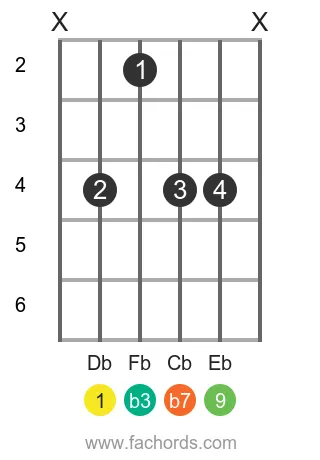
The Dbm9 chord is a complex and rich-sounding member of the Minor Chords family. It's built from the notes Db, Fb, Ab, Cb, and Eb, corresponding to the intervals 1 (Root), b3 (Minor Third), 5 (Perfect Fifth), b7 (Minor Seventh), and 9 (Major Ninth). Use the interactive fretboard tool on this page to visualize fingerings, hear the chord played as a strum or arpeggio, and get instant feedback on your accuracy with the real-time microphone feature.
As a ninth chord, the Dbm9 adds a sophisticated color, often found in jazz and R&B. Mastering it requires understanding how these extended harmonies are built – explore our guide on Ninth Chords to deepen your knowledge. For a broader understanding of how all chords are constructed, check out our comprehensive Chord Construction tutorial. Many Dbm9 voicings involve Guitar Bar Chords, so if those are challenging, you'll find helpful tips there. Once you've learned the shapes, focus on developing smooth chord changes to integrate it seamlessly into your playing.
Further down this page, you'll discover a comprehensive collection of Dbm9 chord diagrams, presented from the simplest open positions to more advanced movable shapes. We've also included essential music theory insights, popular songs that feature the Dbm9 chord, and information on the keys where it commonly appears. But before you delve into the diagrams, make sure to spend some time with the interactive tool above. Use the drum and BPM feature to set a rhythm, play the chord, and let the mic feedback guide your hand placement. This hands-on approach is the most effective way to truly internalize the Dbm9 and make it a natural part of your guitar repertoire. Happy practicing!
Db minor 9th guitar chord is also written as Dbm9, Dbmin9 or Db-9.
Db m9 chord Notes:
Chord Structure:
Db M9 Guitar Chord Diagrams
Position 1
Movable
Position 2
Movable
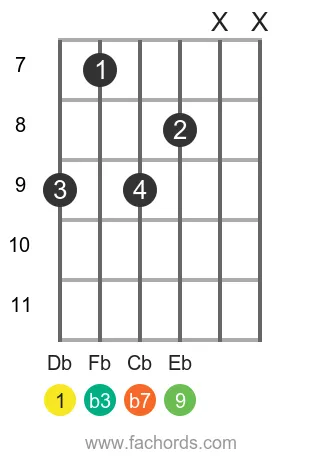
Position 3
Barre
Movable
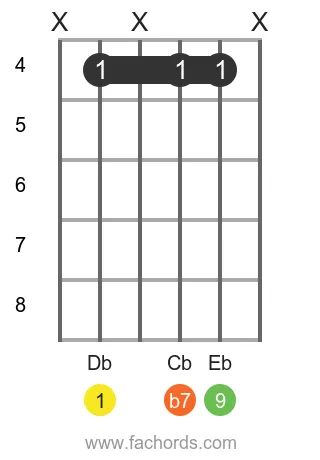
Position 4
Barre
Movable
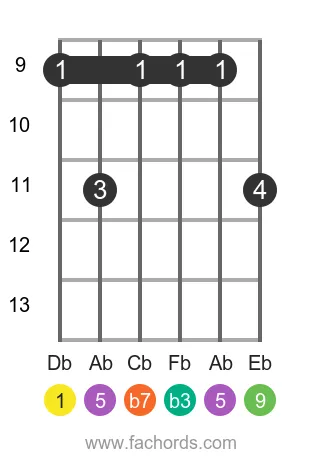
 Find more shapes in our all guitar chords online library. If you
prefer a printable pdf, download
the Free Guitar Chords Chart Pdf
Find more shapes in our all guitar chords online library. If you
prefer a printable pdf, download
the Free Guitar Chords Chart Pdf
You can also use this accessible Dbm9 chord page, with written diagram instructions and screen-reader support for blind users.

Created by
Giancarlo is a musician (teaching guitar since 2000), software engineer, AI consultant and published researcher
FAQ
What notes make up the Db m9 chord?
The Db m9 chord is composed of five specific notes: Db, Fb, Ab, Cb, and Eb. These notes are stacked to create its unique sound.
What are the specific intervals that define a Db m9 chord?
The Db m9 chord is constructed using these intervals relative to the root (Db): 1 (Root), b3 (Minor Third), 5 (Perfect Fifth), b7 (Minor Seventh), and 9 (Major Ninth).
Why is the note Fb used in Db m9 instead of E natural?
The Fb note is used to correctly represent the minor third interval (b3) above the root, Db. Although E natural is enharmonically the same pitch as Fb, using Fb maintains the theoretical consistency of stacking musical thirds to build the chord.
How does a Db m9 chord differ from a basic Db minor chord?
A basic Db minor chord typically includes the root (Db), minor third (Fb), and perfect fifth (Ab). The Db m9 chord expands on this by adding a minor seventh (Cb) and a major ninth (Eb), making it sound much richer and more complex.
What does the '9' in Db m9 signify for the chord?
The '9' in Db m9 indicates the inclusion of a major ninth interval (Eb) added to the chord structure, building upon a minor seventh chord. This ninth interval is key to the chord's characteristic complex and sophisticated sound.
When is the Db m9 chord commonly used in music?
The Db m9 chord is frequently employed in jazz chord progressions. Its complex and harmonically rich qualities make it a popular choice for adding depth and color to musical arrangements.
