C# m Guitar Chord
Chord Diagrams, Interactive Fretboard and Chord Theory
C# minor guitar chord is also written as C#m, C#min, C#- or C#mi.
Position 1
Movable
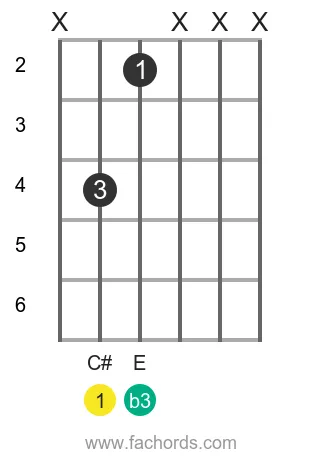
Position 2
Movable
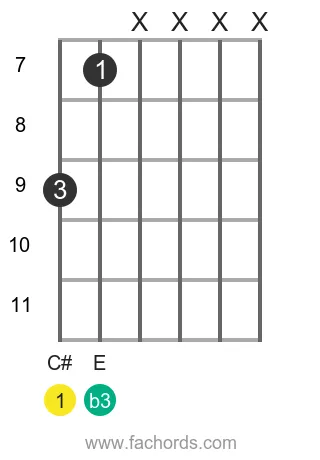
Position 3
Movable
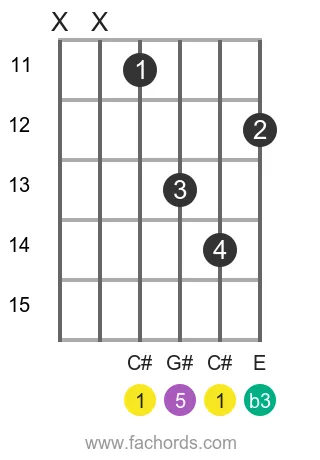
Position 4
Movable
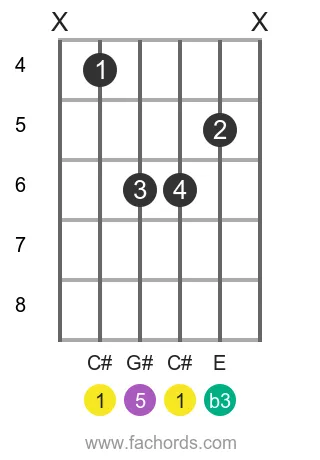
Position 5
Barre
Movable
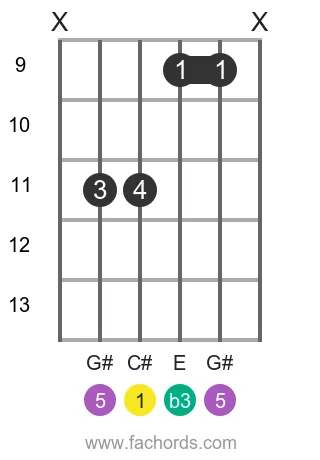
Position 6
Barre
Movable
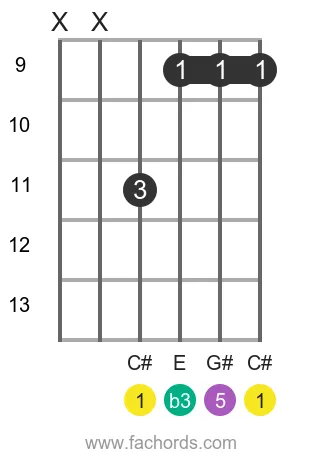
Position 7
Barre
Movable
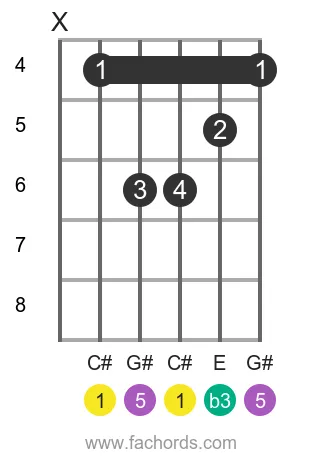
Position 8
Barre
Movable
 Find more shapes in our all guitar chords online library. If you
prefer a printable pdf, download
the Free Guitar Chords Chart Pdf
Find more shapes in our all guitar chords online library. If you
prefer a printable pdf, download
the Free Guitar Chords Chart Pdf
You can also use this accessible C#m chord page, with written diagram instructions and screen-reader support for blind users.
Explore and Master the C#m Guitar Chord Interactively
Want a structured chord roadmap instead of jumping between pages?
Go to the full guitar chords tutorial.
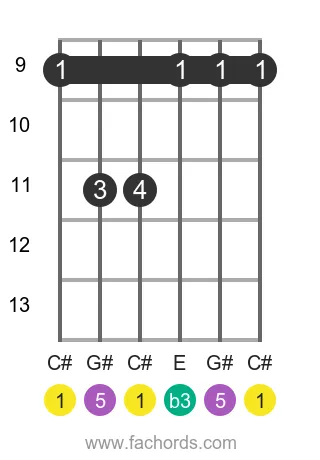
The C# minor chord, often used to evoke a melancholic or introspective mood in music, is a fundamental member of the Minor Chords family. It's constructed from the notes C#, E, and G#, representing the intervals Root (1), Minor Third (b3), and Perfect Fifth (5). Dive into its expressive potential using our interactive tool at the top of the page. Explore fingerings on the virtual fretboard, play its audio as a strum or arpeggio, and receive immediate verification of your playing accuracy with its real-time microphone feedback.
The distinctive emotional depth of the C#m chord, largely due to its minor third interval, is central to its use in countless songs across genres. To truly master this sound, a solid foundation in Chord Construction is invaluable. Given that many common voicings for this chord involve barre shapes, exploring our Guitar Bar Chords tutorial can significantly enhance your technique. Furthermore, practicing improving chord changes will ensure smooth and articulate musical phrases.
Below, you'll discover a comprehensive collection of C#m chord diagrams, organized from the simplest open positions to more intricate barre shapes. We also explore the underlying music theory, highlight popular songs featuring this chord, and indicate its common musical keys. Before you dive into the details, we encourage you to first engage with the interactive tool above. Experiment with the drum & BPM tool, strum the chord, and let the live mic feedback help you refine your playing by ear before dissecting the diagrams.
Notes in the C# m chord:
Chord Formula:
Play This Chord With Other Roots
C m | D m | E m | F m | G m | A m | B m | C#m | D#m | F#m | G#m | A#m | Abm | Bbm | Dbm | Ebm | Gbm

Created by
Giancarlo is a musician (teaching guitar since 2000), software engineer, AI consultant and published researcher
FAQ
What notes are in the C# minor chord?
The C# minor chord is fundamentally composed of three specific notes: C#, E, and G#. These three notes are the essential building blocks for any C# minor chord shape you play on the guitar.
Why is the C# minor chord called a 'minor' chord?
The C# minor chord is classified as 'minor' due to its specific interval structure, most notably the 'b3' or Minor Third interval. In this chord, the notes are C# (Root), E (Minor Third), and G# (Perfect Fifth). The presence of the Minor Third (E in relation to C#) defines its characteristic minor quality.
What do the intervals 1, b3, and 5 represent in the C# minor chord?
The intervals 1, b3, and 5 are a shorthand notation for the specific musical relationships between the notes that form the C# minor chord, relative to its root note, C#. * 1 (Root): This is the foundational note of the chord, which is C# itself. * b3 (Minor Third): This represents the note E, which is a minor third interval above the root C#. * 5 (Perfect Fifth): This indicates the note G#, which is a perfect fifth interval above the root C#. These intervals define the unique sound and structure of the C# minor chord.
How do chord diagrams and fretboard patterns assist in mastering the C# minor chord?
Chord diagrams and fretboard patterns are visual tools that clearly illustrate where the C#, E, and G# notes are located on the guitar strings and frets to form the C# minor chord. By studying these patterns, you can see how the Root, Minor Third, and Perfect Fifth intervals are physically laid out, which connects the theoretical understanding to the practical application of playing, ultimately helping you to visualize and remember the chord shapes more effectively.