C# 9-sharp-11 Guitar Chord
Chord Diagrams, Interactive Fretboard and Chord Theory
C# 9th with sharp 11th guitar chord is also written as C#9(#11), C#9#11 or C#9+11.
Position 1
Barre
Movable

 Find more shapes in our all guitar chords online library. If you
prefer a printable pdf, download
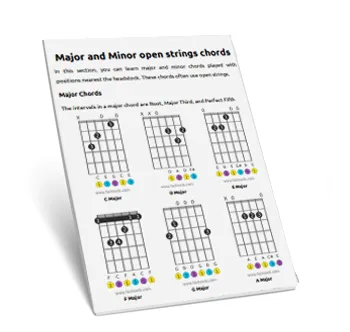
the Free Guitar Chords Chart Pdf
Find more shapes in our all guitar chords online library. If you
prefer a printable pdf, download
the Free Guitar Chords Chart Pdf
You can also use this accessible C#9(#11) chord page, with written diagram instructions and screen-reader support for blind users.
Explore the C# 9(#11) Guitar Chord Interactively
Want a structured chord roadmap instead of jumping between pages?
Go to the full guitar chords tutorial.
To truly grasp the distinctive, jazzy tension of the C# 9(#11) chord, a rich and complex member of the Dominant Chords family, you'll want to experience its sound directly. This chord is built from the notes C#, E#, G#, B, D#, and F##, translating to the intervals 1 (Root), 3 (Major Third), 5 (Perfect Fifth), b7 (Minor Seventh), 9 (Major Ninth), and #11 (Augmented Fourth). Dive into its sophisticated harmony using our interactive fretboard tool: visualize fingerings, play the chord as a strum or arpeggio, and receive precise, real-time feedback on your accuracy through its microphone feature. This immediate interaction is the best way to internalize its unique voice.
This particular extended harmony, the C# 9(#11) chord, builds upon the foundational Dominant Chord structure by adding a major ninth and an augmented eleventh. This augmented eleventh creates a striking, often dissonant, color tone central to its distinctive sound in advanced jazz and fusion contexts. Deepen your theoretical understanding of how such complex chords are formed with our Chord Construction tutorial. For a comprehensive dive into these rich extended harmonies, explore our guide dedicated to Ninth Chords. As you get comfortable with the fingerings, focus on improving your chord changes for smoother musical expression.
Further down this page, you'll find a curated selection of C# 9(#11) chord diagrams, progressing from the most accessible open positions to more challenging barre shapes. These are complemented by in-depth music theory explanations, examples of popular songs where this chord shines, and an overview of common musical keys it appears in. But before dissecting the static visuals, remember to truly *play* and experiment with the interactive tool above. Utilize the drum and BPM tool to set your rhythm, strum the chord, and let the responsive mic feedback refine your technique. Engaging with the chord actively is far more effective than just memorizing shapes.
C# 9(#11) chord Notes:
How to create the Dominant Ninth Sharp Eleventh Added chord:
Play This Chord With Other Roots
C 9(#11) | D 9(#11) | E 9(#11) | F 9(#11) | G 9(#11) | A 9(#11) | B 9(#11) | C#9(#11) | D#9(#11) | F#9(#11) | G#9(#11) | A#9(#11) | Ab9(#11) | Bb9(#11) | Db9(#11) | Eb9(#11) | Gb9(#11)

Created by
Giancarlo is a musician (teaching guitar since 2000), software engineer, AI consultant and published researcher
FAQ
What are the specific notes and intervals that make up the C# 9(#11) chord?
The C# 9(#11) chord is composed of six distinct notes: C#, E#, G#, B, D#, and F##. These notes correspond to the following intervals relative to the C# root: the Root (1), Major Third (3), Perfect Fifth (5), Minor Seventh (b7), Major Ninth (9), and Augmented Eleventh (#11).
Why is the C# 9(#11) chord classified as a dominant chord?
This chord belongs to the dominant chord family because it contains the essential elements of a dominant 7th chord: a root, major third, and minor seventh (1-3-b7). The added 9th and #11th intervals are extensions that enhance and color this core dominant function, often creating tension that resolves to another chord.
What does the '#11' interval signify in the C# 9(#11) chord?
The '#11' in C# 9(#11) denotes an augmented eleventh. This interval is essentially a perfect fourth that has been raised by a half step. It adds a distinctive, often 'sharp' or 'cutting' sound to the chord, making it a popular choice for adding harmonic color and tension, especially in jazz.
When would a guitarist typically use a C# 9(#11) chord?
The C# 9(#11) chord is commonly found in more advanced compositions, particularly within jazz chord progressions. As a dominant chord with extended tensions, it's often used to create a richer, more complex harmonic texture or to lead to a subsequent chord with a strong sense of resolution.
Why are notes like E# and F## included in the C# 9(#11) chord instead of F natural or G natural?
Music theory requires intervals to be spelled correctly according to their scale degree. For a C# chord, the major third is E# (not F), and the augmented eleventh (derived from the fourth degree) is F## (not G natural). Although E# sounds like F natural and F## sounds like G natural (they are enharmonic equivalents), using E# and F## accurately reflects the intervallic structure from the C# root.
Why is the C# 9(#11) chord considered more advanced than other chords?
This chord is considered advanced due to its complex construction. It contains six notes and several extended intervals beyond a basic triad or 7th chord, including the 9th and augmented 11th. Mastering its unique fingerings on the guitar and understanding its theoretical role requires a solid foundation in music theory and fretboard knowledge.
