Explore the C# 6/9 Guitar Chord: Interactive Fretboard & Play
Want a structured chord roadmap instead of jumping between pages?
Download the step-by-step Guitar Chord Ebook
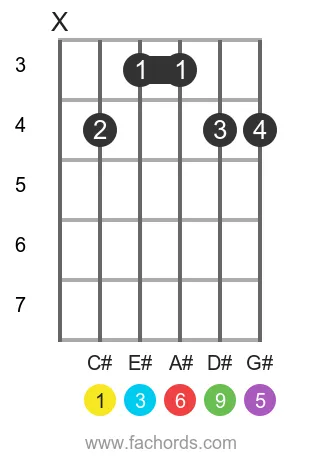
Discover the visual layout of the C# 6/9 chord across your fretboard with our interactive tool. This virtual fretboard helps you locate fingerings and understand the spatial relationships of notes. As you play, our real-time mic feedback verifies your accuracy, ensuring your fingers land perfectly. This rich Major Chords family member is built from C#, E#, G#, A#, and D#, representing the intervals Root (1), Major Third (3), Perfect Fifth (5), Major Sixth (6), and Major Ninth (9).
This sophisticated 6/9 chord adds a unique vintage and jazz sweetness to your playing, enriching harmonies in genres like jazz and funk. To further develop your understanding of these advanced voicings, explore our dedicated guides on 6th Chords and Ninth Chords. Understanding the fundamental principles of how any chord is constructed will also deepen your knowledge; consult our Chord Construction tutorial. Once you're comfortable with various fingerings, focus on making your chord changes smooth and musical.
Below, you'll find comprehensive chord diagrams, arranged from the easiest open positions to more advanced shapes, along with in-depth music theory, a list of songs featuring the C# 6/9, and common keys where it appears. Before you rush to memorize these fingerings, spend some time with the interactive tool above. Use the drum & BPM tool to set a rhythm, strum the chord, and let the mic feedback guide your finger placement. Explore the visual and auditory aspects of this chord first, internalizing its geometry and sound, before committing patterns to memory.
Notes in the C# 6/9 chord:
Chord structure of the Major Sixth Nine Added chord:
C#6/9 Guitar Chord Diagrams
Position 1
Movable
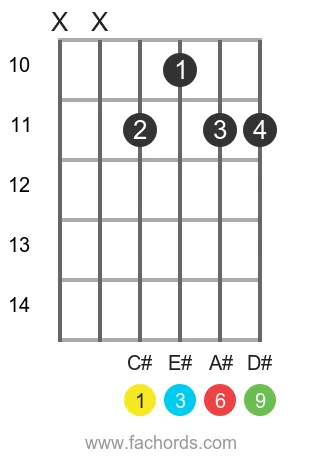
Position 2
Barre
Movable
Position 3
Barre
Movable
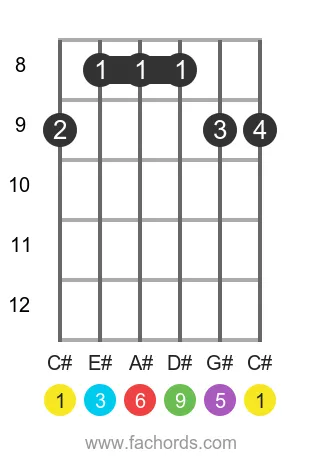
 Find more shapes in our all guitar chords online library. If you
prefer a printable pdf, download
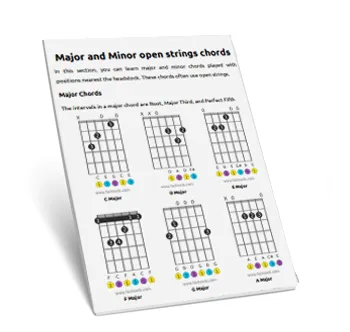
the Free Guitar Chords Chart Pdf
Find more shapes in our all guitar chords online library. If you
prefer a printable pdf, download
the Free Guitar Chords Chart Pdf
You can also use this accessible C#6/9 chord page, with written diagram instructions and screen-reader support for blind users.
FAQ
What notes are included in the C# 6/9 guitar chord?
The C# 6/9 chord is composed of five distinct notes: C# (the root), E# (the Major Third), G# (the Perfect Fifth), A# (the Major Sixth), and D# (the Major Ninth). These specific notes combine to create its unique sound.
Why is the C# 6/9 considered part of the 'Major Chords' family?
The C# 6/9 chord is classified as a major chord because its core structure includes a root, a Major Third (E#), and a Perfect Fifth (G#). The added Major Sixth (A#) and Major Ninth (D#) are extensions that enhance and color this fundamental major quality, without changing its basic major tonality.
How do the intervals (1, 3, 5, 6, 9) define the C# 6/9 chord?
These intervals represent the relationship of each chord tone to the root note (C#). The 1st (Root), 3rd (Major Third), and 5th (Perfect Fifth) establish the chord's major quality. The 6th (Major Sixth) adds a sweet, open quality, and the 9th (Major Ninth) provides a rich, jazzy extension, all stacked to create the chord's distinctive voice.
Is the C# 6/9 chord suitable for beginners, or only advanced guitarists?
While it's a more complex chord than basic major or minor triads, the C# 6/9 chord is not exclusively for advanced players. With focused practice and patience, even beginners can learn to master and incorporate this chord into their playing, adding a sophisticated touch to their repertoire.
When would I typically use a C# 6/9 chord in music?
The C# 6/9 chord is often utilized to add a rich, sophisticated flavor to compositions. It's particularly effective in jazz chord progressions, but it can also be used to enhance common chord progressions, providing a unique and more complex sound than a simple major chord.