B m9 Guitar Chord
Chord Diagrams, Interactive Fretboard and Chord Theory
B minor 9th guitar chord is also written as Bm9, Bmin9 or B-9.
Position 1
Open
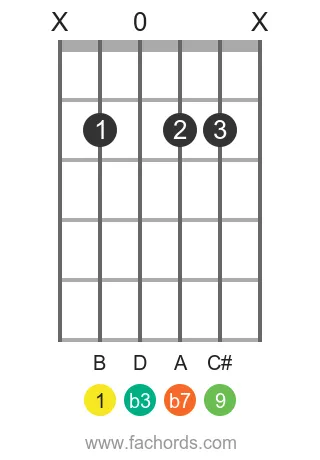
Position 2
Movable
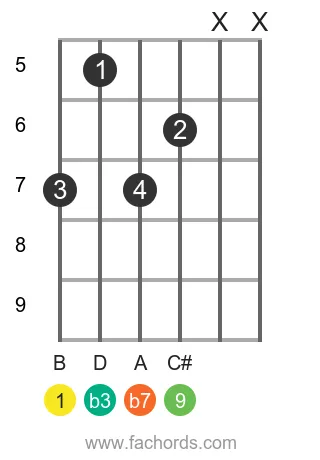
Position 3
Barre
Movable
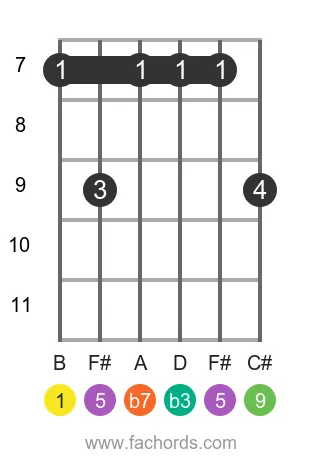
 Find more shapes in our all guitar chords online library. If you
prefer a printable pdf, download
the Free Guitar Chords Chart Pdf
Find more shapes in our all guitar chords online library. If you
prefer a printable pdf, download
the Free Guitar Chords Chart Pdf
You can also use this accessible Bm9 chord page, with written diagram instructions and screen-reader support for blind users.
Master the Bm9 Guitar Chord with Real-Time Feedback
Want a structured chord roadmap instead of jumping between pages?
Go to the full guitar chords tutorial.
Struggling to perfect the complex Bm9 chord? Jump straight into practice with our interactive fretboard, offering instant mic feedback to verify your finger placement and tone in real-time. This advanced Minor Chord is built from the notes B, D, F#, A, and C#, representing the intervals 1, b3, 5, b7, and 9 (Root, Minor Third, Perfect Fifth, Minor Seventh, and Major Ninth).
Ninth chords, like the Bm9, are perfect examples of extended harmony, adding rich color tones beyond the basic triad or seventh. Understanding how these extensions are built upon foundational chords is key to mastering advanced harmony. If you're keen on building chords by stacking intervals, our guide on Chord Construction can provide valuable insights. For a deeper dive into these vibrant extended harmonies, explore our dedicated section on Ninth Chords, and consider how they relate to simpler structures like 3-Note 7th Chords.
Explore the diverse diagrams below, ranked from easiest to hardest, to see the Bm9 chord in various positions. Beyond just memorizing shapes, you'll also find relevant theory to deepen your understanding and suggestions for songs where this chord shines. We encourage you to first utilize our interactive tool to test your grasp of the chord, then apply what you've learned to unlock its full musical potential.
Notes in the B m9 chord:
Chord Formula:
Play This Chord With Other Roots
C m9 | D m9 | E m9 | F m9 | G m9 | A m9 | B m9 | C#m9 | D#m9 | F#m9 | G#m9 | A#m9 | Abm9 | Bbm9 | Dbm9 | Ebm9 | Gbm9

Created by
Giancarlo is a musician (teaching guitar since 2000), software engineer, AI consultant and published researcher
FAQ
What notes are included in the Bm9 chord?
The Bm9 chord is composed of five distinct notes: B (the root), D (the minor third), F# (the perfect fifth), A (the minor seventh), and C# (the major ninth). These intervals create the chord's characteristic rich and complex sound.
What do the 'm' and '9' signify in the Bm9 chord name?
In the Bm9 chord name, the 'm' indicates that the chord is minor, meaning it contains a minor third interval from the root. The '9' signifies the addition of a major ninth interval, which is an extension built upon the minor seventh chord structure.
How does the Bm9 chord differ from a standard B minor chord or a Bm7 chord?
A standard B minor chord contains only the root, minor third, and perfect fifth (B, D, F#). A Bm7 chord adds the minor seventh (A) to those notes. The Bm9 chord further expands upon the Bm7 by adding the major ninth (C#), making it a more harmonically dense and advanced chord.
When is the Bm9 chord typically used in music?
The Bm9 chord is considered an advanced chord, often employed in jazz and other sophisticated music styles. Its lush, complex quality makes it ideal for adding harmonic richness and color, particularly within jazz chord progressions that frequently feature m7 and 9 chord types.
Is the Bm9 chord difficult to play for guitarists?
Yes, the Bm9 chord is generally considered more advanced. Its five-note composition often requires specific fingerings and stretches to articulate all notes clearly on the guitar, making it more challenging than basic minor or seventh chords. It usually requires some familiarity with intermediate chord shapes.