B9#5 Guitar Chord | Play, Hear and Practice It Interactively
Want a structured chord roadmap instead of jumping between pages?
Go to the full guitar chords tutorial.
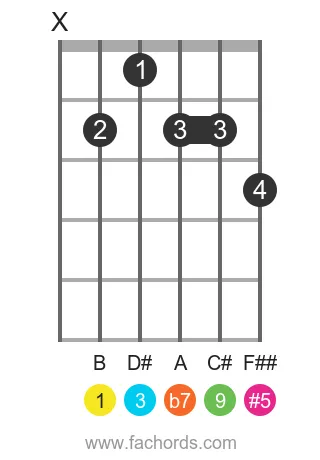
The B9#5 chord belongs to the Augmented Chords family and is built from the notes B, D#, F##, A, and C#. These correspond to the intervals Root (1), Major Third (3), Augmented Fifth (#5), Minor Seventh (b7), and Major Ninth (9). Use the interactive fretboard tool at the top of this page to visualize every fingering, hear the chord played as a strum or arpeggio, and get instant feedback on your playing with the real-time microphone feature.
This chord, with its augmented fifth and major ninth, creates a rich, complex sound often found in jazz and fusion. Understanding its structure is key to unlocking advanced harmony; you can delve deeper into how chords are built with our tutorial on Chord Construction. As a more complex voicing, the B9#5 often involves movable shapes, making our guide to Guitar Bar Chords a useful resource. If you're exploring these advanced voicings, our Ninth Chords tutorial offers more insights into this chord family. Mastering the transition into and out of such chords is crucial for fluid playing; find tips in our Improve Chords Change article.
Below, you'll discover comprehensive music theory for the B9#5, along with keys where it frequently appears and songs that feature this unique sound. We also provide multiple chord diagrams, arranged from the most accessible open positions to more challenging movable shapes. Before you dive into the diagrams, make sure to spend some time with the interactive tool above. Listen to the chord, set a tempo with the drum tool, and use the mic feedback to refine your finger placement and ensure each note rings clear. This hands-on practice loop is the most effective way to truly master the B9#5.
Notes in the B 9(#5) chord:
Chord formula for the Dominant Ninth Sharp Fifth chord:
Fingerings for the B Dominant Ninth Sharp Fifth guitar chord
Position 1
Barre
Movable
 Find more shapes in our all guitar chords online library. If you
prefer a printable pdf, download
the Free Guitar Chords Chart Pdf
Find more shapes in our all guitar chords online library. If you
prefer a printable pdf, download
the Free Guitar Chords Chart Pdf
You can also use this accessible B9(#5) chord page, with written diagram instructions and screen-reader support for blind users.

Created by
Giancarlo is a musician (teaching guitar since 2000), software engineer, AI consultant and published researcher
FAQ
What defines the B 9(#5) as an 'augmented' chord?
The 'augmented' classification for the B 9(#5) chord comes directly from the presence of the Augmented Fifth interval (#5). While it also includes other extensions like the Major Ninth and Minor Seventh, the augmented fifth is the characteristic interval that places it within the family of Augmented Chords.
Why is the note F## used in the B 9(#5) chord instead of G?
The use of F## instead of G in the B 9(#5) chord is crucial for proper music theory notation. Chords are built by stacking intervals, typically in thirds. F## represents the Augmented Fifth (a sharpened fifth scale degree) relative to the root B, maintaining the intervallic structure (1, 3, #5, b7, 9). G, while enharmonically similar, would be interpreted as a Minor Sixth or natural Sixth, which would alter the theoretical construction and relationship of the chord tones.
Why is the B 9(#5) considered an intermediate-level chord for guitarists?
The B 9(#5) chord is classified as intermediate because it moves beyond basic triads and seventh chords by incorporating both an extended interval (the Major Ninth) and an altered interval (the Augmented Fifth). This complexity requires a solid understanding of music theory, including how to build chords by stacking specific intervals, and often demands more advanced fingerings and fretboard knowledge to execute cleanly.
How do the specific intervals (1, 3, #5, b7, 9) help in learning and playing the B 9(#5) chord?
Understanding the specific intervals (Root, Major Third, Augmented Fifth, Minor Seventh, Major Ninth) is fundamental because it provides a theoretical blueprint for the chord. Knowing these intervals allows you to identify the correct notes anywhere on the fretboard, understand why certain notes are used (like F##), and eventually construct or recognize the chord in different positions and voicings, rather than just memorizing a single diagram.