B 7-b9 Guitar Chord
Chord Diagrams, Interactive Fretboard and Chord Theory
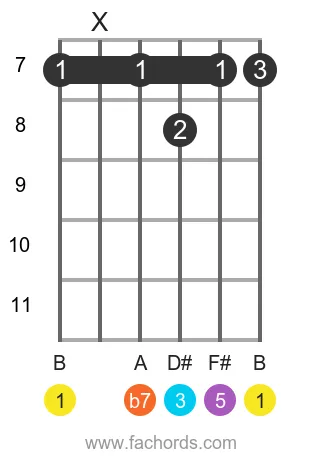
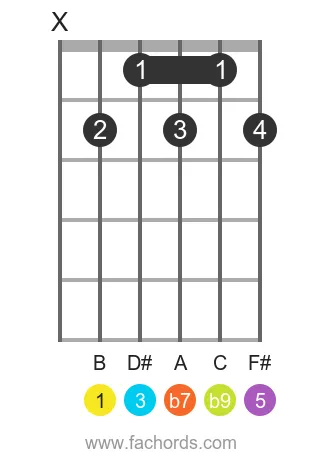
B 7th with flat 9th guitar chord is also written as B7(b9), B7b9 or B7-9.
Position 1
Movable
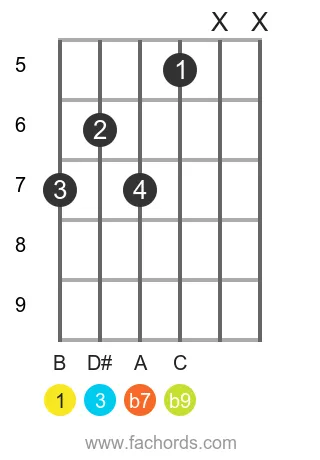
Position 2
Movable
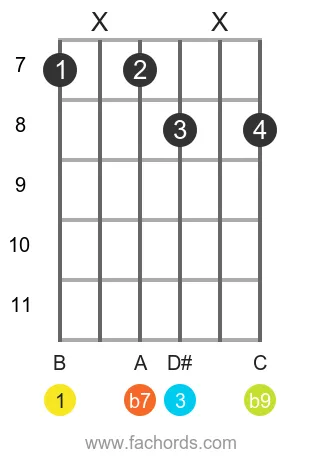
Position 3
Movable
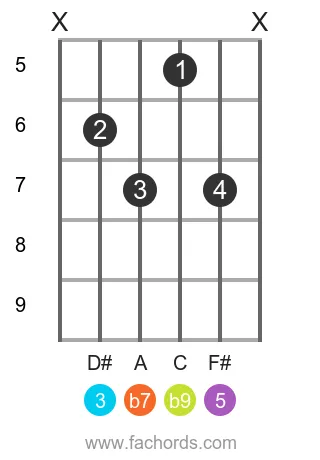
Position 4
Barre
Movable
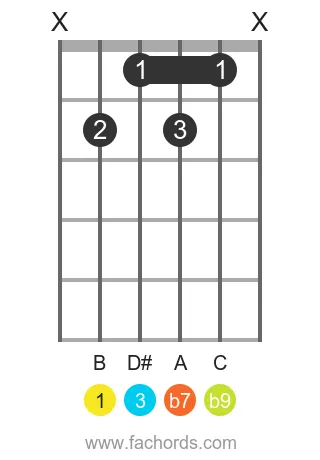
Position 5
Barre
Movable
Position 6
Barre
Movable
 Find more shapes in our all guitar chords online library. If you
prefer a printable pdf, download
the Free Guitar Chords Chart Pdf
Find more shapes in our all guitar chords online library. If you
prefer a printable pdf, download
the Free Guitar Chords Chart Pdf
You can also use this accessible B7(b9) chord page, with written diagram instructions and screen-reader support for blind users.
Explore and Practice the B7(b9) Chord on Guitar
Want a structured chord roadmap instead of jumping between pages?
Go to the full guitar chords tutorial.
To truly grasp the B7(b9) chord on guitar, begin by visualizing its unique shape and how its notes are distributed across the fretboard. Our interactive virtual fretboard is your ideal guide, allowing you to explore different voicings and see the exact positioning of its component notes: B, D#, F#, A, and C. This chord, a powerful member of the Dominant Chords family, is constructed with the intervals 1 (Root), 3 (Major Third), 5 (Perfect Fifth), b7 (Minor Seventh), and b9 (Minor Ninth). As you play, our real-time mic feedback will instantly verify your accuracy, helping you refine your finger placement and sound.
The distinctive sound of the B7(b9) chord, often found in advanced harmonic contexts, comes directly from its extended interval structure. Mastering how to build chords by stacking these intervals is fundamental to expanding your harmonic vocabulary. For a deeper dive into this process, our guide on Chord Construction provides comprehensive insights. This particular chord, with its added b9, belongs to the realm of Dominant Chords, playing a crucial role in creating tension and resolution, and is closely related to Ninth Chords. Understanding the logic behind these extended harmonies will unlock new creative possibilities.
Below, you'll find a curated selection of chord diagrams, presented from the simplest to the more challenging voicings, along with detailed theory. These diagrams will show you various ways to play the B7(b9) chord in different keys and within different songs. However, before committing shapes to memory, we encourage you to spend time with the virtual fretboard above, exploring the fingerings and listening to the chord's unique resonance. Let your hands and ears guide your learning journey.
Notes that compose the B 7(b9) chord:
Tones in the Dominant Seventh Flat Nine Added chord:
Play This Chord With Other Roots
C 7(b9) | D 7(b9) | E 7(b9) | F 7(b9) | G 7(b9) | A 7(b9) | B 7(b9) | C#7(b9) | D#7(b9) | F#7(b9) | G#7(b9) | A#7(b9) | Ab7(b9) | Bb7(b9) | Db7(b9) | Eb7(b9) | Gb7(b9)

Created by
Giancarlo is a musician (teaching guitar since 2000), software engineer, AI consultant and published researcher
FAQ
What notes are included in the B7(b9) chord?
The B7(b9) chord is made up of five specific notes: B, D#, F#, A, and C. These notes give the chord its distinct harmonic character and sound.
What intervals form the B7(b9) chord?
The B7(b9) chord is constructed using the intervals 1 (Root), 3 (Major Third), 5 (Perfect Fifth), b7 (Minor Seventh), and b9 (Minor Ninth). These intervals are stacked from the root note B.
Why is the B7(b9) chord considered a Dominant chord?
The B7(b9) is a Dominant chord because it contains a major third and a minor seventh interval (B-D#-F#-A). The added minor ninth (C) is an extension that enhances its dominant quality, creating tension that typically resolves to a tonic chord.
How is the B7(b9) chord built using intervals?
To build the B7(b9) chord, you start with the root note B. Then, you add a major third (D#), followed by a perfect fifth (F#), a minor seventh (A), and finally a minor ninth (C). Each interval contributes to the chord's full sound.
When should I use the B7(b9) chord in my playing?
The B7(b9) chord is commonly used in music to create harmonic tension and a strong sense of resolution. It is particularly popular in jazz chord progressions, where its complex and rich sound adds color and movement, often leading to a stable tonic chord.
What gives the B7(b9) chord its unique and rich sound?
The B7(b9) chord's unique and rich sound comes from the interplay of its constituent intervals, especially the major third (D#) and the minor seventh (A) which define its dominant quality, combined with the dissonant yet compelling minor ninth (C) interval. This combination creates a distinctive color and tension.
