Practice A#m9 Guitar Chord with Real-time Feedback
Want a structured chord roadmap instead of jumping between pages?
Go to the full guitar chords tutorial.
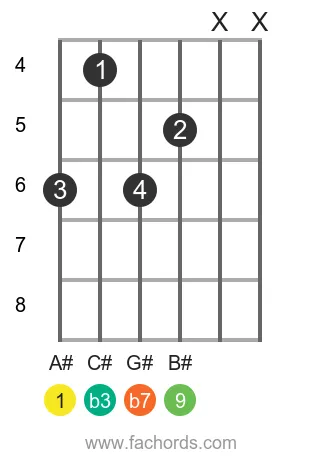
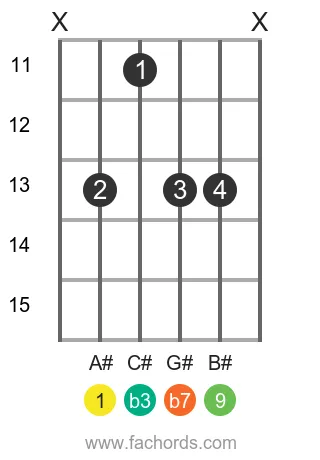
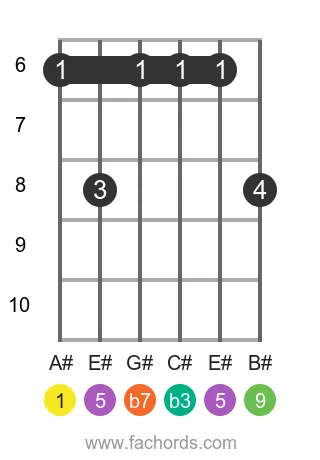
Ready to master the A#m9 chord? The interactive fretboard tool at the top of this page is your personal coach, offering real-time microphone feedback to confirm your accuracy as you play. Visualize every fingering, listen to the chord played as a strum or arpeggio, and fine-tune your technique. This rich member of the Minor Chords family is composed of the notes A#, C#, E#, G#, B#, built with the intervals 1, b3, 5, b7, and 9, which correspond to the Root, Minor Third, Perfect Fifth, Minor Seventh, and Major Ninth.
The A#m9 chord is a sophisticated sound, frequently adding depth and complexity in genres like jazz and blues. Mastering it helps expand your repertoire beyond basic chords. To truly understand how this chord is built and functions, delve into our Chord Construction tutorial. As a ninth chord, it offers a rich harmonic texture; explore more like it in our guide to Ninth Chords. Many advanced chords like this one often involve barre shapes, so our Guitar Bar Chords guide can be a valuable resource. Once you're comfortable with the fingerings, focus on improving your chord changes for seamless playing.
Before diving into the comprehensive set of chord diagrams further down this page, ranging from easy open positions to challenging movable shapes, and exploring detailed music theory, common songs featuring the A#m9 chord, and its typical keys, first test your skills with the interactive tool above. Use the drum tool to set your tempo, strum the chord, and let the accurate mic feedback instantly validate your technique. This immediate, hands-on practice is key to building lasting muscle memory.
Notes of the A# m9 chord:
Tones of the Minor Ninth chord:
Guitar Patterns for the A# Minor Ninth chord
Position 1
Movable
Position 2
Movable
Position 3
Barre
Movable
 Find more shapes in our all guitar chords online library. If you
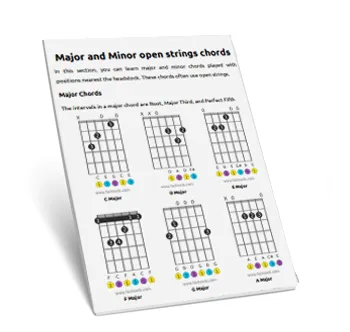
prefer a printable pdf, download
the Free Guitar Chords Chart Pdf
Find more shapes in our all guitar chords online library. If you
prefer a printable pdf, download
the Free Guitar Chords Chart Pdf
You can also use this accessible A#m9 chord page, with written diagram instructions and screen-reader support for blind users.
FAQ
What notes are included in the A#m9 chord?
The A#m9 chord is composed of the five specific notes: A#, C#, E#, G#, and B#. These notes collectively create its unique, rich, and complex sound.
What are the defining intervals of the A#m9 chord?
The A#m9 chord is built using the intervals 1 (Root), b3 (Minor Third), 5 (Perfect Fifth), b7 (Minor Seventh), and 9 (Major Ninth). This specific combination of intervals defines its harmonic structure.
Why is the A#m9 considered a more advanced chord for guitarists?
The A#m9 is considered a slightly more advanced chord because it involves five notes, making its fingering and understanding more complex than basic chords. It expands beyond fundamental triads, offering a rich, full sound often found in sophisticated musical contexts.
What kind of musical sound does the A#m9 chord produce?
The A#m9 chord is known for its rich, full sound. It adds significant depth and complexity to music, making it a valuable addition for expanding a guitarist's harmonic palette.
In what musical genres is the A#m9 chord typically used?
The A#m9 chord is frequently utilized in genres such as jazz and blues. Its complex and full sound contributes significantly to the characteristic harmonies of these styles.
What does the 'm9' in the A#m9 chord name signify?
The 'm' in A#m9 indicates the presence of a minor third (b3) and a minor seventh (b7) interval, establishing its minor quality. The '9' signifies that the chord also includes a major ninth (9) interval, adding to its harmonic richness and complexity beyond a basic minor seventh chord.