Explore A#5 Guitar Chord: Play, Learn, and Practice Interactively
Want a structured chord roadmap instead of jumping between pages?
Go to the full guitar chords tutorial.
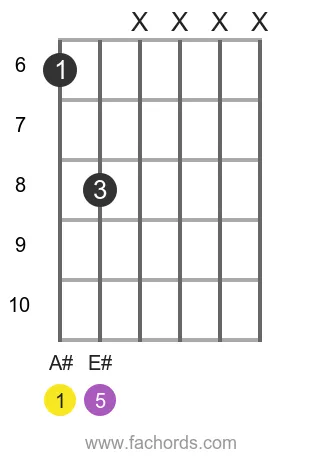
The A#5 chord is a driving force in rock, punk, and metal, delivering a powerful sound perfect for riffs and distortion. Its fundamental structure consists only of A# and E#, representing the 1 (Root) and 5 (Perfect Fifth) intervals of the power chords family. Dive into its sonic impact using our interactive fretboard tool, an exploration lab where you can visualize fingerings, hear the chord played as a strum, and ensure precision with immediate real-time microphone feedback.
Power chords like the A#5 are the bedrock of heavy genres, allowing guitarists to cut through a mix with raw energy. To truly harness their potential, understanding how they differ from full chords is key, which you can explore in our dedicated guide to Power Chords. For a deeper dive into the fundamental principles behind building any chord, our Chord Construction tutorial offers comprehensive insights. Once you've got these potent shapes mastered, optimizing your chord changes will integrate them smoothly into your playing.
Below, you'll find a comprehensive collection of A#5 chord diagrams, ranging from accessible open positions to versatile movable shapes. We also provide relevant music theory, popular songs that feature this chord, and the keys where it frequently appears. Before analyzing the diagrams, spend time with the interactive tool above to play and internalize the A#5 chord yourself. Experiencing the sound and feel first is the fastest way to truly grasp a new chord.
The A# power chord is also written as A#5, A#(no 3rd) or A#(omit 3).
A# 5 chord Notes:
Tones of the Powerchord chord:
A# 5 Guitar Chord Diagrams
Position 1
Movable
 Find more shapes in our all guitar chords online library. If you
prefer a printable pdf, download
the Free Guitar Chords Chart Pdf
Find more shapes in our all guitar chords online library. If you
prefer a printable pdf, download
the Free Guitar Chords Chart Pdf
You can also use this accessible A#5 chord page, with written diagram instructions and screen-reader support for blind users.

Created by
Giancarlo is a musician (teaching guitar since 2000), software engineer, AI consultant and published researcher
FAQ
Why is the A# 5 chord called a '5' chord?
The '5' in A# 5 specifically indicates that it is a power chord. Power chords are uniquely built using only two intervals: the Root (1) and the Perfect Fifth (5), deliberately omitting the third interval typically found in major or minor chords.
The tutorial states the notes for A# 5 are A# and E#. Why is the fifth E# instead of F?
In music theory, the perfect fifth above A# is correctly identified as E#. This is derived by counting five scale degrees from A#. While E# is enharmonically equivalent to F on the guitar fretboard, E# is the theoretically accurate spelling when building a perfect fifth from an A# root.
What is the main difference between an A# 5 power chord and a standard A# major or minor chord?
The primary difference is their construction. An A# 5 power chord consists solely of the Root (A#) and the Perfect Fifth (E#). A standard A# major or minor chord, however, includes a third interval in addition to the root and fifth, which determines whether the chord sounds major or minor.
What makes the A# 5 power chord effective in rock, punk, and heavy music?
The A# 5 power chord, like all power chords, is highly effective in these genres because its simple two-note structure (Root and Fifth) provides a stable, powerful, and less harmonically ambiguous sound. When played with distortion on an electric guitar, this creates a thick, driving tone that cuts through a mix effectively.
How do the 'Root' and 'Perfect Fifth' intervals define the A# 5 chord?
The 'Root' (A#) establishes the fundamental pitch and the name of the chord. The 'Perfect Fifth' (E#) is the second essential note that, when combined with the root, creates the characteristic open, strong, and stable sound of a power chord. These two specific intervals are the defining components of the A# 5 power chord.