Abm9 Guitar Chord | Play, Hear and Master it Interactively
Want a structured chord roadmap instead of jumping between pages?
Go to the full guitar chords tutorial.
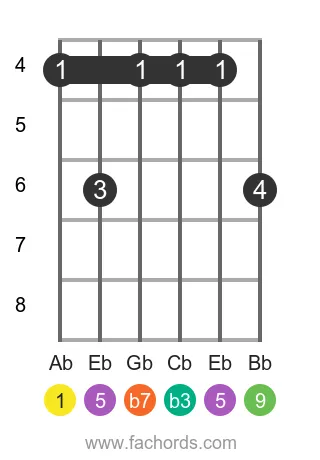
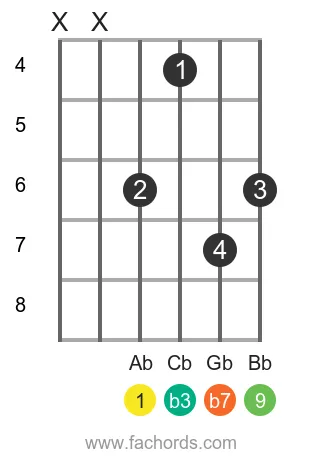
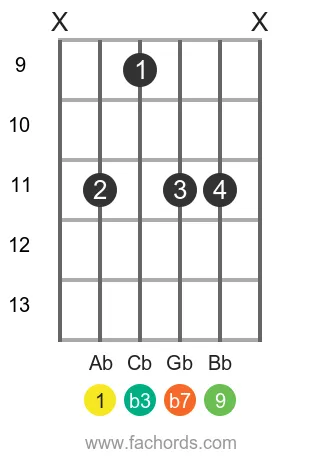
The Ab m9 chord belongs to the Minor Chords family and is composed of the notes Ab, Cb, Eb, Gb, and Bb. These tones correspond to the intervals Root (1), Minor Third (b3), Perfect Fifth (5), Minor Seventh (b7), and Major Ninth (9). Use the interactive fretboard tool at the top of this page to visualize every fingering, hear the chord played as a strum or arpeggio, and get instant feedback on your accuracy with real-time microphone detection.
The Ab m9 is an advanced chord often found in jazz and other complex musical pieces, adding a rich, sophisticated sound. Understanding how these extended chords are built is key; our Chord Construction tutorial can clarify the theory. If you're exploring other ninth chords, our Ninth Chords guide is a great next step. Many voicings for the Ab m9 involve barre shapes, so if you're working on those, check out our tips for Guitar Bar Chords. Mastering smooth chord changes will also help integrate this beautiful chord into your playing seamlessly.
Below, you'll discover chord diagrams ranging from the easiest open positions to more challenging barre shapes. We also delve into the music theory behind the Ab m9, list songs where this chord shines, and identify the keys where it commonly appears. Before you dive into the diagrams, take a moment to engage with the interactive tool above. Set your preferred tempo with the drum & BPM tool, strum the chord, and let the mic feedback guide your practice. This hands-on approach is the most effective way to internalize new chords like the Ab m9.
Notes in the Ab m9 chord:
Tones in the Minor Ninth chord:
Abm9 Guitar Chord Shapes
Position 1
Movable
Position 2
Movable
Position 3
Barre
Movable
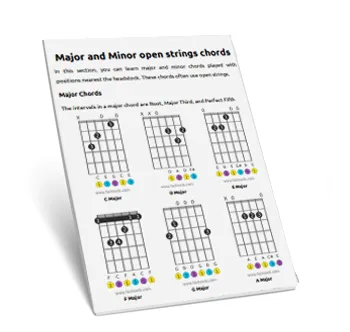
 Find more shapes in our all guitar chords online library. If you
prefer a printable pdf, download
the Free Guitar Chords Chart Pdf
Find more shapes in our all guitar chords online library. If you
prefer a printable pdf, download
the Free Guitar Chords Chart Pdf
You can also use this accessible Abm9 chord page, with written diagram instructions and screen-reader support for blind users.
FAQ
What notes are included in an Ab m9 chord?
The Ab m9 chord is composed of five distinct notes: Ab, Cb, Eb, Gb, and Bb. These notes correspond to the Root, minor third, perfect fifth, minor seventh, and major ninth intervals, respectively.
What do the 'm' and '9' signify in the Ab m9 chord name?
The 'm' indicates that the chord has a minor third interval (Cb) above the root (Ab), giving it a minor quality. The '9' signifies that a major ninth interval (Bb) has been added to the base Ab minor seventh chord, enriching its harmonic sound.
How does an Ab m9 chord differ from a simpler Ab minor (Abm) or Ab minor seventh (Abm7) chord?
An Ab minor (Abm) chord consists of only the Root, minor third, and perfect fifth (Ab, Cb, Eb). An Ab minor seventh (Abm7) adds the minor seventh (Gb) to that structure. The Ab m9 chord takes it a step further by adding the major ninth (Bb) to the Abm7 chord, creating a fuller, more complex sound.
In what musical styles or situations is the Ab m9 chord typically used?
The Ab m9 is considered an advanced chord that brings depth and complexity to music. It is frequently featured in genres like jazz, R&B, and other contemporary styles that utilize richer and more sophisticated harmonic palettes, providing a smooth and expansive feel.
Why is Cb used as a note in the Ab m9 chord instead of B natural?
Although Cb (C-flat) and B natural are enharmonically equivalent (they sound the same), Cb is used to correctly represent the minor third interval (b3) from the root Ab within the context of music theory. Using Cb maintains the diatonic spelling derived from the Ab minor scale, which is essential for understanding chord construction and function.