The G Major Guitar Scale
One Of The Most Used Scales In Guitar Music
Today we're going to learn how to play the G major scale in several ways.
The G major key is one of the most common tonalities in guitar music, so it's important to master its related major scale.
Below on this page you'll also find an interactive freboard with some cool scale patterns.
All the major scales share the same formula, with is:
- 2 whole-steps
- 1 half-step
- 3 whole-steps
- 1 half-step
If we play the G major scale starting from the G open string, and apply it to the formula shown above, we get the notes of this scale:
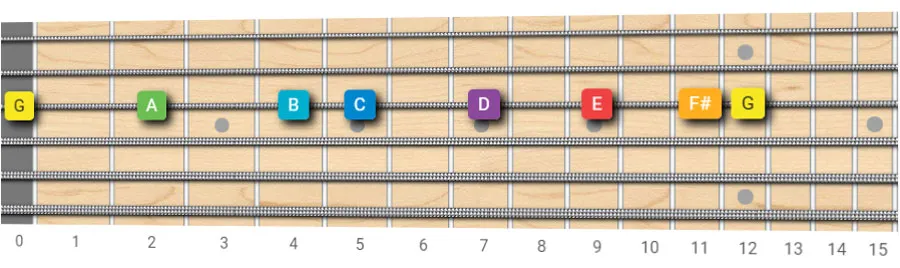
As we can see, the notes in the G major scale are:
G A B C D E F# G
We have only one sharp note, F#, which makes sense because we need a half-step between the last two notes (F# to G).
Let's check the formula:
- G to A (Whole step)
- A to B (Whole step)
- B to C (Half step)
- C to D (Whole step)
- D to E (Whole step)
- E to F# (Whole step)
- F# to G (Half step)
Also, the G major key is the nearest key to the C major key in the Circle Of Fifths.
Remember that, while traversing clockwise the Circle Of Fifths, a sharp is added for each key we encounter.
G Major Scale Guitar Patterns
Use the interactive tool below to see how to play this scale across the whole fretboard:
The D9 chord can be played on different fretboard zones, use the tool below to learn how to:
G Major Scale - Root on the 6th String Pattern - 4-frets-box
This shape is the most common way to play the G major scale, it has the root on the E low string and it's 4 frets wide, so it's quite comfortable to play if you use one finger per fret.
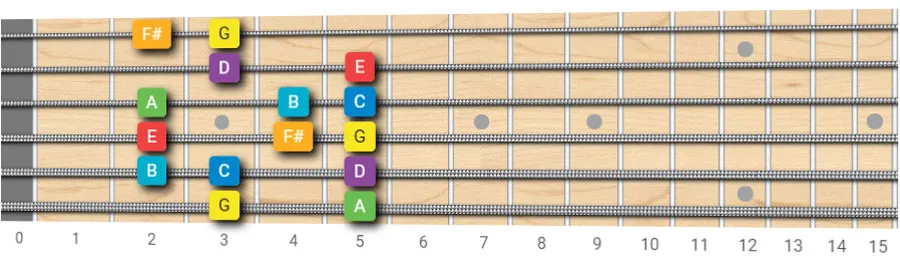
G Major Scale - Root on the 6th String Pattern - 3 nps
This pattern is a classic 3 notes per string shape. It requires a little bit of stretch so be sure to warm up correctly before practicing this shape.
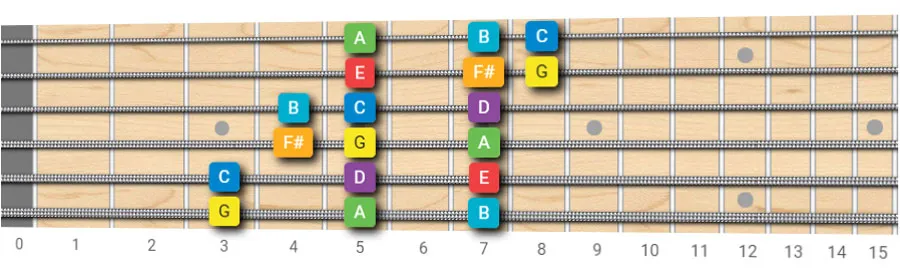
G Major Scale - Root on the 5th String Pattern - 4-frets-box
Another four frets box, this time with root on the A string.
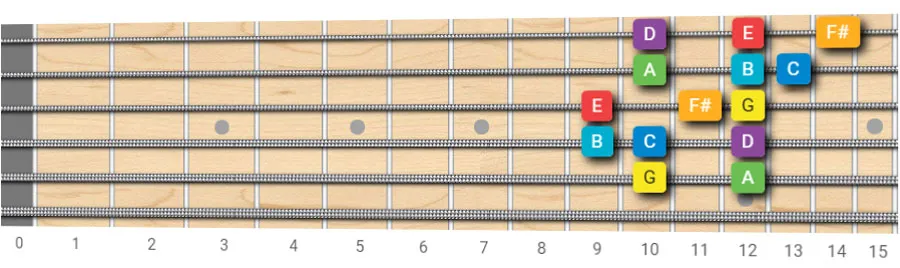
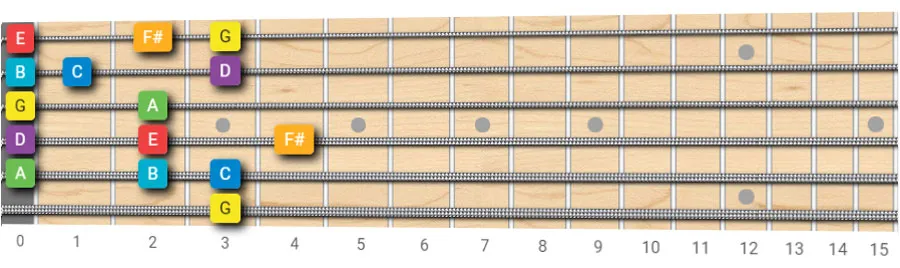
G Major Scale - Open Strings Pattern
This shape is great on acoustic guitar because it uses a lot of open strings, so it has a big and bright sound.
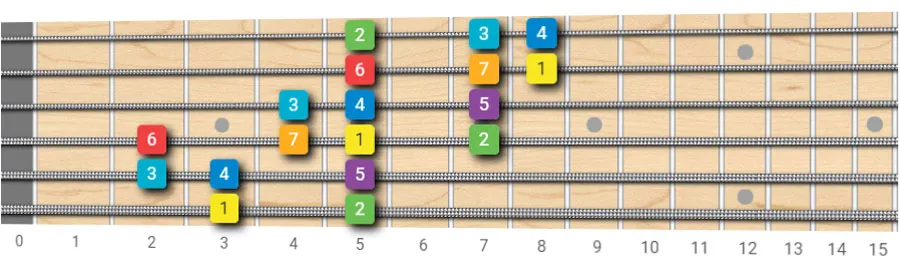
G Major Scale - Diagonal Repeated Octaves
If you connect two octaves by moving up on the fretboard, you get an interesting diagonal pattern that will bring new and fresh ideas.
How To Build Chords On The G Major Scale
By stacking the notes of this scale in thirds, we get the following chords:
- G Major (I): G - B - D
- A Minor (ii): A - C - E
- B Minor (iii): B - D - F#
- C Major (IV): C - E - G
- D Major (V): D - F# - A
- E Minor (vi): E - G - B
- F# Diminished (vii°): F# - A - C
So a widespread progression such as the rock I-IV-V, is G (I), C (IV) and D (V) in the key of G.
Related Scales
There are some scales related to the G major scales that are useful to know:
- E minor scale: this scale is the relative minor of the G major scale, it has the same notes but it starts from E: E F# G A B C D E
- G Major Pentatonic: This scale omits the 4th and 7th degrees of the G major scale. The notes are G, A, B, D, and E. It's commonly used in rock and blues music.
- G Mixolydian Mode: The mixolydian mode is similar to the major scale but has a flattened 7th degree. In G Mixolydian, the notes are G, A, B, C, D, E, and F.
- G Major Blues Scale: This scale is derived from the G major pentatonic scale and adds a bluesy flavor by including the "blue" note, F. The notes are G, A, Bb, B, D, and E.
That's all for today, for a complete ebook on guitar scales, check my Scales Over Chords | Learn How To Play The Right Scales Over Any Chord
FAQ
Why is the G Major scale considered one of the most common scales in guitar music?
The G major scale is fundamental because the G major key is frequently used in guitar music. Its prominence makes mastering its associated scale highly valuable for guitarists.
What are the specific notes of the G Major scale, and why does it include F#?
The notes in the G Major scale are G, A, B, C, D, E, F#, and G. The F# is included to maintain the correct major scale formula, which requires a half-step interval between the 7th note (F#) and the root (G).
How does the major scale formula (whole-step, whole-step, half-step, whole-step, whole-step, whole-step, half-step) apply to the G Major scale?
Starting from G, applying the formula means: G to A (whole-step), A to B (whole-step), B to C (half-step), C to D (whole-step), D to E (whole-step), E to F# (whole-step), and F# to G (half-step). This interval pattern consistently defines all major scales, including G Major.
Why are there different G Major scale patterns, like the '4-frets-box' and '3 notes per string'?
Different patterns provide various ways to play the G Major scale across the fretboard. The '4-frets-box' is often comfortable for a 'one finger per fret' approach, while '3 notes per string' patterns can require more stretching but allow for faster playing or different melodic phrasing. These patterns help guitarists navigate the fretboard and find suitable fingerings for different musical contexts.
How are chords like G Major (I), C Major (IV), and D Major (V) related to the G Major scale?
These chords are built by stacking notes from the G Major scale in thirds. For example, the G Major (I) chord consists of G-B-D, the C Major (IV) chord uses C-E-G, and the D Major (V) chord uses D-F#-A. They represent the primary chords of the G major key, derived directly from the scale's notes.
What is the key difference between the G Major scale and the G Major Pentatonic scale?
The G Major Pentatonic scale is a five-note scale derived from the full G Major scale. It omits the 4th (C) and 7th (F#) degrees of the G Major scale. Its notes are G, A, B, D, and E, giving it a simpler, often more bluesy or rock-oriented sound compared to the full major scale.
What is the relationship between the G Major scale and the E minor scale?
The E minor scale is the relative minor of the G Major scale. This means both scales share the exact same notes (E, F#, G, A, B, C, D, E for E minor). They are 'related' because they use the same set of pitches, but starting from different root notes (G for major, E for minor) gives them distinct tonal centers and emotional qualities.
