The A Major Scale
Learn How To Play The A Major Scale On Guitar
In this comprehensive tutorial we are going to learn the A minor scale, a fundamental scale for guitarists across various genres.
Understanding the A minor scale is crucial for improvisation, chord construction, and enhancing your overall musical vocabulary.
So, let's dive in!
A Minor Scale - Interactive Fretboard
Use the tool below to learn several ways to play the A minor scale over the entire fretboard:
What is a Scale?
A scale is a sequence of notes ordered by pitch.
In Western music, scales serve as the building block for melodies, chords, and improvisation.
The A minor scale, specifically, is a natural minor scale, which means it follows a specific pattern:
The A minor scale contains all natural notes:
There are two types of minor scales, which have a little different formula: the harmonic minor scale and the melodic minor scale.
Understanding Relative Scales
Relative scales are pairs of major and minor scales that share the same key signature but have different root notes.
The concept of relative scales is pivotal in understanding the relationship between scales and how they interact within compositions.
The A minor scale is the relative minor of the C major scale.
This means both scales contain the same notes but start from different root notes.
- For A minor, the notes are A, B, C, D, E, F, and G, starting on A.
- For C major, the notes are C, D, E, F, G, A, and B, starting on C.
So, by looking at those note sequences, is easy to say:
The natural minor scale starts from the 6th degree of its corresponding major scale
The significance of this relationship lies in their shared notes and chords, allowing for seamless substitution and modulations between the two in musical pieces.
A Minor Scale Guitar Scale Patterns
A Minor Scale - Root on the 6th string
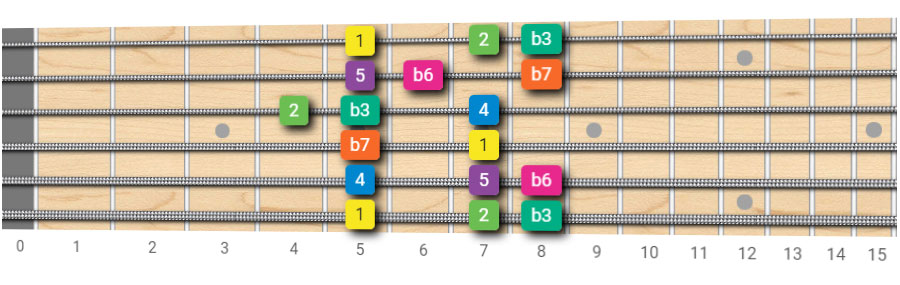
A Minor Scale - Root on the 6th string - 3 Note Per String
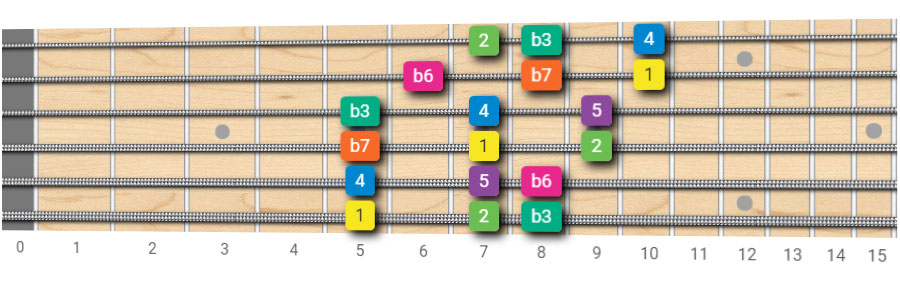
A Minor Scale - Root on the 5th string
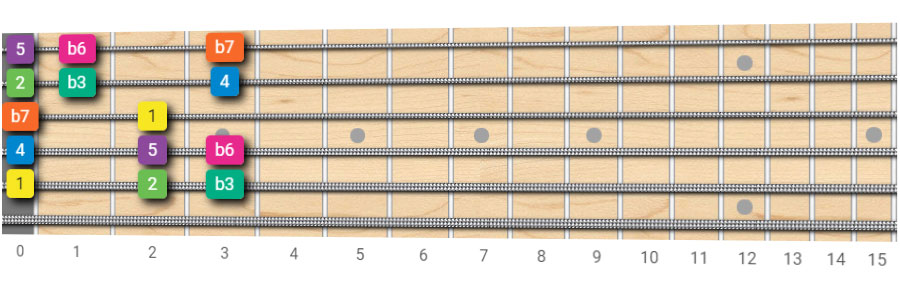
A Minor Scale - Root on the 5th string - 3 Note Per String
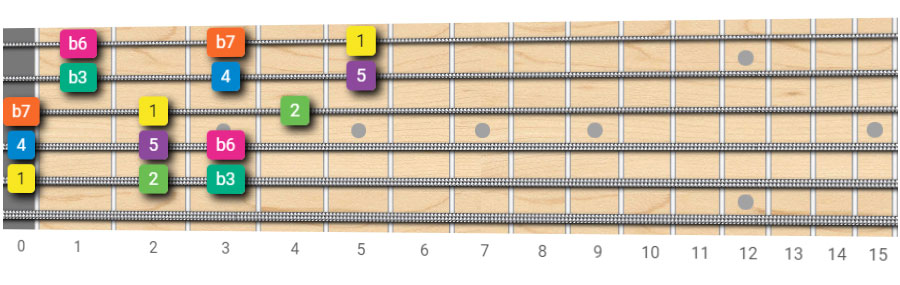
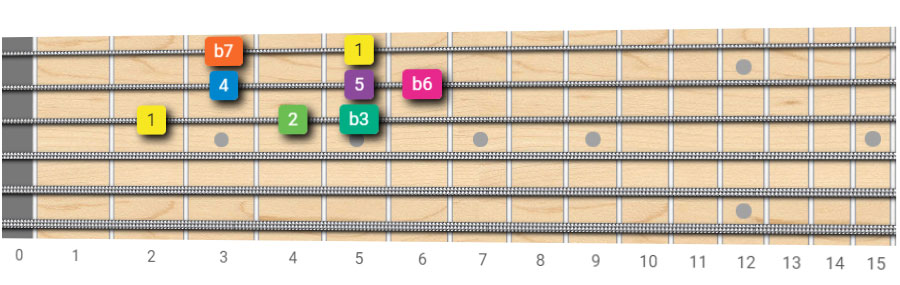
A Minor Scale - Root on the 3rd string - 1 Octave Pattern
Chords Generated from the A Minor Scale
The A minor scale generates specific chords based on its notes.
By stacking thirds on each scale degree, we form the following chords:
- A minor: A, C, E
- B diminished: B, D, F
- C major: C, E, G
- D minor: D, F, A
- E minor: E, G, B
- F major: F, A, C
- G major: G, B, D
Notice that the chords in this scale are the same of those in the C major scale, but in different order.
I IV V Progression in A Minor
In music theory, the I IV V progression is a common chord progression that forms the basis of countless songs.
In the key of A minor, this progression is:
- I (Am): A minor chord
- IV (Dm): D minor chord
- V (Em): E minor chord
This progression highlights the natural minor feel, providing a melancholic and introspective mood typical of minor keys.
Comparing I IV V in A Minor and C Major
In contrast, the I IV V progression in the C major scale (the relative major of A minor) consists of:
- I (C): C major chord
- IV (F): F major chord
- V (G): G major chord
This progression in C major feels brighter and more resolved due to the inherent characteristics of major chords and scales, offering a stark emotional and tonal contrast to the A minor progression.
Conclusion
Understanding the A minor scale, its chords, and progressions, as well as its relationship with the C major scale, is fundamental for guitarists.
It enriches your musicality, allowing you to navigate between major and minor tonalities with ease, and provides a foundation for composing and improvising across a wide range of musical genres.
Exploring these concepts on your guitar will not only improve your technical skills but also deepen your appreciation for the emotional depth and versatility that music theory offers. Happy playing!
To stay updated, please subscribe for free now.
FAQ
What notes are in the A minor scale?
The A minor scale is a natural minor scale composed of the notes A, B, C, D, E, F, and G. These are all natural notes, meaning they do not include any sharps or flats.
Why is the A minor scale important for guitarists to learn?
Understanding the A minor scale is crucial for guitarists because it forms a fundamental basis for improvisation, helps in constructing various chords, and significantly enhances your overall musical vocabulary, allowing for greater musical expression across genres.
What is a relative minor scale, and how does the A minor scale relate to the C major scale?
Relative scales are pairs of major and minor scales that share the exact same set of notes and key signature, but begin on different root notes. The A minor scale is the relative minor of the C major scale, meaning both scales consist of the same seven notes: A, B, C, D, E, F, and G.
How can I determine the relative minor scale for any given major key?
To find the natural minor scale corresponding to a major scale, you simply start the minor scale on the 6th degree of that major scale. For instance, A is the 6th degree of the C major scale, making A minor its relative minor.
How are chords generated from the A minor scale?
Chords are generated from the A minor scale by stacking notes in intervals of thirds on each degree of the scale. This process results in the following chords: A minor (I), B diminished (II), C major (III), D minor (IV), E minor (V), F major (VI), and G major (VII).
What is the I IV V chord progression in the key of A minor?
In the key of A minor, the I IV V chord progression consists of the A minor chord (I), the D minor chord (IV), and the E minor chord (V). This sequence typically creates a melancholic and introspective mood characteristic of minor keys.
Why do the A minor and C major scales generate the same set of chords?
The A minor and C major scales generate the same set of chords because they are relative scales. This means they share the identical collection of notes. Although the order of the chords derived from each scale differs (due to their different starting notes), the specific chords themselves are identical.
How do the emotional qualities of the I IV V progressions in A minor and C major compare?
The I IV V progression in A minor (Am-Dm-Em) typically conveys a melancholic and introspective mood, reflecting the nature of minor keys. In contrast, the I IV V progression in C major (C-F-G) feels brighter and more resolved, due to the inherent characteristics of major chords and scales, offering a distinct emotional difference.