Guitar Scales Applications
Learn Which Scale To Play Over a Given Chord Quality: Some Examples
Learn which scale to play over a given chord during your guitar solos. This page includes an interactive tool to check how well a scale matches a chord, plus detailed examples using modes of the Melodic Minor scale.
We cover the Lydian Dominant scale over dominant chords, the Superlocrian scale over altered dominants, and the Aeolian b5 scale over half-diminished chords, with formulas, fretboard diagrams, and audio examples.
Scales Over Chords | Interactive Tool
With this interactive tool, you can easily check the tones shared by a scale and a chord.
When it comes to playing lead guitar solo, what makes a difference is the ability to highlight the tones composing the tune harmony, thus chords.
If you choose the tones composing the chords as main notes of your melodic lines, your solos will be more expressive and blended with the music.
So this tool has been conceived to show you exactly how well a scale matches a given chord.
Curious fact: try to superimpose a C Major Pentatonic Scale to a C 6/9 chord. You'll find that they match perfectly!
Scale Over Chords Tutorial
This tutorial will provide you with some rules useful to choose which scale to play over a given chord during your guitar solos.
There exist many different guitar scale, but it's not always easy to decide which ones to use over a chord progressions.
This topic has been already tackled in my complete ebook Scales Over Chords | Learn How To Play The Right Scales Over Any Chord, but in this tutorial, we are going to go deeply into some real applications, so that you can learn a framework that will be useful in many situations.
So let's get started with some cool examples.
Lydian Dominant Scale Over a Dominant Chord
The Lydian Dominant Scale is a scale built on the 4th degree of the Melodic Minor Scale
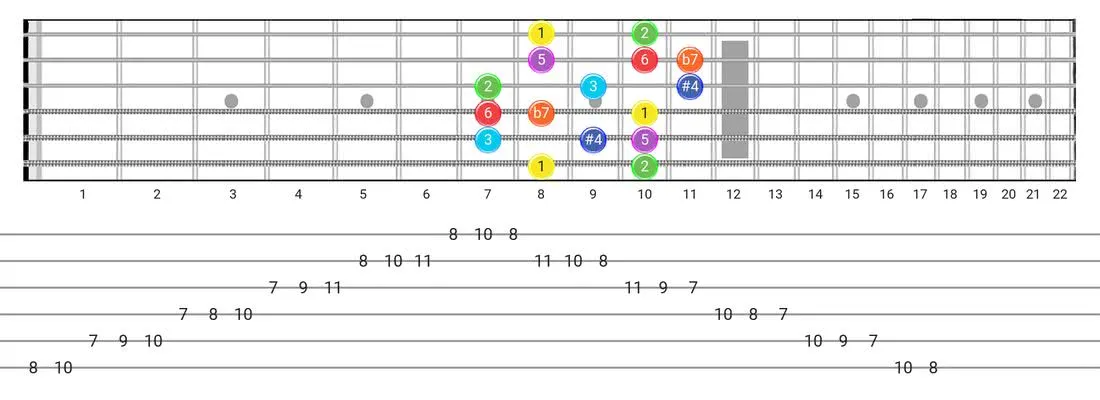
Its peculiar sound is created from the #4, that introduces more tension than the mixolydian scale. So this scale is a great option to use over a dominant chord.
Let's analyze these concepts deeper with an example: the formula of the Melodic Minor scale is:
Melodic Minor Scale Formula
In case of the C Melodic minor scale, the notes are: C, D, Eb, F, G, A, B, C
If we play this scale starting from the 4th degree (F) we get a Lydian Dominant Scale composed of the notes: F, G, A, B, C, D, Eb, F
The Lydian Dominant scale has the following formula:
Lydian Dominant Scale Formula
While the formula of a dominant chord is:
Dominant Chord Formula
As you can see, the tones in the chord (1, 3, 5 and b7) match perfectly with the intervals in the Lydian Dominant scale, so we can elaborate this rule:
Over a Dominant Chord we can play a Lydian Dominant Scale with the same root of the chord.
Application Example
The guitar tab below shows you a C Lydian Dominant Scale over a C7 Dominant chord:
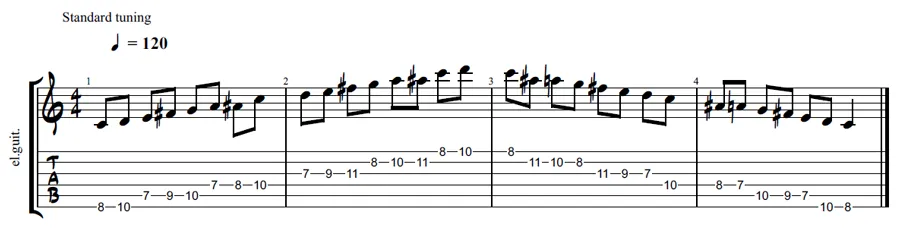
We can also express this rule as follows:
Over a Dominant Chord we can play a Melodic Minor Scale one fifth up the root of that chord. For example, play the C Melodic Minor scale over a F7 dominant chord
Note: the C Melodic Minor scale and the F Lydian Dominant scale have the same notes but the scales begin from different roots.
What about a F9 dominant chord?
The scale still works great: the F9 chord is 1, 3, 5, b7 and 9 (F, A, C, Eb and G); the 9th (G), is the 2nd degree of the F Lydian Dominant scale, so it's still a perfect match!
To learn more about this scale, check the Lydian Dominant scale fretboard diagrams and chords page.
Using The Superlocrian Scale Over an Altered Dominant Chord
The Superlocrian Scale is another mode of the Melodic Minor Scale.
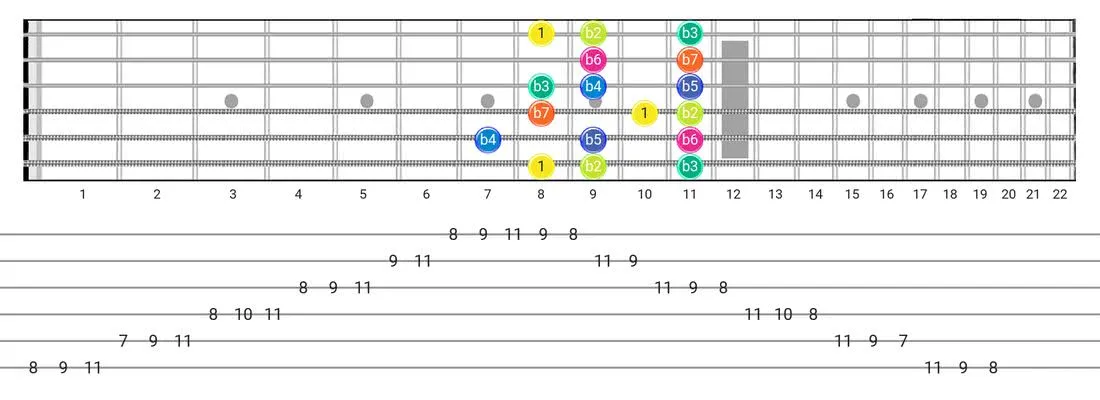
One of the most common contexts of the Superlocrian scale is using this scale over an Altered dominant chord.
Indeed, the formula of the Superlocrian scale is the following:
Altered dominant chords exist in different types, depending on the sharps and flats they have: #5, b5, #9 and b9.
As you can see, the #9 of the chord matches with the b3 of the scale, as well as the b9 that matches with the b2. Also, the #5 matches with the b6 and the b5 is also included in the scale.
The rule here is: over an Altered Dominant Chord, we can play a Superlocrian scale starting from the root of the chord.
We can express this rule in another way:
Over an Altered Dominant chord, we can play a Melodic Minor scale one half-step up the root of the chord (Db melodic minor scale over a C Altered Dominant Chord
Example: C Superlocrian Scale over a C7#5 chord:
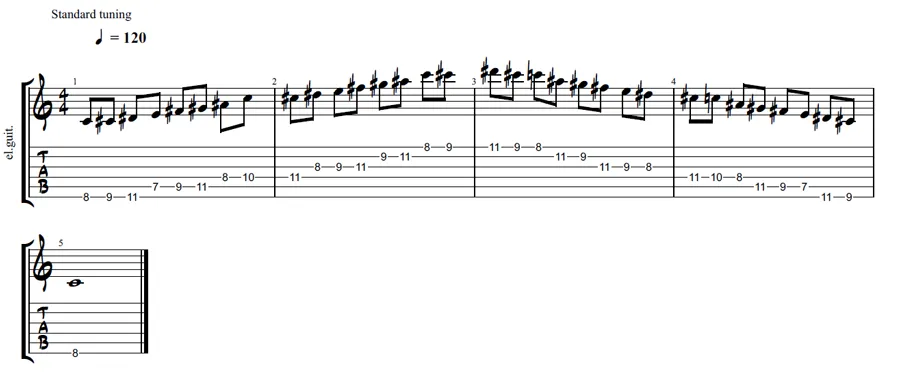
Aeolian b5 Scale Over an Half-Diminished Chord
The Aeolian b5 scale, also called Locrian #2 scale, is another mode created from the Melodic Minor Scale.
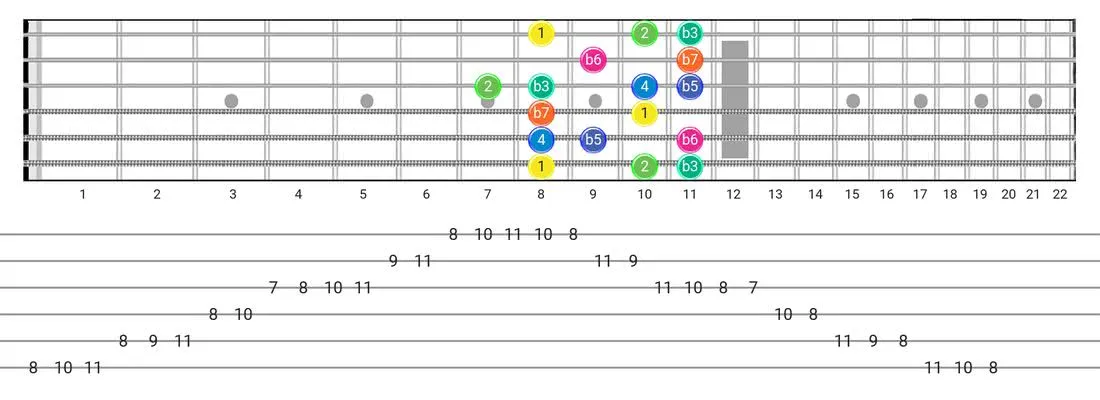
This scale sounds great over an half-dimished chord (m7b5):
Aeolian B5 scale formula:
m7b5 chord formula:
As you can observe from the diagrams above, the tones in the chord are perfectly matched by the scale. So we have another rule here:
Over an Half-Diminished Chord, we can play an Aeolian B5 scale.
Or, in another words:
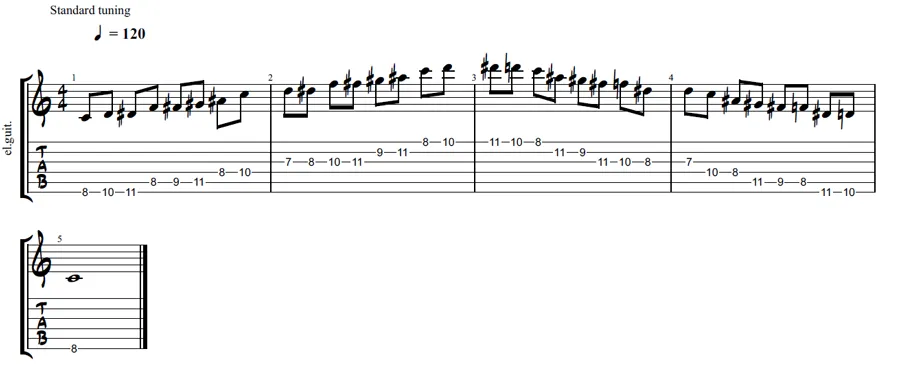
Over an Half-Diminished chord, we can play a Melodic Minor scale 3 half-steps up the root of the chord (E Melodic minor scale over a Cm7b5 chord).
Example: C Aeolian b5 scale over a Cm7b5 chord:
Which Scales To Play Over a Chord: Conclusions
Ok, we have just seen some practical applications of scales over chords. As you should have noted, basically it's a matter to find a scale that matches well with the tones in the chord. They can have different roots (such as a C melodic minor scale over an F7 chord), or they can start from the same tonic.
The cool thing about the guitar is that you can shift a scale shape up or down the neck, so you can learn one-fingering and apply it in many situations.
You can find more scale shapes and chord applications in my complete ebook Scales Over Chords | Learn How To Play The Right Scales Over Any Chord (download a free excerpt here).
FAQ
Why is the Lydian Dominant scale a good choice to play over a dominant chord?
The Lydian Dominant scale is an excellent choice for dominant chords because its unique interval structure (1, 2, 3, #4, 5, 6, b7) perfectly matches the essential tones of a dominant chord (1, 3, 5, b7). The distinctive #4 interval adds a pleasing tension and flavor that enhances the dominant sound, offering a richer melodic option compared to a standard Mixolydian scale.
What is the relationship between the Lydian Dominant scale and the Melodic Minor scale?
The Lydian Dominant scale is actually a mode of the Melodic Minor scale. Specifically, it is the 4th mode of the Melodic Minor. This means that if you take a Melodic Minor scale and start playing it from its fourth degree, you will get a Lydian Dominant scale. For example, a C Melodic Minor scale shares all its notes with an F Lydian Dominant scale, just starting on a different root.
When should I use the Superlocrian scale over a dominant chord instead of the Lydian Dominant?
You should use the Superlocrian scale specifically when improvising over an 'Altered Dominant Chord'. An altered dominant chord includes specific altered extensions like a b5, #5, b9, or #9. The Superlocrian scale contains intervals like b2 (which matches b9), b3 (which matches #9), b5, and b6 (which matches #5), making it the perfect fit to harmonize with these complex altered dominant sounds. For standard dominant 7th or 9th chords without these alterations, the Lydian Dominant scale is generally more appropriate.
How can the #9 of an altered dominant chord match the b3 of the Superlocrian scale, or b9 match b2?
This is due to enharmonic equivalence in music. On the guitar, the same physical note can have different names depending on its harmonic context. A #9 chord extension is enharmonically equivalent to a b3 an octave higher, and a b9 extension is enharmonically equivalent to a b2 an octave higher. When the Superlocrian scale contains a b2 or b3, it means that the notes forming the altered b9 or #9 extensions of the chord are present and harmonically congruent within the scale.
Why is the Aeolian b5 scale a good match for a half-diminished (m7b5) chord?
The Aeolian b5 scale, also known as Locrian #2, is an ideal choice for a half-diminished (m7b5) chord because its precise intervallic structure (1, 2, b3, 4, b5, b6, b7) directly encompasses all the essential chord tones (1, b3, b5, b7) of a m7b5 chord. This ensures that any melodic lines played using this scale will strongly outline and complement the unique, tense quality of the half-diminished harmony.
The tutorial mentions that I can shift scale shapes. How does this help me apply these rules on the guitar?
The ability to shift scale shapes is a fundamental advantage on the guitar. Once you learn the physical finger pattern for a scale like Lydian Dominant, Superlocrian, or Aeolian b5 in one position, you can move that entire shape up or down the fretboard. This means you only need to learn a few shapes, and then you can apply them to different chords and keys by simply repositioning the root of the scale shape to match the root of the chord you are playing over, making complex theory highly practical.
