The Phrygian Mode
A Scale That Evokes Exotic and Dark Vibes
If you like heavy metal, jazz, or exotic-sounding music you are likely going to be a fan of Phrygian mode.
The note intervals and qualities have a great mix of dissonance, but not too much.
When playing this scale on guitar allows you to make some unique solos and riffs, as long as you stay grounded in proper resolution and consonance.
What is the Phrygian mode?
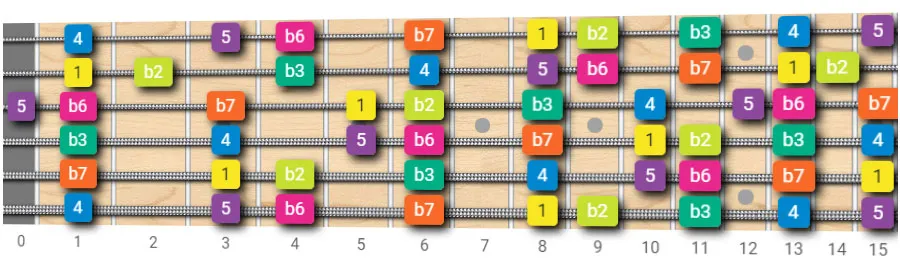
A mode is simply another term for a scale that starts on a particular degree.
The most common is the Ionian or plain major scale.
The Phrygian mode starts on the 3rd scale degree, so E Phrygian has the notes E F G A B C D.
Now these are the same notes as the C Ionian C D E F G A B. Even though they have the same notes, they now have different intervals.
Play around with each scale on your guitar and you will see the entire vibe is more foreign or exotic sounding.
Now because these new minor intervals cause some dissonance, the Phrygian is often used along with other modes.
It isn't as limited as the Locrian, but it still can use the help of better resolution.
Interactive Tool To Learn The Phrygian Scale
Be sure to play with this interactive fretboard and learn all the possible shapes for the Phrygian Scale:
The Phrygian Scale Formula
The Phrygian mode is just a natural minor scale with a b2 degree added.
Above when you play the E Phrygian that first E-F movement is what really gives the scale its vibe.
Because the b2 and b7 are so eager to resolve back to the tonic, this creates a scale that sounds off and sometimes disturbing.
Plus the b2 interval to the 5 is a tritone, adding more dissonance.
It is no wonder it is used a lot in heavy metal riffs.
It is also common to see the scale known as Phrygian Dominant, and it has the formula:
This slight change on the 3 allows for more variety and less dissonance.
This scale is also known as the Spanish gypsy scale, and you may recognize it from flamenco music.
It is also found in movies, like the intro here.
Depending on your genre choice you may be using the dominant version more than the regular Phrygian mode.
Phrygian Scale Fretboard Patterns
Here below you find the most common shapes for playing the Phrygian Scale.
All these examples are provided in the key of C; as usual, you can shift these shapes up or down the neck to play the scale in another key.
The table below the diagrams shows you the notes for the Phrygian scale in all the keys.
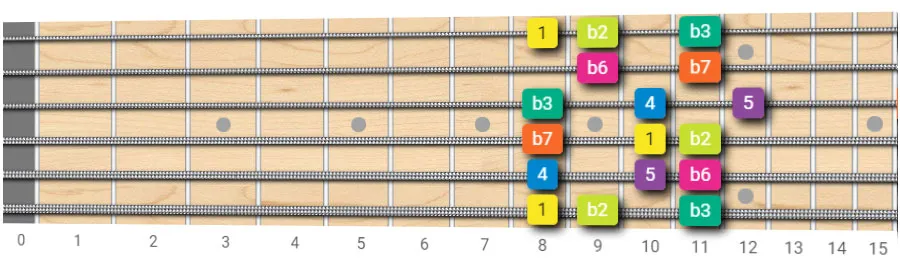
Phrygian scale pattern starting index finger
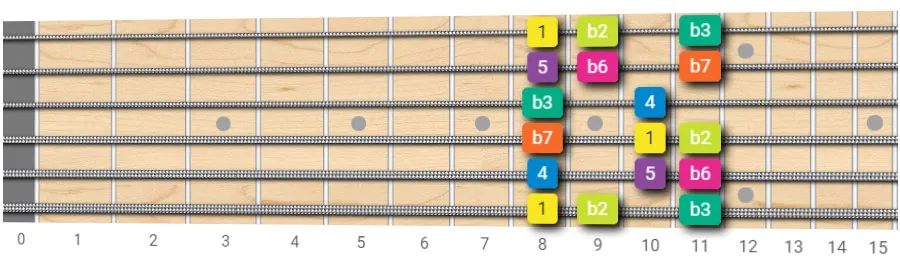
Phrygian scale pattern starting with the index finger (more compact fingering)
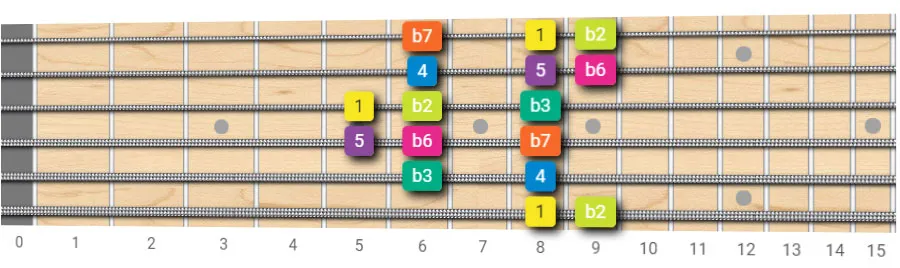
Phrygian scale pattern starting with ring finger
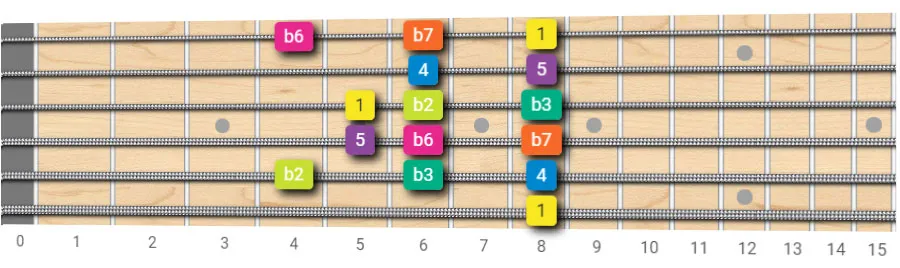
Phrygian scale pattern starting with pinkie
You'll find more scale patterns across the entire fretboard in my ebook Scales Over Chords | Learn How To Play The Right Scales Over Any Chord
Phrygian Scale Notes in all Keys
| 1 | b2 | b3 | 4 | 5 | b6 | b7 |
|---|---|---|---|---|---|---|
| C | Db | Eb | F | G | Ab | Bb |
| G | Ab | Bb | C | D | Eb | F |
| D | Eb | F | G | A | Bb | C |
| A | Bb | C | D | E | F | G |
| E | F | G | A | B | C | D |
| B | C | D | E | F# | G | A |
| F# | G | A | B | C# | D | E |
| Gb | Abb | Bbb | Cb | Db | Ebb | Fb |
| C# | D | E | F# | G# | A | B |
| Db | Ebb | Fb | Gb | Ab | Bbb | Cb |
| G# | A | B | C# | D# | E | F# |
| Ab | Bbb | Cb | Db | Eb | Fb | Gb |
| D# | E | F# | G# | A# | B | C# |
| Eb | Fb | Gb | Ab | Bb | Cb | Db |
| A# | B | C# | D# | E# | F# | G# |
| Bb | Cb | Db | Eb | F | Gb | Ab |
| F | Gb | Ab | Bb | C | Db | Eb |
Common Chords and Progressions
Normally to find the chords of a specific scale we use the same formulas as always.
And in the case of the Phrygian and Locrian modes, the chords that form are not all that usable as progressions.
Please refer to the tables below to find the chords in this mode.
Therefore we often find these modes being used partially or in short bursts.
Using the scale to build chords, we can see a minor triad (1 b3 5) and a minor 7th chord can be built (1 b3 5 b7).
Otherwise it doesn't have many usable chords, but where this scale shines is when using the b2, these sus chords are the most important in the Phrygian mode.
A sus(b9) can be built using this scale, so it is called the Phrygian chord.
That is the most likely chord you will be jamming over in this mode, or at least the best fit.
And these sus(b9) chords can be used to substitute over the V7 or any regular sus chords.
A regular jazz progression like II-V is a perfect place to try this placement of Phrygian.
While there are some chord progressions to be found, most of the time Phrygian is used as riffs over more stable sounds.
In some cases the minor tonic triad or the iii is used as a drone while the 1 b2 and b6 are prominently played.
This is common in heavy metal, a Phrygian riff played over chords that sound better.
This difference between the tonic and those tones produces the exotic flavor of the mode.
The Phrygian dominant has more uses with just the 3rd-degree change.
But it still doesn't produce the greatest chord progressions.
Just like regular Phrygian it is best played over regular progressions like II-V, or over any notes that sound and resolve better.
We will rarely come across pure Phrygian modal examples, you will mostly be playing the scale over other progressions to provide a contrast in sound.
C Phrygian scale Triads
| C min | Db maj | Eb maj | F min | G dim | Ab maj | Bb min |
|---|---|---|---|---|---|---|
| G (5) Eb (b3) C (1) |
Ab (b6) F (4) Db (b2) |
Bb (b7) G (5) Eb (b3) |
C (1) Ab (b6) F (4) |
Db (b2) Bb (b7) G (5) |
Eb (b3) C (1) Ab (b6) |
F (4) Db (b2) Bb (b7) |
C Phrygian scale Quadriads
| C m7 | Db maj7 | Eb 7 | F m7 | G m7/b5 | Ab maj7 | Bb m7 |
|---|---|---|---|---|---|---|
| Bb (b7) G (5) Eb (b3) C (1) |
C (1) Ab (b6) F (4) Db (b2) |
Db (b2) Bb (b7) G (5) Eb (b3) |
Eb (b3) C (1) Ab (b6) F (4) |
F (4) Db (b2) Bb (b7) G (5) |
G (5) Eb (b3) C (1) Ab (b6) |
Ab (b6) F (4) Db (b2) Bb (b7) |
Notable Examples Of Phrygian Mode
Phrygian is going to be one of the strangest and sometimes darkest modes you use, it is way more common than Locrian as that mode is far too unstable.
And you usually see the dominant version, especially in the flamenco genre.
It is a very old mode so can be found in abundance in classical music, but we will focus on more modern examples.
Some great jazz examples are "Dolphin Dance", "Flamenco Sketches", and "Spain".
These show the side of Phrygian that is exotic and unique, which is usually how it is used in jazz.
But we switch to heavy metal, and they use the darker side of the mode. "Wherever I May Roam", has a mix of exotic and dark vibes.
Other great examples are "Reflections", "Jimmy", and other Tool songs; they love the Phrygian mode.
If you notice with metal Phrygian riffs, as they play that scale, there is another underlying droning or static note.
And of course we have rock and pop examples like "Spanish Caravan".
If the song uses Spanish or flamenco terms, it likely has some Phrygian in it.
"Set the Controls for the Heart of the Sun", "If U Seek Amy" "Sails of Charon", and even "Things We Said Today" have brief uses.
Often you will find examples like that final Beatles tune, mostly in another mode (Aeolian) but with passing Phrygian use.
You cannot only identify this mode by its overall feeling, but as mentioned there is always a flattened second degree.
That b2 (or b9 as it is the same note) can and will be used when adding a "foreign" flavor to the song.
Phryigian Scale - Conclusions
The pure Phrygian mode is going to probably be your second least used (Locrian being last) in pure form unless you are in the Dominant one for flamenco.
Basically the pure Phrygian scale is used when you want an exotic and dark vibe in a guitar riff or solo.
However the whole song overall is rarely going to be all in this mode, as it needs some resolution to fit in better with modern music.
Hope you've found this tutorial useful. For more learning material about scales and chords, check my complete ebooks here, and don't forget to subscribe to stay updated on new content.

Created by
Giancarlo is a musician (teaching guitar since 2000), software engineer, AI consultant and published researcher
FAQ
What gives the Phrygian scale its characteristic 'exotic' and 'dark' sound?
The Phrygian scale's distinctive sound comes primarily from its flattened second (b2) interval, which is only a half step above the tonic. This creates a strong sense of dissonance and a tension that pulls strongly towards resolution. Additionally, the interval from the b2 to the 5th creates a tritone, further contributing to its 'off' or 'disturbing' quality, making it popular in genres like heavy metal for its dark vibe.
How is the Phrygian mode different from a major scale, even if they can share the same notes?
While a Phrygian mode and a major scale can contain the exact same collection of notes (they are 'relative' modes), their starting point, or tonic, is different. For example, E Phrygian uses the same notes as C Major (C D E F G A B). However, by starting on E, the relationships between the notes (the intervals) change dramatically relative to the new tonic. This alteration in interval structure gives Phrygian its unique melodic character and 'vibe' compared to a major scale.
What is the 'Phrygian Dominant' scale, and how does it differ from the standard Phrygian mode?
The Phrygian Dominant scale is a variation of the Phrygian mode where the third degree is natural (3) instead of flattened (b3). Its formula is 1 b2 3 4 5 b6 b7, making it a major-based mode, unlike the minor-based standard Phrygian. This single change provides more melodic variety and reduces some of the dissonance found in the regular Phrygian mode, making it particularly common in flamenco and 'Spanish gypsy' music.
Why is the Phrygian mode often used for riffs and solos rather than full chord progressions?
Due to the inherent dissonance caused by intervals like the flattened second (b2) and the tritone (b2 to 5), building entirely consonant and 'usable' chord progressions strictly within the Phrygian mode can be challenging. Therefore, guitarists typically employ the Phrygian mode in shorter melodic bursts, riffs, or solos over more stable underlying harmonies or droning notes. This allows them to harness its exotic and dark flavor without the entire composition feeling unstable, often providing a contrast in sound.
How can I effectively use the Phrygian mode when composing or improvising on guitar?
To effectively use the Phrygian mode, focus on its primary function of creating exotic and dark atmospheres in riffs and solos. It's often played over a sustained tonic or a static chord that grounds the sound, allowing the characteristic b2 and b6 intervals to stand out. In jazz, try it over II-V progressions or as a substitute for V7 chords using a sus(b9) chord. The Phrygian Dominant variant is excellent for a 'Spanish' or flamenco sound. Remember that it rarely sustains an entire song and usually works best when resolved or contrasted with other modes.
Which musical genres commonly feature the Phrygian mode?
The Phrygian mode is frequently found in genres that embrace its exotic and dark qualities. It's a staple in heavy metal for its aggressive and unsettling sound, often heard in riffs. In jazz, it's used to add a unique, foreign flavor to solos and improvisation. The Phrygian Dominant variation is especially prominent in flamenco and other Spanish or Middle Eastern-influenced music due to its distinct melodic character. You can also find brief uses in rock and classical compositions for specific dramatic effects.
