Modal Chord Progressions
A Guide About Modes and Chords From a Guitarist's Perspective
In this tutorial, we're going to apply modes theory to chord progressions, in order to generate new cool ideas for your songs.
Modes are a tricky topic, there's a lot of confusion on the Internet; to get a basic introduction, be sure to check out my "Learn modes with relative and parallel approach" guide before diving in this tutorial.
So let's get started!
As in many situations when it comes to music theory, it's helpful to start from the Major Scale:
Now we're going to build chords starting from this scale, by stacking notes with third intervals; basically you skip one note at a time: C, E and G, D, F and A, E, G, and B, and so forth.
Here below is the triad chords table from the major scale:
| C maj | D min | E min | F maj | G maj | A min | B dim |
|---|---|---|---|---|---|---|
| G (5) E (3) C (1) |
A (6) F (4) D (2) |
B (7) G (5) E (3) |
C (1) A (6) F (4) |
D (2) B (7) G (5) |
E (3) C (1) A (6) |
F (4) D (2) B (7) |
So far so good.
Now with these chords we can create some cool progressions, such as the popular rock and blues 1-4-5 (C, F and G in the key of C), or the over-abused 1-5-6-4 (C, G, Am and F) present in most of the pop songs.
Chords From Modes
What if we apply the same method used above, to a modal scale?
Let's use an example.
Creating Chords From The Lydian Mode
We know that the Lydian Mode has the 4th degree raised by one sharp:
Respect to the Major Scale, we have a F# instead of a natural F. And this changes some of the chords generated from the scale:
| C maj | D maj | E min | F# dim | G maj | A min | B min |
|---|---|---|---|---|---|---|
| G (5) E (3) C (1) |
A (6) F# (#4) D (2) |
B (7) G (5) E (3) |
C (1) A (6) F# (#4) |
D (2) B (7) G (5) |
E (3) C (1) A (6) |
F# (#4) D (2) B (7) |
The D minor in the major scale turned into a D major one, and the B diminished became a B minor chord.
The 4th degree, F, is now a F# diminished chord.
Mixolydian Mode Chords
Another example: in the Mixolydian mode, we have the 7th degree flattened by one half-step (The b7 in a major context is typical of dominant chords):
So the chords derived from the Mixolydian mode are:
| C maj | D min | E dim | F maj | G min | A min | Bb maj |
|---|---|---|---|---|---|---|
| G (5) E (3) C (1) |
A (6) F (4) D (2) |
Bb (b7) G (5) E (3) |
C (1) A (6) F (4) |
D (2) Bb (b7) G (5) |
E (3) C (1) A (6) |
F (4) D (2) Bb (b7) |
Here we have some important changes: the E diminished on the 3rd degree, the G minor on the fifth, and the Bb major on the 7th degree, which is one of the most used chord substitutions in rock.
Chords In The Dorian Mode
The Dorian mode has the 3rd and the 7th flattened by one half-step:
And the chords from this scale are:
| C min | D min | Eb maj | F maj | G min | A dim | Bb maj |
|---|---|---|---|---|---|---|
| G (5) Eb (b3) C (1) |
A (6) F (4) D (2) |
Bb (b7) G (5) Eb (b3) |
C (1) A (6) F (4) |
D (2) Bb (b7) G (5) |
Eb (b3) C (1) A (6) |
F (4) D (2) Bb (b7) |
This is a minor mode (because of the minor 3d), so its tonal center is minor (C minor in the key of C).
We also have the 3rd that is major, the 5th that is minor, the 6th is diminished, and the 7th is major, like in the Mixolydian mode.
Chords From The Other Modes and 4 Tones Chords
Of course there would be other modes to analyze: Locrian, Phrygian, Aeolian, modes generated from the Melodic Minor scale and Harmonic Minor scale, and so forth.
Here you find a table with all the chords from modes in all keys.
Also, for the sake of simplicity, in this tutorial I'm considering only triads chords (major, minor, augmented and diminished), but keep in mind that using 4 tones chords, like dominant, major and minor seventh and other types, will highlight better the unique feeling of each mode.
Now we're going to see some practical examples involving modal chord progression. All the examples provided are in the key of C.
Modal Chord Progressions - Some Examples
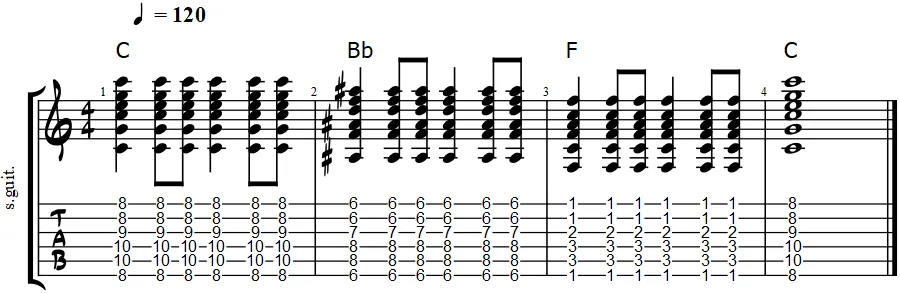
Mixolydian Progression: 1 b7 4
The example below is built on the C Mixolydian scale, and the chords are: C Bb F.
Does it sound familiar?
It's likely you already encountered this progression in Sweet Home Alabama by Lynyrd Skynyrd! (which is in D Mixolydian, D, C and G).
Lydian Progression: 1 2 5 2
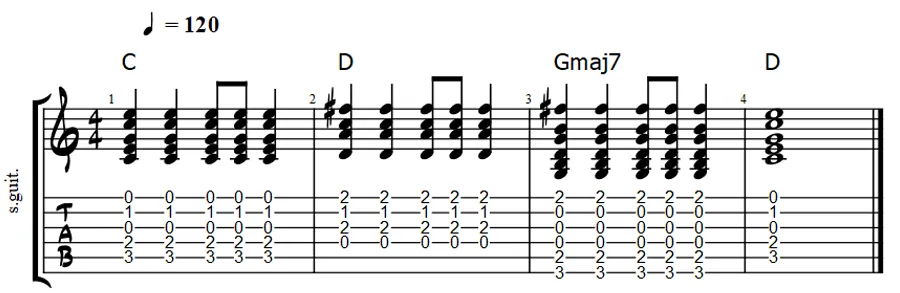
The Lydian mode has a dreamy feeling, given by the light tension introduced by the #4.
In the example below, on the 5th degree, I use the G maj7 chord, where F# is the exactly major seventh of the chord.
This highlight better the characteristics of the Lydian mode.
Dorian Progression: 1m b7 4
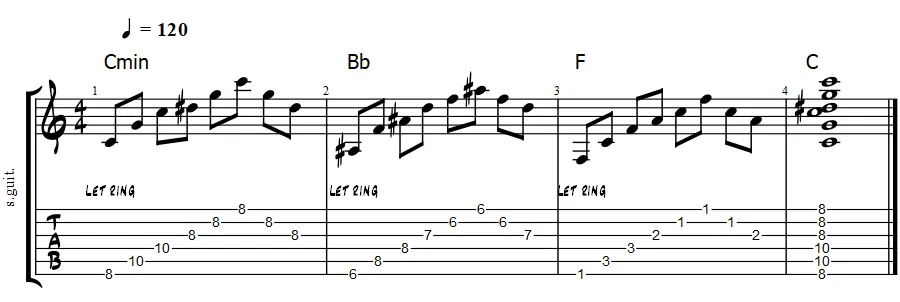
This progression is similar to the Mixolydian progression above, apart from the tonic (1) which in this case is minor (C minor).
I'm sure you'll recognize the progression used in Wicked Game by Chris Isaak.
Modal Chord Progression: Conclusion
Basic knowledge of modes can enhance your songwriting capabilities. As we have just seen, we can create progressions starting from each mode; you could even borrow chords from other modes, this process is called modal interchanges.
Take your time to experiment and digest all this stuff, I'm sure you'll have a lot of fun!
That's all for today.
To stay updated, and get free access to the learning resources, subscribe here.
FAQ
What exactly is a modal chord progression?
A modal chord progression is a sequence of chords derived from and centered around a specific musical mode, rather than just the standard Major or natural minor scale. By using the unique set of chords available within a mode, you can create distinct sonic textures and moods in your music that differ from typical major or minor key progressions.
How are chords created from a specific mode like Lydian or Mixolydian?
Chords are created from a mode using the same method as with the Major scale: by stacking notes in third intervals from each degree of the mode. For example, to build a chord on the first degree of C Lydian, you take the 1st, 3rd, and 5th notes (C, E, G) to form a C Major chord. The specific intervals present in each mode, such as the raised 4th in Lydian or flattened 7th in Mixolydian, directly determine the quality of the chords built upon its degrees.
Why do the chord qualities change when building them from a mode compared to the Major scale?
The chord qualities change because the modes themselves have different interval structures compared to the Major scale. For instance, in C Lydian, the natural F of the C Major scale becomes an F#. This F# alters the chord built on the 2nd degree, changing the D minor chord (D-F-A) from the Major scale into a D Major chord (D-F#-A) in Lydian. Each characteristic altered note in a mode directly impacts the quality of the chords built from its degrees.
What is the significance of using 4-tone chords (like 7ths) when creating modal progressions?
While triads provide a foundational understanding of a mode's chords, using 4-tone chords (such as major 7th, minor 7th, or dominant 7th chords) can more effectively highlight and emphasize the unique 'feeling' or character of each mode. The added 7th often contains a characteristic interval that distinctly defines the modal quality, making the progression sound more pronouncedly modal.
How can I make a chord progression sound distinctly Lydian, Mixolydian, or Dorian?
To make a progression sound distinctly modal, focus on incorporating the chords that contain the mode's characteristic intervals. For Lydian, emphasize the #4 (e.g., by using a major 7th chord on the 5th degree where the #4 is the 7th). For Mixolydian, utilize the b7 chord (e.g., C-Bb-F progression for C Mixolydian). For Dorian, ensure your tonic chord is minor due to its b3, and leverage other chords that reflect its b3 and b7, creating its unique minor sound.
What makes the Dorian mode a 'minor mode' and how does it affect its chord progressions?
The Dorian mode is considered a 'minor mode' because its tonic chord (the chord built on its 1st degree) is a minor chord (e.g., C minor in C Dorian). This is due to the presence of a flattened 3rd degree (b3) in its scale structure. Its chord progressions typically revolve around this minor tonic, with other chords in the mode reflecting its characteristic b3 and b7 intervals, contributing to its distinct minor sound.