Practice the Gm(maj9) Chord on Guitar with Interactive Lessons
Want a structured chord roadmap instead of jumping between pages?
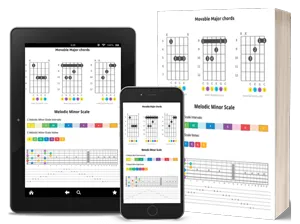
Download the step-by-step Guitar Chord Ebook
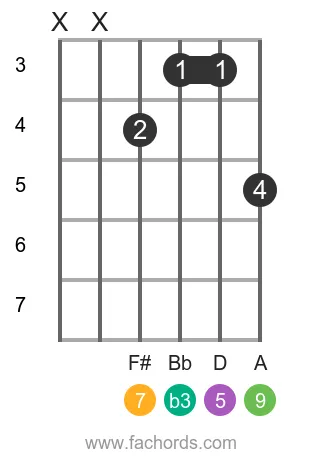
Ready to elevate your guitar playing with a sophisticated sound? Our interactive fretboard is the perfect practice ground for the Gm(maj9) chord. Play it on your guitar and receive instant, real-time mic feedback to confirm your accuracy, ensuring every note is perfectly struck. This intriguing Minor Chord, the G minor major ninth, is built from the notes G, Bb, D, F#, and A. Its distinct, rich flavor comes from the intervals: Root, Minor Third, Perfect Fifth, Major Seventh, and Major Ninth (1, b3, 5, 7, 9). You can also hear the chord played back at various tempos, helping you internalize its unique character.
The Gm(maj9) chord introduces a delightful complexity, often heard in jazz and contemporary music. Understanding its unique interval structure, particularly the major seventh and major ninth, is key to mastering its application. For a deeper dive into how these extended harmonies are built, explore our guide on Chord Construction. This chord expands beyond basic triads, adding rich color. If you're looking to smoothly integrate such advanced chords into your playing, our tips on Improve Chords Change can be invaluable. To truly grasp the significance of the ninth, you might also find our Ninth Chords tutorial enlightening.
Before scrolling down to the diagrams, we encourage you to experiment with our interactive tool. Use it to visualize and play the Gm(maj9) chord in various keys and positions, getting a feel for its unique voicing. Then, refer to the detailed diagrams below, presented from easiest to most challenging, to refine your fingering. Combine this practical application with a solid understanding of the underlying theory, and you'll soon be incorporating this chord into your own songs. Test your skills and see how quickly you can master this rich sound!
G m(maj9) chord Notes:
Chord Formula:
Fingerings for the Gm(maj9) guitar chord
Position 1
Barre
Movable
 Find more shapes in our all guitar chords online library. If you
prefer a printable pdf, download
the Free Guitar Chords Chart Pdf
Find more shapes in our all guitar chords online library. If you
prefer a printable pdf, download
the Free Guitar Chords Chart Pdf
You can also use this accessible Gm(maj9) chord page, with written diagram instructions and screen-reader support for blind users.
FAQ
What specific notes make up the G m(maj9) chord?
The G m(maj9) chord is composed of the notes G, Bb, D, F#, and A. These five notes are fundamental to its unique harmonic structure.
Why is the G m(maj9) chord considered an advanced chord?
The G m(maj9) chord is labeled as advanced due to its extended nature, incorporating both a Major Seventh and a Major Ninth interval. This complexity makes it common in jazz and more intricate musical compositions.
What do the 'm' and 'maj9' signify in the G m(maj9) chord name?
The 'm' indicates that the chord features a minor third interval (Bb relative to G), giving it a minor quality. The 'maj9' denotes the presence of both a Major Seventh (F#) and a Major Ninth (A) interval above the root, adding richness and extension to the chord.
What are the defining intervals that construct the G m(maj9) chord?
The G m(maj9) chord is built with the following intervals relative to its root (G): the Root (1), Minor Third (b3), Perfect Fifth (5), Major Seventh (7), and Major Ninth (9). These intervals correspond to the notes G, Bb, D, F#, and A respectively.
In what musical contexts is the G m(maj9) chord typically used?
The G m(maj9) chord is frequently employed in jazz music and other genres that require a more sophisticated and complex harmonic palette. Its unique sound adds depth and color to musical arrangements.