Practice the G7 Chord: Master Dominant Seven on Guitar
Want a structured chord roadmap instead of jumping between pages?
Go to the full guitar chords tutorial.
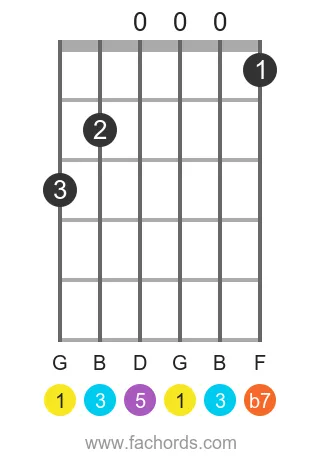
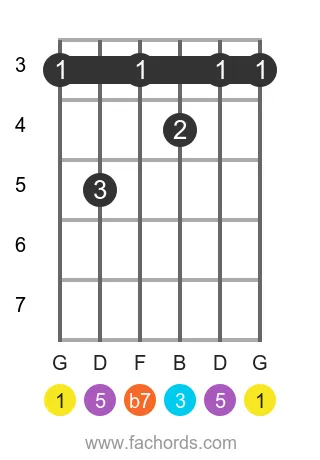
Ready to confidently play the G7 chord? Our interactive fretboard is here to guide you, offering instant, real-time mic feedback on your accuracy as you play. This crucial dominant chord is built from the notes G, B, D, and F, making it a key member of the Dominant Chords family. Its structure uses the intervals of 1, 3, 5, and b7, which you can explore through chord and arpeggio playback with our integrated BPM/drum tool.
The G7 chord provides a powerful sense of tension that naturally seeks resolution, making it indispensable in blues, rock, and jazz for creating compelling harmonic movement. Its complete constituent music intervals are Root (1), Major Third (3), Perfect Fifth (5), and Minor Seventh (b7). To understand how these intervals are stacked to build chords, our chord construction tutorial offers a deeper dive into guitar music theory. You can also learn more about these specific 7th chords with our Learn 3-Note 7th Chords guide.
We provide detailed chord diagrams, ranked from easiest to hardest voicings, alongside theoretical explanations and song examples across various keys. But before diving into static charts, challenge yourself with the interactive fretboard above, verifying your playing with real-time mic feedback to truly test your understanding of the G7 chord.
Notes in the G 7 chord:
How the Dominant Seventh chord is built:
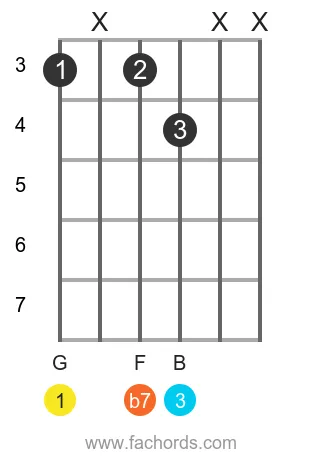
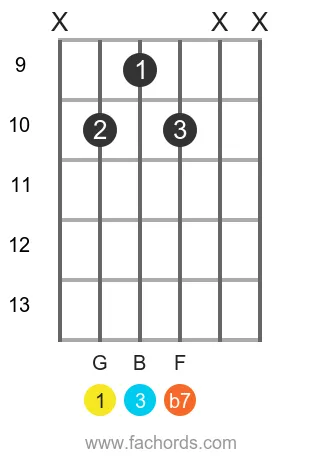
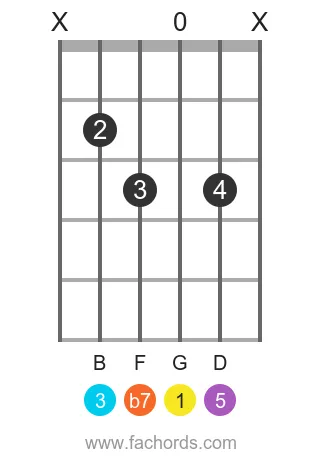
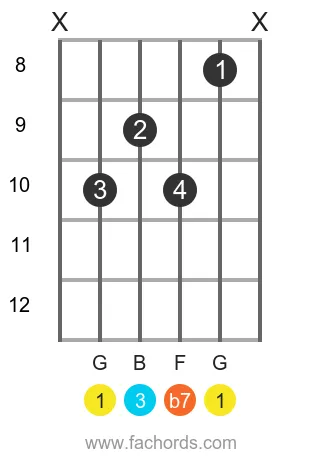
Fingerings for the G Dominant Seventh guitar chord
Position 1
Open
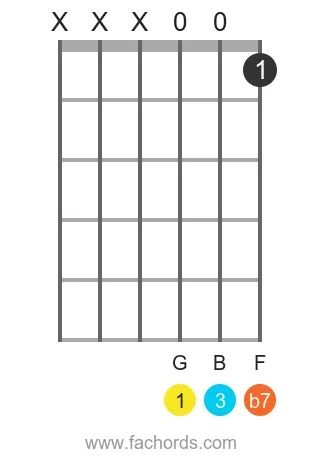
Position 2
Movable
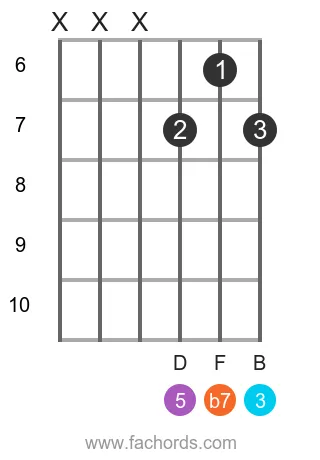
Position 3
Movable
Position 4
Movable
Position 5
Open
Position 6
Movable
Position 7
Movable
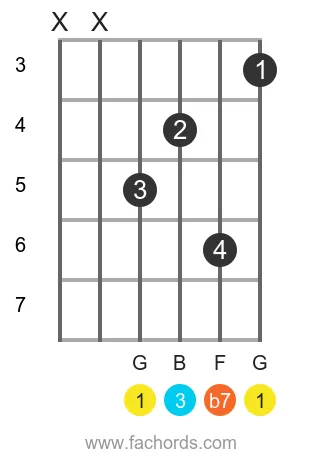
Position 8
Movable
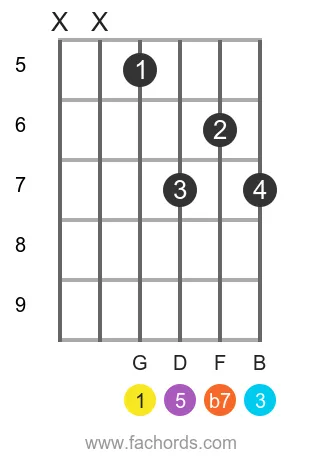
Position 9
Movable
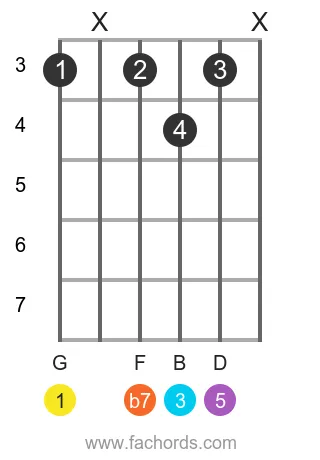
Position 10
Movable
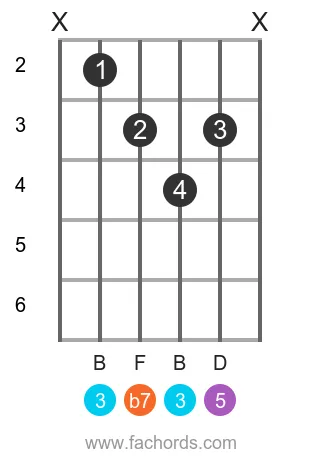
Position 11
Movable
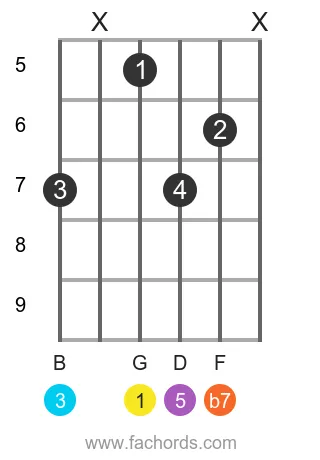
Position 12
Movable
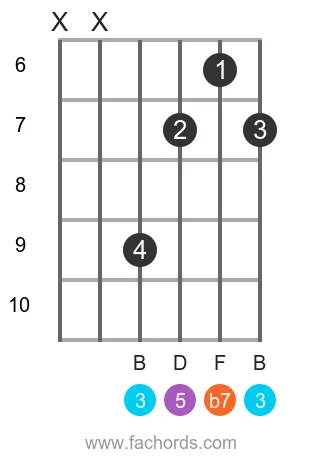
Position 13
Open
Position 14
Open
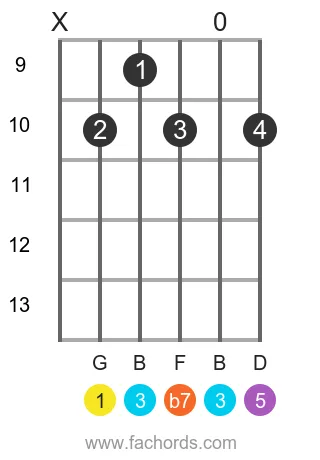
Position 15
Open
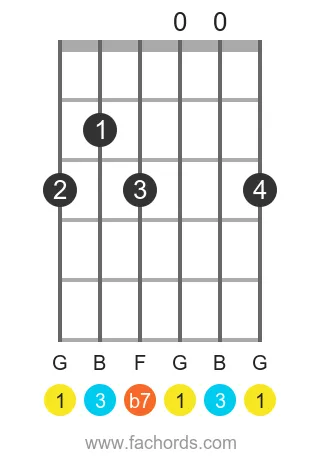
Position 16
Open
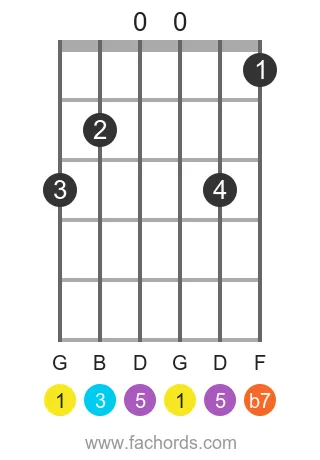
Position 17
Open
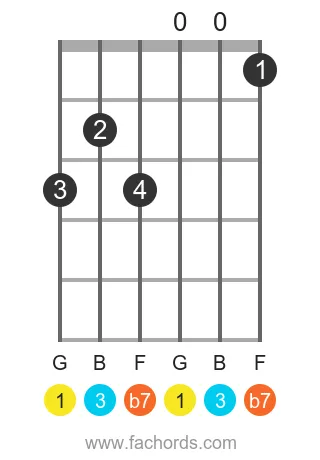
Position 18
Barre
Movable
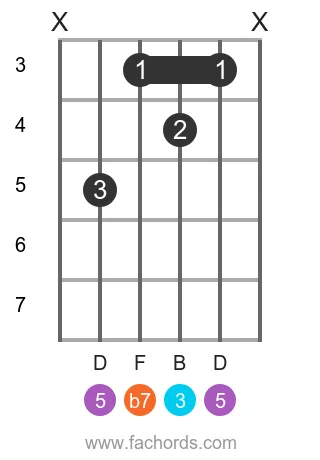
Position 19
Barre
Movable
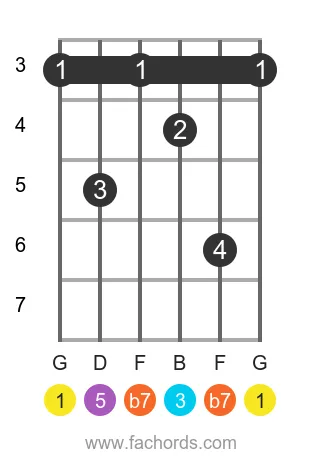
Position 20
Barre
Movable
 Find more shapes in our all guitar chords online library. If you
prefer a printable pdf, download
the Free Guitar Chords Chart Pdf
Find more shapes in our all guitar chords online library. If you
prefer a printable pdf, download
the Free Guitar Chords Chart Pdf
You can also use this accessible G7 chord page, with written diagram instructions and screen-reader support for blind users.
FAQ
What notes are included in the G7 chord?
The G7 chord is composed of four specific notes: G, B, D, and F. These notes together create its characteristic rich and resonant sound.
What musical intervals define the G7 chord's structure?
The G7 chord is constructed using the following intervals relative to its root note (G): Root (1), Major Third (3), Perfect Fifth (5), and Minor Seventh (b7). These intervals are stacked to build the chord.
Why is the G7 chord referred to as a 'dominant chord'?
The G7 chord is a member of the Dominant Chords family due to its specific interval structure. The inclusion of the Minor Seventh (b7) interval, alongside the Root, Major Third, and Perfect Fifth, is what defines it as a dominant seventh chord.
What does the 'b7' represent in the G7 chord's interval notation?
In the context of the G7 chord, 'b7' stands for a Minor Seventh interval. This specific interval is a key component that gives the G7 chord its distinctive sound and dominant quality.
What resources does this tutorial offer to help me play the G7 chord on guitar?
This tutorial provides detailed chord diagrams and fretboard patterns. These visual aids are designed to help you understand and master the different ways to play the G7 chord on your guitar.