G#maj9 Guitar Chord | Play, Hear and Practice Interactively
Want a structured chord roadmap instead of jumping between pages?
Download the step-by-step Guitar Chord Ebook
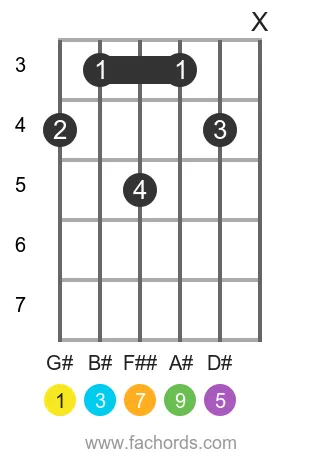
The G#maj9 chord belongs to the Major Chord family. It is composed of the notes G#, B#, D#, F##, and A#, which correspond to the intervals Root (1), Major Third (3), Perfect Fifth (5), Major Seventh (7), and Major Ninth (9). Unlock the full potential of this chord with our interactive fretboard tool at the top of this page. You can visualize every fingering, listen to the chord played as a strum or arpeggio, and get instant feedback on your playing accuracy with the real-time microphone feedback feature.
Ninth chords add a rich, jazzy flavor to your playing by extending the basic major seventh chord with an additional major ninth. If you're new to the world of ninth chords, our comprehensive tutorial on Ninth Chords is an excellent starting point. Understanding how chords are built by stacking intervals is key to mastering them, and our Chord Construction guide can help you deepen your knowledge. Many G#maj9 voicings involve barre shapes; if these are challenging, our Guitar Bar Chords resource offers essential tips. Smooth transitions are also crucial, so don't forget to check out our advice on how to Improve Chords Change.
As you scroll down, you'll find a curated selection of G#maj9 chord diagrams, ranked from the easiest open positions to more advanced movable shapes. We'll also dive into the music theory behind this chord, suggest songs where it shines, and list the keys where you'll most likely encounter it. But before you explore the static diagrams, take a moment to use the interactive tool above. Experiment with the different voicings, use the drum and BPM tool to practice in time, and let the mic feedback guide your hand placement. This active learning approach is the fastest way to truly integrate new chords into your playing.
Notes in the G# maj9 chord:
Chord Formula:
G#maj9 Guitar Chord Diagrams
Position 1
Movable
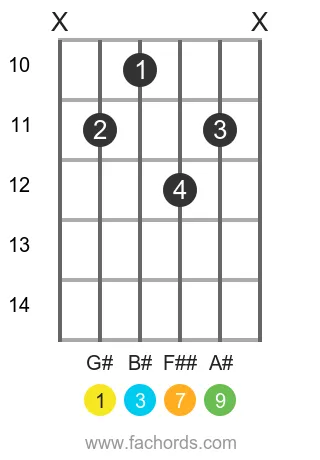
Position 2
Barre
Movable
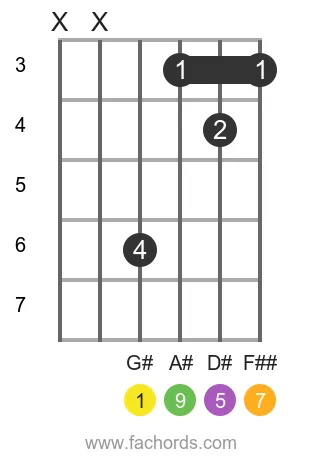
Position 3
Barre
Movable
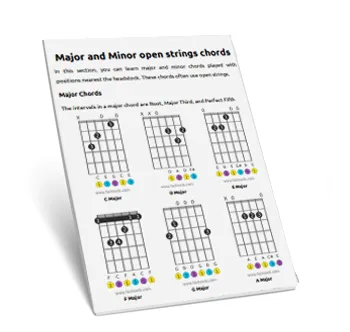
 Find more shapes in our all guitar chords online library. If you
prefer a printable pdf, download
the Free Guitar Chords Chart Pdf
Find more shapes in our all guitar chords online library. If you
prefer a printable pdf, download
the Free Guitar Chords Chart Pdf
You can also use this accessible G#maj9 chord page, with written diagram instructions and screen-reader support for blind users.
FAQ
What are the specific notes that form the G# maj9 chord?
The G# maj9 chord is composed of the notes G#, B#, D#, F##, and A#. These five notes are stacked to create its unique sound and structure.
Why are notes like B#, D#, and F## used in the G# maj9 chord instead of C, E, and G?
These specific sharp spellings (B#, D#, F##) are used to maintain the correct interval relationships and to ensure each letter name (A, B, C, D, E, F, G) is represented once within the chord when building it from the G# root. This adheres to music theory principles for clarity in harmony.
What do the intervals 1, 3, 5, 7, and 9 represent in the G# maj9 chord?
These numbers define the relationship of each note to the root (G#). '1' is the Root (G#), '3' is the Major Third (B#), '5' is the Perfect Fifth (D#), '7' is the Major Seventh (F##), and '9' is the Major Ninth (A#). Together, these intervals precisely define the sound and structure of a major ninth chord.
How does the G# maj9 chord fit into the 'Major Chords family'?
The G# maj9 chord is a member of the Major Chords family because it fundamentally contains a major third (B#) and a perfect fifth (D#) above its root (G#), which are the defining characteristics of a major triad. The addition of the major seventh and major ninth further expands it within this family while retaining its major quality.
What makes a G# maj9 chord different from other ninth (9) guitar chords?
The 'maj' in G# maj9 indicates that it specifically uses a *Major* third (B#) and a *Major* seventh (F##) from the root, in addition to the perfect fifth (D#) and major ninth (A#). Other types of ninth chords, such as dominant 9th or minor 9th, would feature different qualities for their third or seventh intervals.
When might a guitarist typically use a G# maj9 chord?
The G# maj9 chord adds rich, sophisticated harmony and is often used in musical contexts that benefit from extended chords. It's particularly common in genres like jazz, fusion, and R&B, where complex harmonic colors are desired, often appearing in jazz chord progressions or as a colorful substitution for simpler major chords.