G# maj7 Guitar Chord
Chord Diagrams, Interactive Fretboard and Chord Theory
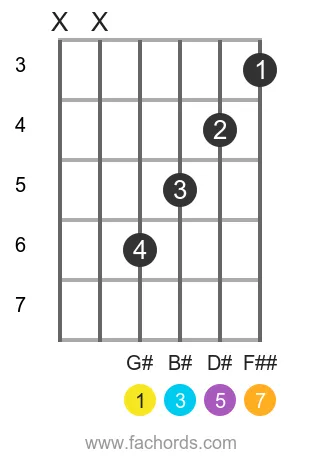
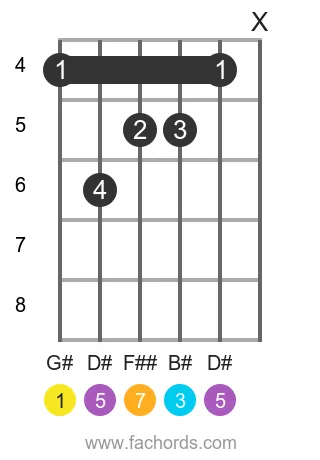
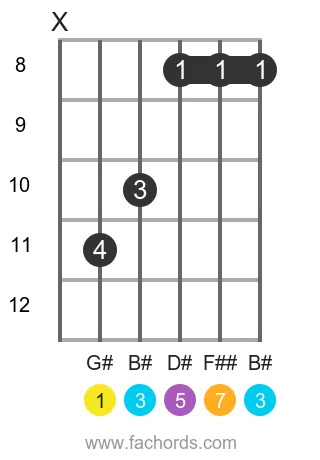
G# major 7th guitar chord is also written as G#maj7, G#M7, G#Δ7 or G#ma7.
Position 1
Movable
Position 2
Barre
Movable
Position 3
Barre
Movable
 Find more shapes in our all guitar chords online library. If you
prefer a printable pdf, download
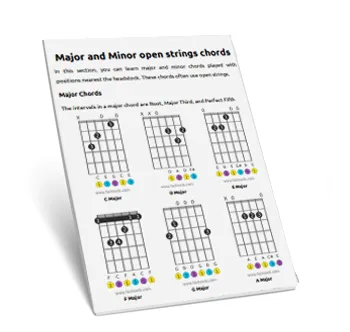
the Free Guitar Chords Chart Pdf
Find more shapes in our all guitar chords online library. If you
prefer a printable pdf, download
the Free Guitar Chords Chart Pdf
You can also use this accessible G#maj7 chord page, with written diagram instructions and screen-reader support for blind users.
G#maj7 Guitar Chord | Play, Hear and Practice Interactively
Want a structured chord roadmap instead of jumping between pages?
Go to the full guitar chords tutorial.
The G#maj7 chord, a member of the Major Seventh family, is built from the notes G#, B#, D#, and F##. These correspond to the intervals Root (1), Major Third (3), Perfect Fifth (5), and Major Seventh (7). Utilize the interactive fretboard tool on this page to visualize countless fingerings, hear the chord played as a strum or arpeggio, and get instant feedback on your accuracy with the real-time microphone check.
This elegant major seventh chord adds a rich, sophisticated flavor to your playing and is a staple in jazz, but also shines in pop and rock. Understanding how chords are built by stacking intervals, like the G#maj7, is fundamental to mastering the fretboard. Dive deeper into its construction and role in music with our Chord Construction guide. To ensure smooth transitions when incorporating this chord into progressions, check out our tips on Improve Chords Change. For exploring different sonorities, learning about Understanding Chord Inversions can open up new voicings, especially for advanced chords like this one. Many G#maj7 shapes also involve barre techniques, which you can master with our Guitar Bar Chords tutorial.
Further down the page, you'll discover multiple G#maj7 chord diagrams, presented from the simplest open positions to more challenging barre shapes. We'll also explore its music theory, common songs that feature this chord, and the keys where it naturally appears. Before you explore the diagrams, spend some time with the interactive tool above. Set your pace with the drum and BPM tool, strum or arpeggiate the G#maj7, and let the mic feedback guide your finger placement. This hands-on approach is the most effective way to internalize new chords and make them a part of your playing.
G# maj7 chord Notes:
Chord Formula:
Play This Chord With Other Roots
C maj7 | D maj7 | E maj7 | F maj7 | G maj7 | A maj7 | B maj7 | C#maj7 | D#maj7 | F#maj7 | G#maj7 | A#maj7 | Abmaj7 | Bbmaj7 | Dbmaj7 | Ebmaj7 | Gbmaj7

Created by
Giancarlo is a musician (teaching guitar since 2000), software engineer, AI consultant and published researcher
FAQ
What are the specific notes that compose the G#maj7 chord?
The G#maj7 chord is built from four specific notes: G# (the root), B# (the major third), D# (the perfect fifth), and F## (the major seventh). These notes create the chord's distinct sound and structure.
Why are notes like B# and F## used in the G#maj7 chord instead of C and G?
Music theory uses specific note names to accurately represent the intervalic relationship to the root. For a G# major seventh chord, the third must be a 'B' note modified to B# to be a major third from G#, and the seventh must be an 'F' note modified to F## to be a major seventh from G#. This spelling correctly reflects the theoretical construction of the chord, even though B# and F## are enharmonically equivalent to C and G respectively.
What do the intervals 1, 3, 5, and 7 represent in the context of the G#maj7 chord?
These numbers represent the specific scale degrees from the G# major scale that are used to build the chord. '1' is the Root (G#), '3' is the Major Third (B#), '5' is the Perfect Fifth (D#), and '7' is the Major Seventh (F##). These exact intervals define the G#maj7 chord and contribute to its unique sound.
How does the G#maj7 chord achieve its 'unique sound' or 'unique flavor'?
The unique sound of the G#maj7 chord comes from the specific combination of its intervals, particularly the presence of the Major Seventh (F##). This interval creates a sophisticated, rich, and often 'jazzy' quality when combined with the major third and perfect fifth above the root, distinguishing it from simpler major chords.
When and where is the G#maj7 chord commonly used in music?
As a Major Seventh chord, the G#maj7 is frequently used in jazz chord progressions, where its sophisticated harmony is highly valued. However, its rich and distinctive quality also makes it suitable for adding a 'unique flavor' to various other genres, including rock, pop, and contemporary music, offering harmonic depth and interest.